


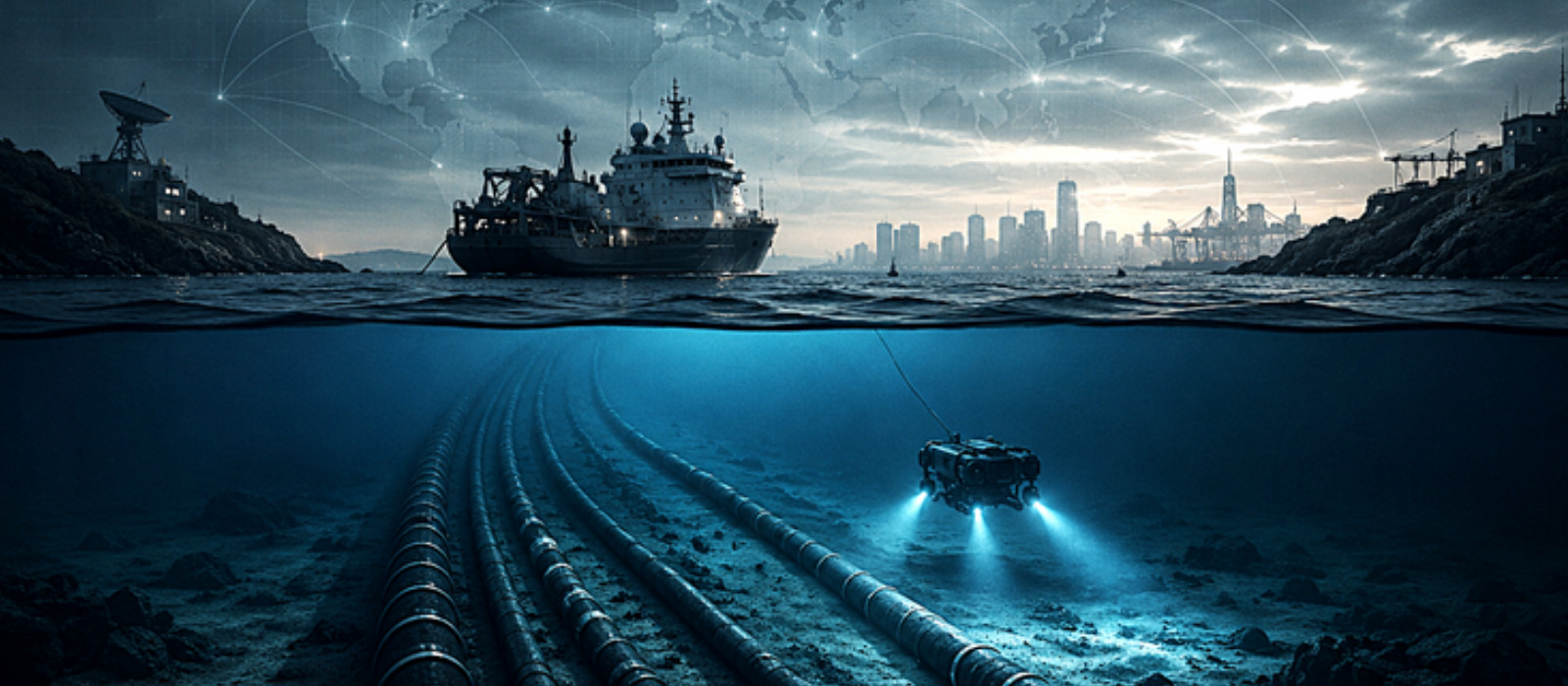


Abstract: Undersea communication cables, submerged along sea and ocean beds, form the silent arteries of our global economy and connectivity. This essay explores their historical evolution, strategic significance, and vulnerabilities, emphasising the critical role of the Indian Navy and international cooperation in safeguarding these lifelines. The world’s first trans-oceanic cable connected Ireland to Newfoundland in 1858, marking a pivotal moment in global communication. During both World Wars, cable disruption became a strategic tool, prompting nations to protect their own cables. The telegraph’s evolution from economic facilitator to military dominance underscores its historical importance. Covert operations targeting the entire cable ecosystem—manufacturing, supply, vessels, and seabed maintenance—could cripple economies. Knowledge of adversaries’ cables becomes a strategic requirement for disrupting communication and information systems. Submarine operations, combining warfare, information, and cyber elements offer deniability and impact. Telecom companies with niche expertise (Tata Communication, Reliance Jio) are strategic enablers. Legislation must address cable protection, resilience, and encryption within national cybersecurity frameworks. Public-private partnerships and security zones enhance cable security. In an interconnected world, safeguarding undersea cables ensures economic prosperity, national security, and responsible global leadership.
Introduction
On 20 May 2023, PM Narendra Modi, President Joe Biden, PM Anthony Albanese and PM Kishida Fumio met at Hiroshima, Japan for the fifth convention of the Quad Leaders’ Summit. One of the key agendas amongst issues such as maritime security, cyberspace and climate change was ‘Quad Partnership for Cable Connectivity and Resilience.’1 Why is the Quad talking about investing in resilient undersea cables? And why are countries like Japan prioritising achieving complete self-reliance in undersea cable laying technology?2 This essay attempts to explore the complex domain of undersea cables and their growing strategic significance to a country’s economic functioning.
As the Indian telecom industry continues to grow by leaps and bounds, so does our insatiable need for data connectivity. It is this global connectivity that powers and runs our economy, finance, space and defence sectors. In this melee of bandwidth and data rates lies the silent bastion of global telecommunication. Hidden away from everyone’s view, embedded deep below the ocean’s surface lie our critical data communication lines – submarine cables. These are the same purple wavy lines that we often see on our nautical charts but understand little about. While we look towards the ‘cloud’ for data connectivity, it is the submarine cables in cloudy and saline waters that provide more than 97% of global data communications.3
Today, submarine cables have become the literal “Sea Lines of Communications (SLOCs)” – our digital, real-time links to the globalised world. These underwater fibre-optic links connect various cable landing stations, thus ensuring ubiquitous internet and data connectivity throughout the country. According to the Telecom Regulatory Authority of India (TRAI), India’s demand for international bandwidth is expected to grow at a compound annual growth rate of 38% and reach ten times its current level by 2028 . The Society for Worldwide Interbank Financial Telecommunication (SWIFT), which provides the international framework for about 11,000 financial institutions to conduct an average of 15 million transactions a day, is wholly reliant on undersea cables.4
Although cables have gone through their share of evolution from copper cores (1858) to fibre-optic cores (2024), the ocean remains a hard taskmaster. Despite all the odds against the 1.4 million kilometres long network of critical cables laid deep below the sea, the most common sources of cable outages remain bottom trawling and anchoring.5 What if this weakness were to be exploited by state-sponsored actors? Submarine cables are more crucial for the country’s economy than telecommunication satellites (satellites account for about 3% of global data connectivity).6
The Cable Network
India presently has five Cable Landing Stations (CLS), at Mumbai, Kochi, Thiruvananthapuram, Tuticorin and Chennai. Three new landing stations are under construction at Puducherry, Digha and Visakhapatnam. These landing stations are where the cables emerge from the sea and make landfall and are the terminal points of submarine cables, whereinafter the onus of data connectivity is taken over by our terrestrial and radio networks. Illustrated below is the existing submarine cable systems in India:

Fig 1: List of submarine cables landing in India. (source – Submarine Cable Networks, by Suvesh Chattopadhyay, https://www.submarinenetworks.com/en/stations/asia/india)
As is apparent from Fig 2, above, these submarine cables not only connect India to the rest of the world, but also provide real-time communication with Lakshadweep and Andaman and Nicobar Islands. The cable from Kochi to Lakshadweep provides connectivity with eleven islands (Chetlat, Kiltan, Bitra, Kadmat, Bangaram, Amini, Androth, Agatti, Kavaratti, Kalpeni and Minicoy). This undersea system is known as the KLI (Kochi-Lakshadweep Island cable). Similarly, the domestic cable on the East coast of India is the CANI (Chennai-Andaman and Nicobar Islands cable) connecting Chennai to Rangat, Long Island, Port Blair, Havelock, Little Andaman, Car Nicobar, Kamorta and Great Nicobar).7

Fig 2: Map of submarine cables from/to India (source – Telegeography, 2024. https://www.submarinecablemap.com/multiselect/submarine-cable?ids=india-asia-xpress-iax,mist)
Mumbai is the busiest cable landing station with a total of eleven cables converging on its shores. For example, the Gulf Bridge International Cable System (GBICS)/ Middle East North Africa (MENA) Cable System connects the Middle East and North Africa to India. The Europe India Gateway with a capacity of 3.84 terabits is 15,000 km long and connects India to Europe. The SEACOM/ Tata TGN – Eurasia cable with a capacity of 1.5 terabit capacity is also 15000 km long.8 The magnitude of data flowing through these fibre-optic submarine cables is enormous. All the cables in India are owned by private tech firms (or a consortium of firms) such as Tata Communications, Reliance Jio, Global Cloud Exchange and others. State intervention in the security of these cables is non-existent – and here lie some problems. Private tech firms invest very little in ensuring the security of undersea cables against external aggression or sabotage and the need does not quite align with their commercial drivers. Therefore, national security and risk assessments need to be undertaken from time to time to ensure that measures exist for the safety and security of undersea communication cables.
Evolution of Undersea Telecommunication
The perseverance of an enthusiastic investor (Cyrus West Field) and a team of keen engineers was all it for took Britain and the United States to successfully lay the world’s first trans-oceanic cable from Ireland to Newfoundland, Canada. He had first established the famous American Telegraph Company that also morphed an offshoot, the Atlantic Telegraph Co. Queen Victoria of Britain and President James Buchanan of the United States of America become the first people in the world to communicate using underwater cables.9 On the morning of 07 August 1858, the headlines of the Saturday Review in London read thus, “The Old and the New World are brought into instantaneous communication.” This short exchange of pleasantries had now flagged off an arduous race to master the business of trans-oceanic submarine telegraph cables. By 1902, Britain had nearly encircled the world with its undersea cables. The age of undersea telecommunication had now arrived.
Despite being a private enterprise, the British Eastern Telegraph Company maintained its monopoly over cable-laying technology through both World Wars, wherein it effectively cut off Germany’s telegraph cables at the outbreak of World War I. As a response, in 1917 Germany engaged in reciprocating Britain’s actions by cutting cables from Britain to Portugal, Gibraltar and the Azores using U-Boats and submarines with specialised cutting equipment.10 Both sides soon realised that severing of telegraphic cables directly impacted the country’s economic and military functioning, and protecting ones’ own cables thus became a strategic imperative.
Although telegraph cables had initially set out to speed up economic and business transactions, their efficacy in achieving military dominance was soon realised and duly exploited. As Anirudh Suri rightly points out in his book ‘The Great Tech Game,’ the telegraph was to the twentieth century what the internet is, today. Trade interests necessitated transoceanic telecommunication, which in turn required protection by navies. This history lesson certainly has echoes today for the high-speed fibre-optic cables running deep beneath our oceans, but with its importance having multiplied many folds. Sea Lines of communications (SLOCs) have included telegraph cables for nearly two hundred years as they do data cables today.
Legislative Framework – Far from Adequate
The National Maritime Foundation journal had published an article by Soham Agarwal and Vice Admiral Pradeep Chauhan on 07 Mar 2020 titled, “Underwater Communication Cables: Vulnerabilities and Protective Measures Relevant to India.” The article was a very comprehensive study of the prevailing legislation and policies in India with specific regards to submarine cables. The paper sharply pointed out that the closest that Indian legislation came to defining a submarine cable was by virtue of the Indian Telegraph Act, 1885! However, the Telecommunication Bill, 2023 does make a mention of submarine cables just once in its entire text, “… a ‘telecommunication network’ means a system or series of systems of telecommunication equipment or submarine networks, or a combination of such networks, used or intended to be used for providing telecommunication services...”.11 There is, however, no separate legislation mentioned for the monitoring and protection of submarine cable infrastructure in the Maritime Zones of India or the High Seas.
In contrast, the Australian Telecommunication Act, 1997 was amended in 2014 to the Telecommunications Legislation Amendment (Submarine Cable Protection) Act 2014. For example, Clause 1 of Schedule 3A explicitly states, “The ACMA (Australian Commission and Media Authority) may declare protection zones in relation to submarine cables. In a protection zone, certain activities are prohibited, and restrictions may be imposed on other activities… this schedule regulates the installation of certain submarine cables that are connected to places in Australia.” Subclause 2(1) of the same schedule also defines and amplifies the meanings of domestic and international submarine cables. Many a nation are already observing the Australian model of Water Space Management (WSM) and progressing towards incorporating the same “best practices” within their waters.12
Recognising Strategic Significance and Emerging Threats
Expertise on submarine cables continues to primarily be the domain of private telecom companies in India. Being tech giants, these companies must comply with the regulations of TRAI and hold valid licenses issued by the Department of Telecommunication (DoT). These companies in India are:
-
Tata Communications.
-
Bharti Airtel.
-
Global Cloud Exchange.
-
Reliance Jio.
-
Bharat Sanchar Nigam Limited (BSNL).
-
Vodafone.
-
Sify.
-
Indian Ocean Exchange (IOX).
Rishi Sunak (then an MP in the British Parliament in 2017) had submitted a report on the criticality of protecting undersea cables routing through the United Kingdom.13 This was published in Policy Exchange – a London based think-tank. One of the key takeaways from his report was that since cable-laying and maintenance is the domain of private enterprises worldwide, governments exercise little control over their security and monitoring mechanisms. He highlighted the deficiencies in international law (UNCLOS) in giving states adequate jurisdiction and powers to deal with potential disruptors on these cables. The current laws, Sunak argued, were more suited to an earlier era, not to the current era where these cable networks have become indispensable to the economic and national security of nations. He deliberately calls undersea cable sabotage, an “existential threat” to the UK – firmly validating his point in his paper. The position and routing of every undersea cable is readily available on website today, making them even more vulnerable than we might think.
Telegeography is a telecom company with an expertise in collecting, collating and analysing global telecommunication statistics. The nature of their work is analogous to that of Jane’s Information Services in the open-source domain for military intelligence. The company maintains strategic and crucial intelligence about the state of global telecommunication affairs, with algorithms based predictions and analyses for its consumers. The statement on their webpage, “Telecom Intelligence Starts Here,” indicates their significance in the global telecom race and strategic decision making.
It Takes an Earthquake
To gain some geo-strategic perspective, we shall examine the case of Luzon Strait (a body of water between Taiwan and Philippines) of 26 December 2006.14 An underwater earthquake in the Luzon Strait caused severe damage on land as well as to undersea cables. Six out of seven undersea cables were severed that connected North America to China, Hong Kong, Taiwan, Japan, Singapore and South Korea. Almost immediately, Chunghwa Telecom (Taiwan’s largest telecom service provider) reported an internet outage of 100% to Hong Kong and Southeast
Asia. Hong Kong lost 80% of its internet connectivity, leaving Asia’s financial giant devoid of any means of trading stocks or performing financial transactions. Although it took 49 days to restore the connections, the economy of the entire Southeast Asia was held to ransom by natural forces that highlighted the strategic importance and vulnerabilities of these cables.
Egypt witnessed a similar incident in 2008 where two merchant vessels had anchored north of Alexandria owing to bad weather. Hoping to ride out the weather with their anchors, the ships unknowingly started dragging their anchors over submarine cables. These snagged cables systems were Egypt’s connections with Europe, North Africa and the Middle East. As a result of this outage, more than 80 million people in the Middle East and Asia suffered loss of internet connectivity. Egypt and Pakistan lost up to 70% of their internet. India too lost about 50-60% of its internet connections from the west coast, impacting international banking transactions, education, agriculture and critical sectors.15
One of the tenets of Information Warfare is to protect our own information systems while denying our adversary the same. In the Russia-Ukraine conflict, one of the key lessons drawn was that of achieving information superiority through social media and internet. Russia and Ukraine have been in the news for their exploitation of Starlink (a constellation of low-earth orbit satellites owned by Elon Musk) services for military operations.16 The same aggressive use of the internet was evident in the US Presidential elections of 2017. State and non-state actors alike rely heavily on the internet as a tool of influence. It is an established fact that the internet is a source of projecting state power and influence and requires state-level intervention.
Role of the Indian Navy
In the event such an act of intended disruption in the future, India’s economy and its critical sectors could receive a crippling blow, and whose effects could be long-lasting and far-reaching. As an immediate response, the Navy would be called in, since the acts of disruptions would be undertaken in the high seas, far away (and deep below) likely away from one’s sight. It is here that the Navy’s preparedness to hunt for and locate the disruptors would come to be tested. Therefore, prior knowledge and understanding of undersea communication cable infrastructure and routing would become a key enabler in ensuring their security and fidelity.
Concomitantly, knowledge of the adversary’s undersea cables serves as a strategic target to disrupt their communication and information systems, delivering long-lasting damage to the economy. In due course, our submarines, manned and unmanned could be equipped to execute such tasks covertly and escape undetected (including a frogman escape) – thereby achieving an element of deniability. Such operations could form a subset and union of submarine warfare, information warfare and cyber warfare. Three aspects may be worth noting. First, adversaries too may use similar measures, and possibly may have better wherewithal to do so. Second, like all contemporary technologies available today, the pace of evolution of such technologies far outpaces the pace of legislation and policy-making process. Third, some of these disruptions could take place in the grey zone between an understood state of peace—even if it is an uneasy peace—and a recognisable state of conflict.
That is why telecom companies with niche expertise in laying and repairing of submarine cables would become important partners and enablers in the event of cable disruptions especially that are due to deliberate actions by others and need to be included in the Op Response Planning matrix at the national security level. Such a formulation of public-private partnerships in the maritime domain has been long overdue.
The Way Ahead
Despite being in the hands of private tech companies, the expertise for laying and maintaining undersea cables needs to be reviewed by the National Security Council. Undersea cables require due attention by virtue of their strategic importance and vulnerability, and a realistic estimate of ‘Repair and Overhaul’ capability needs to be established in the event of a major outage. The following issues merit consideration:
-
A partnership between state agencies, corporations and private tech firms could be the way forward to invest in ramping up encryption, resilience to undersea espionage and disruption attacks by adversaries. As cited earlier, the NMF study emphasised that India’s undersea cables are part of our “Critical Information Infrastructure Systems (CIIS).”17
-
Establishment of Cable Protection Zones (CPZ) as has been seen in Australia and New Zealand. The ‘Mariner’s Handbook for Australian Waters’ also elaborates the guidelines and prohibition on types of trawling and anchoring within CPZ. Something similar could be considered jointly by the Director General of Shipping and National Hydrographic Office (NHO) for implementation in Indian waters.18
-
The Indian Navy could incorporate the security of undersea cables within the scope of its National Maritime Security Strategy – Strategy for Shaping a Favourable and Positive Maritime Environment. This would further bolster the national stance of being the primary security provider in the maritime domain.
-
Cable Landing Stations (CLS) continue to remain a soft target for precision attacks on the landward side. These CLS require stringent security and access control, with added layers of redundancy, disaster recovery (DR) sites and geographical distribution. By incorporating such measures in their licensing criteria, the TRAI and DoT could play pivotal roles.
-
The entire ecosystem of undersea cables spanning from the manufacturing and supply of long-distance fibre-optic cables, vessels designed for laying of undersea cables, the seabed maintenance of cable laying zones and associated equipment as well as CLS could all be targeted in a series of covert operations to ‘snip’ the economy to some extent with a ‘snap’ in one or more cables. Recognising this emerging threat is a necessary step towards minimising the threat exposure to own critical infrastructure.
Conclusion
The United Nations’ General Assembly Resolution 66/231 adopted on 24 Dec 2011 describes the undersea cables as “vitally important to the global economy and the national security of all states.”19 It also highlights the need for all states to adopt national regulations to protect submarine cables and render their wilful damage as punishable offences. With ever-growing reliance on internet associated services, a country and its economic growth is deeply intertwined with its ability to possess and protect its Critical Information Infrastructure Systems (CIIS). The backbone of this CIIS is India’s deep connectivity with the rest of the world. With aspirations to be a future world leader on global issues such as semi-conductor technology, space exploration, transition to net-zero emissions, artificial intelligence, leading the cause for the ‘global south’ and provider of maritime security in the region, it is a pertinent responsibility that needs due focus. This requires a holistic appreciation of new and emerging threats, especially when technology evolves so rapidly that policies often seem to be catching up.
With the national drive towards Digital India and Digital Bharat Nidhi, the volume of financial transactions over the internet are likely to rise exponentially. It now becomes imperative to create legislative and administrative frameworks for the protection and security of our undersea cables within the ambit of national cyber-security. One would like to end with a relevant excerpt from the External Affairs Minister S Jaishankar’s book, The India Way: “in an increasingly uncertain world, India’s shaping of the regional environment as a responsible maritime power includes stepping up its game in areas like connectivity and development projects. It has powerful cards in the form of geography, culture and societal contacts. How well it uses them will be a real test of its strategy.”20
Endnotes
-
The White House – “Quad Leaders’Summit Facts Sheet”, https://www.whitehouse.gov/briefing-room/statement-release/2023/05/20/quad-leaders-summit-fact-sheet/. Published on 20 May 2023. accessed 10 February 2024.
-
Geoffrey Gresh, Hotaka Nakamura, “Japan: New Lord of the Subsea?”, The Diplomat, 18 May 2023. accessed 13 February 2024.
-
Georgia Bafoutsou, Maria Papaphilippou, Marnix Dekker, Report on “Subsea Cables – What is at Stake?”, ENISA (European Union Agency for Cybersecurity). Published July 2023. https://www.enisa.europa.eu/news/dive-into-the-deep-sea-a-view-of-the-subsea-cable-ecosystem/. accessed 27 January 2024.
-
Michael Sechrist, “New Threats, Old Technology - Vulnerabilities in Undersea Communications Cable Network Management Systems”, Harvard Kennedy School, Discussion Paper #2012-03, Science, Technology & Public Policy Program Discussion Paper Series. accessed 24 January 2024.
-
Submarine Cable 101, The Map, https://www2.telegeography.com/submarine-cable-faqs-frequently-asked-questions. accessed 07 June 2024.
-
Rishi Sunak, “Britain’s Submarine Cables – Indespensable, Insecure”, Policy Exchange, Published on 01 December 2017. accessed 21 January 2024.
-
https://www.submarinecablemap.com/country/india. accessed 10 February 2024.
-
NEC Pvt India Ltd, “Submarine Cable Systems – Connecting Continents and Communities”, https://in.nec.com/en_IN/solutions_services/submarine/index.html. accessed 12 February 2024.
-
Bill Glover, “History of the Atlantic Cable & Undersea Communications”, https://atlantic-cable.com/Cable/. Last revised on 27 February 2023. accessed 12 February 2024.
-
Jonathan Reed Winkler, Nexus: Strategic Communication and American Security in World War I, Harvard Historical Studies (Harvard University Press, 2008). Kindle, loc. 147.
-
The Gazette of India, “The Telecommunications Bill” (No. 44 of 2023), 24 December 2023.
-
AHP20 – Mariner’s Handbook for Australian Waters.
-
Rishi Sunak, “Britain’s Submarine Cables – Indespensable, Insecure”, Policy Exchange, Published on 01 Dec 2017. accessed 21 January 2024.
-
Ibid.
-
Ibid.
-
“Ukraine claims Russian Forces using Musk’s Starlink in occupied areas”, The Guardian, 12 February 2024, https://amp.theguardian.com/world/2024/feb/12/ukraine-accuses-russia-forces- using-elon-musks-starlink/. accessed 15 February 24.
-
Soham Agarwal and Vice Admiral Pradeep Chauhan, “Underwater Communication Cables: Vulnerabilities and Protection Measures Relevant to India Part-I”, National Maritime Foundation, Published on 07 April 21.
-
Pooja Bhatt, “Protecting Indian Ocean Submarine Cables: Exploring India-Australia Cooperation”, https://www.orfonline.org/expert-speak/protecting-indian-ocean-submarine-cables-exploring-australia-india-cooperation/. accessed 10 February 2024.
-
UN General Assembly Resolution A/RES/66/231, December 2011, Oceans and the Laws of the Sea, https://www.un.org/en/ga/62/plenary/oceansseas/bkg.shtml/. accessed 10 February 24.
-
S Jaishankar, The India Way: Strategies for an Uncertain World (HarperCollins, 2020), 147.
