


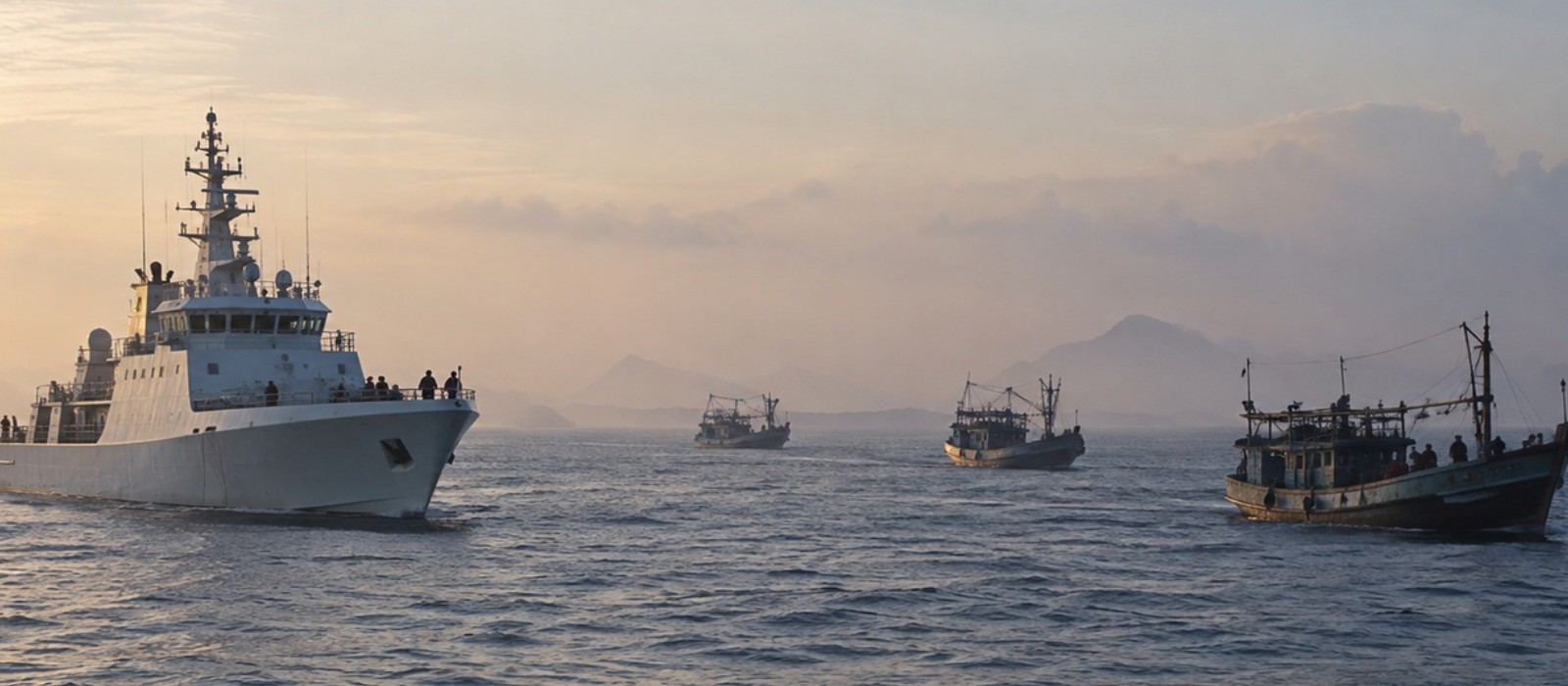


If the colours black and white are analogous with definitive choices at the opposite ends of the spectrum of conflicts such as peace and war, then shades of grey could connote something between the two. This simplistic analogy has been extended to the concept that the grey zone is that space that lies between peace and war. The term grey zone has gained traction in the last decade, and academics are divided on its meaning, scope and implications. Is the delineation between peace and war or armed conflict a prerequisite to understanding the grey zone? Are grey zone operations a distinctive form of warfare or are they mere tactical extensions of a geostrategic design? If grey zone operations are indeed a new-fangled innovation of warfare, what could be the possible means of conduct? Are the so-called grey zone operations limited to peace? What are the legal dimensions of grey zone operations? Are there cohesive strategies for the grey zone in the maritime domain? What is the scope and the possible counter to grey zone operations in the maritime domain? The paper examines the legitimacy of the grey zone strategies concept and its corollaries in the maritime domain while suggesting possible options to counter it.
The Space Between Peace and War
If grey zone operations are conducted on the premise that actions in the grey zone would not transition to war, it is imperative to examine the idea of war and study its delineation from peace. Such a delineation will allow the identification of the space for so-called grey zone operations. The delineation is critical as provisions of international and customary laws that apply specifically to the state of war or armed conflict and its conduct may not apply to grey zone actions.
Clausewitz in his seminal book, On War portrays war as a duel between a pair of wrestlers. He argues that war could be visualised as a set of duels aimed at compelling the adversary to do your will. He defines war as “an act of force to compel our enemy to do our will.” He posits that the construct of war would be hemmed in by international law and customs.¹ Clausewitz captures war’s violent and adversarial nature while highlighting its political core. He amplifies it as a continuation of political intercourse, carried on with other means.² By extension, in the Westphalian system, nations wage war to compel another nation-state to their will.
Nonetheless, a state of war need not necessarily be declared and it has been increasingly so since the 18th Century.³ Nevertheless, the declaration of war ticks four boxes. Firstly, the acts of belligerents are governed by the laws of armed conflict. Secondly, the “non-hostile relations” between the hostile parties are suspended. Thirdly, the laws of neutrality are invoked and lastly, laws about the responsibility of the belligerents to the international community are affected.⁴ Thomas Hobbes has argued that the absence of war is peace. Although this assertion appears rather simplistic, it deserves consideration in light of increasing references to no-war no-peace as a contemporary and perpetual state of conflict.⁵ Nation, not in an armed conflict would continue to further their national interest by all means of national power. Geostrategic competition between states without conflict or limited use of military power is a norm and not a new form of conflict or a political state presumably lesser than war. While the difference between peace and war is not binary, the efforts of the state to favourably shape the geostrategic environment may not be conflated with the notion of war. The view that war is a continuum between unrestricted warfare and devastation on one side and global peace on the other has also been voiced in academic circles.⁶ The argument is probably an extension of Thomas Hobbes’s dictum that war is the natural state of humans and can be viewed as a spectrum of conflict with a broad swathe assigned to war with contrasting intensities at its opposite ends. However, the concept is questionable as it is built around the subjective nature of war.
Has war been defined in international law? War as such has not been defined in international law, however, there have been efforts to define an act of aggression. The United Nations General Assembly Resolution 3314 (XXIX), with the definition of aggression annexed to it was adopted on 14 December 1974. Article 1 of the definition establishes the link of an act of aggression between the armed forces of a state and its use “against the sovereignty, territorial integrity or political independence of another State”. Article 3 qualifies the acts of aggression within the provisions of Article 2, which permits the Security Council to determine if “an act of aggression has been committed would not be justified in the light of other relevant circumstances, including the fact that the acts concerned or their consequences are not of sufficient gravity.” Article 4 enumerates that the list of acts of aggression are not “exhaustive” and may include others within the Charter of the United Nations. Lastly, Article 7 provides a window for a struggle for self-determination. In summation, war can be viewed as a contest of nations over political objectives using violent means which might even mean the use of armed forces, armed bands, groups, irregulars or mercenaries.⁷ Therefore, the aggressive actions by irregulars such as the Chinese People’s Armed Forces Maritime Militia (PAFMM) or any other irregular force could be deemed as an act of aggression. The determination would be based on the circumstances of the situation and the gravity of the action.
Article 2 (4) of the UN Charter urges nation-states to “refrain in their international relations from the threat or use of force against the territorial integrity or political independence of any state.”⁸ Academics have therefore argued that a state of war is at variance with the Charter, however, such an argument must also factor in the humanitarian considerations and their applicability to both sides during a conflict. Exercising the right of self-defence enshrined in Article 51 of the UN Charter within the bounds of the principle of proportionality could also lead to a state of war.⁹
The nature of war as a struggle for the achievement of political objectives remains immutable however its character has transformed through the ages. If war as such is difficult to be defined, consequently the notion that there are actions short of war that are in a so-called grey area is elementally flawed. War is a state of conflict between nations; therefore, responses or actions could be qualified by the degree of violence, the means and the nature of the actors. If war is a state of interaction between nation-states, how can an action be short of such a state?
Nation states always have, and always will use all available means to seek geostrategic advantage. Some of these actions may be escalatory and could lead to a full-blown conflict. Leveraging the indeterminable nature of this escalation is not novel. The actions may be viewed as geostrategic contestation and do not warrant a new term.
Is there a Grey Zone?
The use of the term, “grey zone” can be traced back to its introduction in military documents such as the U.S Quadrennial Defense Review Report – 2010 as it qualifies future security challenges as a resident in an “ambiguous grey area” which is neither “fully war” nor “fully peace.”¹⁰ Notwithstanding the problematic assertion of gradations of peace and war,¹¹ the term stuck and shone to the foreground in numerous academic papers. A grey zone has also been defined as a state of security competition between peace and war.¹²
Michael Mazarr’s work, Mastering the Gray Zone seeks to define grey zone and identify nation-states with a proclivity to grey zone operations. He argues that “rising revisionist intent, a form of strategic gradualism, and unconventional tools - are creating a new approach to the pursuit of aggressive aims, a new standard form of conflict.”¹³ Contrary, to the popular perception that Mazarr propounded a new form of conflict, he goes on to state that grey zone operations have been conducted during the Great Wars and the Cold War. Mazarr opines that actors employing grey zone operations do so with the understanding of not escalating it to a major war. However, he does not define a major war, thereby leaving the understanding of the associated escalation threshold open-ended. He argues that the actors employing grey zone strategies for territorial objectives and achievement of regional hegemony do so by calibrating their actions in a manner to not invite a response. He posits that such actions are parts of a larger design aimed at securing a given objective in the medium to long term. Grey zone actions are underwritten by the principle of gradualism thereby not inviting a response or escalation from the adversary. The tools employed for grey zone actions may be military or non-military, however, revisionist states are more inclined to keep the military resigned to the rear ground as a guarantor and not an actor. He opines that tools for grey zone actions have a degree of ambiguity attached to them and some tools such as “cyber attacks and political subversion, offer limited attribution.” A varied application of such tools splits the deterrent response of the adversary.¹⁴ Mazarr theorises that revisionist states seek a favourable distribution of power but are not prepared to employ military power for the same, and therefore use strategies that slowly alter the status quo over time. He adds that the incremental nature of the action does not elicit a response.¹⁵
Hoffman defines grey zone tactics as, “covert or illegal activities of non-traditional statecraft that are below the threshold of armed organized violence; including disruption of order, political subversion of government or non-governmental organizations, psychological operations, abuse of legal processes, and financial corruption as part of an integrated design to achieve strategic advantage.”¹⁶ Hoffman debatably clubs elements of grand strategy as grey zone actions at a tactical level.
Adam Elkus criticising the notion of grey-zone warfare argues that the concept is steeped in historical illiteracy and is a quest for inventing a new lexicon. He argues that the limitation in means during a conflict is hardly a novel idea. Even the use of non-state actors is a derivative of the concepts of limited war and compellence.¹⁷ However, it has also been postulated that terms such as irregular warfare, low-intensity conflict, asymmetric warfare, military operations other than war and small wars have been used to describe contestations at the fringes of full-blown armed conflict between nation-states.¹⁸
During the Cold War, Osgood defined the geographical areas at the fringes of spheres of the influence of communism as grey areas. In such areas, containment strategies might not work due to “foreign subversion, infiltration, insurrection, and conventional military attacks.” Osgood’s enunciation of the means to favourably alter the geostrategic environment are no different from those being employed for the so-called grey zone operations. Therefore, the very idea of grey zone operations is not novel but old wine bottled afresh.¹⁹ Similarly, General Vottel of the US Army has argued that grey zone engagements are built on intense geopolitical competition using all available means and goes on to classify the Cold War as a 45-year-long grey zone struggle. However, he does highlight that there is a space between peace and war and tools of national power must be sharpened to be wielded in this space.²⁰ Echevarria, brackets grey zone activities against the threshold of violence. He positions grey zone actions below a threshold that would require a response under NATO’s Article 5 and below a level that would prompt a UN Security Council resolution. As these actions lie below thresholds of response they may not lead to a war but “definitely do not qualify as peace.”²¹
Schelling argues that adversaries may conduct minor transgressions below the response threshold and, imperceptibly increase the scale of transgressions to slowly alter the status quo.²² Therefore, testing the response of an adversary to gauge the threshold of response and calibrating one’s action accordingly, is not a novel idea.
However, the term grey zone has steadily crept into government defence white papers. Notably, the Defense White Paper of Japan - 2020, defines grey zone situations as “situations simply represent a wide range of situations that are neither peacetime nor wartime.”²³ The paper goes on to qualify such exertions as those that could be used to alter the baseline of territorial disputes. The paper further postulates that actions in the grey zone are facilitated by the so-called hybrid warfare, “while intentionally blurring the boundaries between the military and non-military realms, forcing affected actors to take complex measures that are not limited to military actions.”²⁴ Notably, many academics and political commentators have equated Russia’s action against Ukraine in 2014 and the Chinese attempts to alter the status quo in the South China Sea as grey zone actions.²⁵ However, as has been correctly argued, these are attempts at subversion and subversion is not to be confused with war. “Subversion and its tools are used both in peace and war.”²⁶
If nations, employing so-called grey zone strategies make use of various tools of national power, then it is an application of grand strategy rather than a course of action that can be countered at the strategic or tactical level. The muddled usage of terms such as grey zone leads to the militarisation of grand strategy, Michael Handel classified such military extension into strategic domains as, “tactisation of strategy.”²⁷
Nonetheless, revisionist powers are continuing to alter their geostrategic and geopolitical standing by slowly but steadily chipping away at the recognised international system of order and governance. The modus-operandi involves using all available means such as diplomatic and economic coercion, narrative shaping, use of non-military tools, land reclamation and reinterpretation of international legal standards.
In summation, grey zone activities are nothing but tools for geostrategic competition using all means of comprehensive national power and need not be conflated with war. As Stoker and Whiteside have aptly described this phenomenon is, “the failure of analysts and policymakers to understand the differences between war and peace and the frequent conflation of acts of subversion, harassment, and espionage among countries nominally and legally at peace with war.”²⁸ The so-called grey zone strategy as a component of the grand strategy of a nation-state can be viewed as a contestation that can be maritime or terrestrial depending on the nature of the dispute and the political priority of the actor. Therefore, instead of using the term grey zone, domain-specific contestation as a subset of grand strategy may be a more apt expression.
Nevertheless, there is consensus as regards the nature of these contestations. Primarily, they have three notable characteristics. Firstly, the actions are calibrated to not draw a military response, secondly, the actions unfold over some time and are linked to an overall plan, and lastly, there is a concerted effort to reduce attributability to the state.
The examination of the idea of the grey zone has brought to the fore the deficiencies in developing a universally acceptable meaning of the grey zone. This conceptual and doctrinal ambiguity in turn fuels the inability to develop deterrence options to counter such actions.
Discerning the Grey in Blue Waters
The maritime domain has a character that is largely primed for the so-called grey zone or maritime contestation strategies. The abstruse nature of the seas is abetted by the varied acceptance and interpretation of the laws of the sea. For instance, the UN Convention of the Law of the Seas (UNCLOS) is rather ambiguous in the demarcation of EEZ among countries sharing water boundaries. While the law establishes the centrality of the principle of equity, however, it does not provide a specific criterion or guideline, thereby leaving it open to interpretation.²⁹ Maritime competition strategies could range from a salami slice approach to territorial disputes, incremental advances to establish maritime claims, limiting access to contested areas, securing economic resources and reclamation of islands. The maritime domain lends itself to the indistinct application of these approaches.
Maritime strategists often discount the possibility of maritime conflicts over the exploitation of resources, however, the so-called Cod Wars between Iceland and UK from 1958 to 1976 stand in opposition to this presumption. The source of strife was the fishing of cod in Icelandic waters. The British laid historical claims to fishing in those waters whereas the Icelanders want to restrict them due to dwindling Cod fishing hauls. In 1958, Iceland extended their territorial water claims to 12 nautical miles and started impounding British trawlers. From thereon, the Cod Wars waxed and waned with multiple incidents of Icelandic Coast Guard vessels firing at or near British trawlers and many incidents of ramming by Royal Navy warships, British tugboats and Icelandic coast guard vessels. Eventually, as Iceland threatened to walk out of NATO, the dispute was settled in favour of Iceland with the UK acquiescing to the Icelandic demand of 200 nautical mile territorial waters with limited and temporary fishing rights for the British fishing community. The Cod Wars highlight the ability of smaller nations to contest maritime disputes against bigger nations by shaping the discourse in non-military terms along with an “asymmetry in will.”³⁰
Another example of choosing an appropriate geostrategic window and adopting a calibrated approach bordering on the idea of so-called grey zone operations could be the Chinese occupation of the South Vietnamese-controlled Paracel Islands in January 1974. In early 1973, China set the scene by indulging in commercial fishing activities in the vicinity of the Paracel Islands. These commercial activities were then used as garb to recapture Duncan Islands and set up a seafood processing plant on another island thereby staking Chinese claims to the islands. These actions resulted in a naval conflagration with losses on both sides but PLAN trumped the South Vietnamese forces. The crisis was carefully managed by calibrating force using both military, paramilitary and civilian means, favourably shaping the international discourse and orchestrating these activities within the geostrategic window of opportunity.³¹ The ongoing feud over the territorial waters of Gibraltar between the UK and Spain is another example of efforts to increase maritime contestation by non-military means. The source of the feud is contained in the 1713 Treaty of Utrecht which ceded Gibraltar to the UK but did not delineate the territorial waters. Spain has often engaged in maritime activities aimed at undermining British territorial claims to the waters off Gibraltar.³²
As the above examples highlight, nations increase the degree of competition in the maritime domain to shape the space favourably in geostrategic terms. The maritime contestation methods could range from actions to reduce access to the competitors, increasing maritime claims by a corresponding increase in presence, informational campaigns to publicise claims and coercive tactics to dissuade other competitors from staking their territorial claims. There is increasing evidence that nation-states are using both military and paramilitary maritime capabilities to pursue these methods. However, what would be the legal dimension of such actions in the maritime domain?
The Legality of Maritime Grey Zone Actions
The use of ‘paranaval’ forces and non-state actors for coercive actions in the maritime domain brings into focus the applicability of state responsibility.³³ Nation-states have certain obligations under customary international law. These customary laws are reflected in the decisions of international tribunals and the Articles on Responsibility of States for Internationally Wrongful Acts adopted by the Law Commission in 2001.³⁴ The laws specify that a wrongful act may emanate from an action or omission that is “attributable to the State under international law, and constitutes a breach of an international obligation of the State.” The laws equate the conduct of the organs of a state with that of the state.³⁵ Even if the organs are not attributable to the state, their actions may be attributed to the state if they are “empowered by the law of that State to exercise elements of the governmental authority.”³⁶ China has utilised the Chinese Coast Guard and PAFMM to achieve its maritime objectives in the South China Sea by slowly altering the status quo. The Chinese Coast Guard is undoubtedly an organ of the state. PAFMM is funded, trained, equipped and tasked by the Chinese government. The personnel of PAFMM are compensated and controlled by the PRC government.³⁷ Therefore, the acts of the PAFMM can be attributed to the state under Article 5 of the Laws of Responsibility of States for Internationally Wrongful Acts as they are empowered by the state. Nations cannot absolve themselves of their responsibilities under customary international law by using ‘paranaval’ forces and seeking to blur the lines between military and non-military application of force. Furthermore, the use of irregular forces does not make such actions immune to classification as acts of aggression under the UN Charter.
What are the legal dimensions of using non-state actors and ‘‘paranaval’’ forces to impede freedom of the seas underwritten by UNCLOS? The laws enshrined in UNCLOS balance the overarching principle of freedom of the seas with the privileges of the coastal state. This balance is reflected in the duties of coastal states both in the Territorial Sea and the Exclusive Economic Zone (EEZ). In the EEZ, “the coastal State shall have due regard to the rights and duties of other States and shall act in a manner compatible with the provisions of this Convention.” Therefore, efforts to restrict freedom in the EEZ, irrespective of the means of enforcement are in contravention of UNCLOS. While in territorial waters, the coastal state, “shall not hamper the innocent passage of foreign ships through the territorial sea except in accordance with this Convention” and “discriminate in form or in fact against the ships of any State or against ships carrying cargoes to, from or on behalf of any State.”³⁸ If the ‘paranaval’ forces being used to restrict the freedoms guaranteed by UNCLOS are an organ of the state or are attributable to a state by its empowerment then the state bears the responsibility of contravening UNCLOS. However, it may be argued that a revisionist state would not be bothered by such an interpretation, as the provisions to enforce UNCLOS and its binding nature remain weak. A case in point is the Permanent Court of Arbitration’s (PCA) ruling in the case of The Republic of the Philippines vs The People’s Republic of China which was binding but was nevertheless disregarded by the Chinese government. The PRC government unheeded the judgement under the pretext of Chinese historical sovereignty claims, and the so-called limited jurisdiction of the tribunal.³⁹ Likewise, revisionist states may also shun laws pertaining to the applicability of state responsibility. Therefore, establishing the illegality of maritime coercive actions may not deter the actor.
Trends
Many trends are discernible from the increased maritime contestation, especially in South East Asia. Considering the perceived success of these strategies, they are liable to be absorbed and applied in different forms by other nation-states.
First, the use of military and paramilitary forces in concert with maritime objectives. The increasing operational synergy PLAN and PAFMM by China is a case in point. Vietnam also appears to be following a similar course of action by developing its maritime militia.⁴⁰ While challenges of command and control between naval and ‘paranaval’ forces shall prove to be daunting, the combined strength of such forces poses a significant challenge to the adversary. The amassing of maritime elements such as a large number of fishing vessels could swamp the adversary’s capability to observe and respond. In effect, traditional naval deterrence structures would be complicated by treading the thin line between challenging law enforcement agencies and inviting a military response.
Secondly, the perceived success of the Chinese model in altering the status quo in the South and East China Sea by enforcing and publicising excessive territorial claims could lead to other nations adopting a similar model. For instance, other nations such as Indonesia which lays claims to its archipelagic waters could find the Chinese model lucrative to enforce its viewpoint as fait accompli and may restrict maritime access by deploying a large number of fishing vessels and ‘paranaval’ forces.
Thirdly, the presence of state and non-state actors coupled with the union of military and non-military maritime forces shall force navies to rethink conventional deterrence strategies, rules of engagement and management of escalation. The swamping of the Senkaku Islands by more than a hundred Chinese fishing boats in August 2016 is a prime example of such a scenario. What are the options available to deter such actions? If such actions cannot be deterred, can they be mitigated by corresponding responses in other domains? Should nations strive to create ‘paranaval’ forces to counter such actions?
Fourthly, notwithstanding the conceptual incongruity in the phrase ‘grey zone,’ the term and its manifestations will continue to gain currency both in naval and security discourse. This anomaly needs to be addressed by a more informed discussion on the grey zone as a concept, and its position within the spectrum of conflict.
Countering Grey Zone Actions
The first step in addressing the so-called grey zone strategies being employed by states is to establish conceptual clarity. Grey zone is not a novel idea and the unbalanced discussion on grey zone tactics and strategies further adds to the absurdity of conflating strategy and tactics. As some commentators have pointed out the actions in the maritime domain can be viewed as acts in an overall design for “tailored coercion.”⁴¹ The use of naval and ‘paranaval’ forces to favourably shape the maritime domain could be the subset of a larger geostrategic design and accordingly has to be combated with a whole-of-government approach. Viewing the so-called grey zone actions as a singular strategy will lead to a muddled response. Challenging maritime contestation requires a multi-pronged approach utilising all the arms of national power. Revisionist states will continue to rely on all means of statecraft to gain geostrategic advantage; especially on contentious territorial issues. Pushing the boundaries in the maritime domain could be one prong of a larger strategic design underlining revisionism. Actions in the so-called grey zone have to be combated across economic, diplomatic, institutional and legal domains.
What are the possible options to counter the use of ‘paranaval’ forces? The use of maritime militia degrades conventional methods of combatting aggression at sea by introducing legal, operational and tactical dilemmas. The peacetime Rules of Engagement (ROE) of naval forces may not be adequate to address territorial transgressions committed by ‘paranaval’ forces of a peer competitor. The initial thrust of ‘paranaval’ forces can be parried by law enforcement agencies. On escalation, naval forces may have to take the baton from law enforcement agencies. This can be achieved by developing a scalable response strategy that transitions the response to maritime transgression committed by ‘paranaval’ forces from law enforcement agencies to naval forces. Therefore, there has to be greater synergy between law enforcement agencies and navies to squeeze the degree of freedom of operations of ‘paranaval’ forces. The transition from action by law enforcement agencies to the employment of naval forces can be driven by event-based triggers along with graded escalation. This transition should be supported by a narrative that pierces the cloak of deniability shielding the actions of ‘paranaval’ forces. The capability of law enforcement agencies should match those amassed by the competitor and swift transition mechanisms between law enforcement agencies and naval forces should be developed and practised. Another option is to create competing maritime militia structures with matching capabilities. The creation of such forces may be more suited to revisionist states and may be ideologically unacceptable in largely rules-based nation-states.
In the maritime domain, early identification of potential hotspots susceptible to gradualism could be the key to developing a calibrated and definitive response. These hotspots could be centred around territorial disputes or the exploitation of resources from the seas. Once identified, augmentation of surveillance, coupled with increased naval and maritime law enforcement agency presence could reduce the advantage to the revisionist state by constraining freedom of action. The space for a salami slice approach can be constricted by proactive presence and signalling.
A revisionist state engaged in maritime contestation does so based on an astute understanding of the red lines of the defending state. The aggressor calibrates actions such as short transgressions into disputed waters, isolated incidents of resource accretion, and efforts to constrict freedom of the seas in a manner to irritate but not anger the defender. A ploy to disturb this calculation could be to signal red lines in the maritime domain that would invoke a response. Red lines tend to fail when the “circumstances and consequences are not clear” to the aggressor, therefore the consequences of crossing red lines must outweigh the benefits to the aggressor.⁴² However, defining red lines in the maritime domain with respect to the grey zone is significantly more challenging. Nevertheless, adroit articulation of maritime red lines could disadvantage nation-states seeking to employ salami-slice maritime strategies. Articulation of red lines in the maritime domain must be complemented by a commitment to the cause. Ambiguity in the commitment of the defender reduces the credibility of the red lines and strengthens the resolve of the aggressor.
The responses to the range of incremental maritime transgressions by revisionist states can be broken down into three groupings. First, responses to actions of the aggressor that distinctly cross red lines would invite a response that could be marginally escalatory in nature. These responses can be templated based on specific scenarios. For instance, actions by the adversary that are centred on the use of force that possibly endanger maritime assets or compromise territorial integrity may be met with an escalatory response. Secondly, response to actions of the aggressor that aren’t overly aggressive but ambiguous, and could be countered with maritime deterrent actions that may not mandate the use of force. Amongst others, these actions of the adversary could be - efforts to constrict freedom of the sea, harassing of naval vessels, and restricting access to ocean resources and fishing. And lastly, responses to the actions of the aggressor gradually shape the environment but cannot be counteracted directly in the maritime domain. These acts of maritime coercion pivot on the tools of diplomacy, lawfare and economics. The aggressor slowly but steadily alters the circumstances of maritime disputes. Some of the actions could be - informational campaigns in support of its claims, building dependencies with other nations that could influence the maritime hotspot, economic coercion and utilisation of ‘paranaval’ forces. These actions have to be countered with strategies that harness all tools of comprehensive national power across the Diplomatic, Information, Military and Economic (DIME) domains. The speed of responses is of utmost importance. Responding to acts of maritime coercion in haste could erase the benefits of gradualism to the aggressor. The coercer must believe that every action would meet a response and under certain circumstances, the response could be escalatory.
The risk of escalation from responses to acts of maritime coercion could be controlled by developing norms and procedures. These could involve formulating a code of conduct for encounters at sea, formation of crisis management instruments, and institutionalising communication mechanisms and hotlines to de-escalate. For instance, Japan and China set up a “Maritime and Aerial Communication Mechanism” in 2018 to reduce the prospects of accidental sea and air clashes.⁴³ Arrangements such as the Code for Unplanned Encounters at Sea (CUES) unveiled at the Western Pacific Naval Symposium - 2014 could be harnessed to reduce escalatory risks. These measures may reduce the escalatory risks from the interaction between naval assets - de-escalatory mechanisms need to be expanded to include actions of civilian maritime assets and maritime militia.
In summary, responding to the so-called grey zone challenge must begin with doctrinal clarity founded on a proficient understanding of the hierarchy of strategy and tactics, and an appreciation of the multi-pronged strategies used by the adversary to alter the status quo. The grey zone strategies are a more nuanced interpretation of George Kennan’s idea of political warfare. Although the usage of ‘warfare’ may not be conceptually correct, Kennan defined it as, “employment of all the means at a nation’s command, short of war, to achieve its national objectives.”⁴⁴ While Western theorists continue to proliferate the term, revisionist practitioners do not have such a term in their lexicon.⁴⁵ “Maritime coercion” encapsulates all the facets of the so-called grey zone strategies. The proliferation of doctrinally erroneous concepts not only convolutes strategic thinking and tactical responses but also fuels revisionist schemes. A whole-of-nation approach using all the tools of DIME could address the conundrum of this new-age “political warfare.” Nations must strive to limit the ambiguity of defence by outlining red lines and the consequences of their transgression. Deterrence is founded on capability and resolve to instil fear of consequences in the adversary. If a nation does not follow through on its threat, the lack of commitment will trigger more instances of maritime coercion.
The gradualism associated with maritime coercion needs to be countered by an urgency of response. The tactical actions flowing from revisionist strategies need to be countered in quick time before their effects settle in. Depending on the scale of the provocation, the responses in the maritime domain could be along three paths. The first type of response could be immediate along with the possibility of escalation. The second type of response could be complementary; matching action for action. Eventually, the last type of response could be for actions that cannot be countered but can be mitigated by mobilising all arms of national power. Nations could harness all the tools of DIME to expose the perfidious nature of such coercive actions. All these responses must be public and unwavering to highlight the cost to the adversary.
Maritime coercion or grey zone tactics; irrespective of the preference of the term; must be countered both in the strategic and tactical domains. In strategic terms, countering this new-age “political warfare” would require rethinking traditional mindsets towards using economic leverage, informational dominance, international law, partnerships and alliances. In tactical terms, it would mean reconsidering the traditional approach of strict boundaries of influence and action of navies and other maritime agencies. However, the use of such maritime capability must be supported by a robust decision support system including adroit rules of engagement catering to all escalation scenarios. Maritime coercion can be countered by shrinking the space for coercive action with proactive naval and ‘‘paranaval’’ deployments in contested areas, the synergy between all maritime law enforcement agencies and navies, the creation of ‘‘paranaval’’ security forces and strident geopolitical posturing backed by a whole-of-government approach. A coordinated and resolute response backed by an ability to escalate could deter a grey zone practitioner to rethink his approach. Additionally, effective management of information to shape local and global narratives and the support of international partners could also shrink the space for grey zone operations.
Endnotes
-
Carl von Clausewitz, et al., On War (Princeton, N.J: Princeton University Press, 1989), 75.
-
Ibid., 87.
-
Christopher Greenwood, “The Concept of War in Modern International Law,” The International and Comparative Law Quarterly vol. 36, no. 2 (1987), 285.
-
Ibid., 294–95.
-
Thomas Hobbes, Leviathan, Oxford World’s Classics (New York: Oxford University Press, 1998), 87.
-
“What Is War? A New Point of View,” Small Wars Journal. https://smallwarsjournal.com/jrnl/art/what-is-war-a-new-point-of-view, accessed 20 February 2021.
-
“United Nations General Assembly Resolution 3314 (XXIX),” http://hrlibrary.umn.edu/instree/Gares3314.html, accessed 01 March 2021.
-
“Repertory of Practice of United Nations Organs-Codification Division Publications.” https://legal.un.org/repertory/art51.shtml, accessed 30 October 2020.
-
Greenwood, “The Concept of War in Modern International Law,” 288–89.
-
US DoD, “Quadrennial Defense Review Report-2010.” https://archive.defense.gov/qdr/QDR%20as%20of%2029JAN10%201600.pdf, accessed 30 October 2020.
-
David Barno and Nora Bensahel, “Fighting and Winning in the Gray Zone,” War on the Rocks, 19 May 2015. https://warontherocks.com/2015/05/fighting-and-winning-in-the-gray-zone/, accessed 09 March 2021.
-
Amy Chang et al., “Shades of Gray: Technology, Strategic Competition and Stability in Maritime Asia,” Center for a New American Security (2015, March), 3.
-
Michael J. Mazarr, Mastering the Gray Zone: Understanding a Changing Era of Conflict (United States: Army War College, 2015), 4.
-
Michael J. Mazarr, “The Role of Deterrence in Responding to Chinese Gray Zone Campaigns,” China’s Maritime Gray Zone Operations, eds. Andrew S. Erickson and Ryan D. Martinson (Annapolis, Maryland: Naval Institute Press, 2019), 256–58.
-
Mazarr, Op Cit., n.13, 28.
-
Frank G. Hoffman, “Examining Complex Forms of Conflict: Gray Zone and Hybrid Challenges,” Prism vol. 7, no. 4 (2018), 36.
-
Adam Elkus, “50 Shades of Gray: Why the Gray Wars Concept Lacks Strategic Sense,” War on the Rocks. https://warontherocks.com/2015/12/50-shades-of-gray-why-the-gray-wars-concept-lacks-strategic-sense/, accessed 23 March 2021.
-
Philip Kapusta, “The Gray Zone,” Special Warfare vol. 28, no. 4 (2015, October), 19-25.
-
Donald Stoker and Craig Whiteside, “Blurred Lines: Gray-Zone Conflict and Hybrid War: Two Failures of American Strategic Thinking,” Naval War College Review vol. 73, no. 1 (2020), 22.
-
Joseph L. Votel et al., “Unconventional Warfare in the Gray Zone,” Joint Force Quarterly vol. 80, no. 1st Quarter (2016), 102.
-
Antullio J.II Echevarria, “How Should We Think about ‘Gray-Zone’ Wars?,” Infinity Journal vol. 5, no. 1 (Fall 2015),15.
-
Thomas C. Schelling, Arms and Influence (New Haven, CT: Yale University Press, 2008), 68–69.
-
“Defense of Japan – 2020.” https://www.mod.go.jp/e/publ/w_paper/wp2020/pdf/R02010100.pdf, accessed 23 March 2021.
-
Ibid., 23.
-
Stoker and Whiteside, Op Cit., n.19, 18.
-
Stoker and Whiteside, Op Cit., n.19, 25.
-
Michael I. Handel, Masters of War: Classical Strategic Thought (London: Cass, 2005), 271.
-
Stoker and Whiteside, Op Cit., n.19, 23.
-
“United Nations Convention on the Law of the Sea,” https://www.un.org/depts/los/convention_agreements/texts/unclos/unclos_e.pdf, accessed 23 February 2021.
-
Walker Mills, “The Cod Wars and Today: Lessons from an Almost War,” Center for International Maritime Security (blog), 28 July 2020. https://cimsec.org/the-cod-wars-and-today-lessons-from-an-almost-war/, accessed 23 February 2021.
-
James Goldrick, “Special Report: Grey Zone Operations and the Maritime Domain,” Australian Strategic Policy Institute (2018, October), 10–11.
-
Ibid., 12-13.
-
Paranaval as been defined as non-naval maritime forces such as maritime militia that do not lend themselves to military character yet have sufficient capability to be utilised for coercive actions.
-
Ibid.
-
Op Cit., n.33, Art 2 and 4.
-
Op Cit., n.33, Art 5.
-
Jonathan G. Odom, “When Grey Zone Meets Black letter,” China’s Maritime Gray Zone Operations, eds. Andrew S. Erickson and Ruan D. Martinson (Annapolis, Maryland: Naval Institute Press, 2019), 56–57.
-
“United Nations Convention on the Law of the Sea,” 1982, Art 24 and Art 56.
-
Rakshit Mohan and Aditya Laxman Jakki, “Sovereignty Issues in the South China Sea: The Republic of the Philippines vs The People’s Republic of China,” Maritime Affairs: Journal of the National Maritime Foundation of India vol. 15, no. 2 (Winter 2019), 27.
-
Goldrick, Op Cit., n.31, 24.
-
Patrick M. Cronin et al., “Tailored Coercion: Competition and Risk in Maritime Asia,” Center for a New American Security (2014, March), 9.
-
Bruno Tertrais, “Drawing Red Lines Right,” The Washington Quarterly vol. 37, no. 3 (2014, July), 7–10.
-
Kyodo News, “Japan, China to Seek Early Setup of Defense Hotline amid Isles Row,” Kyodo News, 14 December 2020. https://english.kyodonews.net/news/2020/12/dede35a518c8-japan-china-to-seek-early-setup-of-defense-hotline-amid-isles-row.html, accessed 03 June 2021.
-
George F. Kennan, “The Inauguration of Organized Political Warfare” [Redacted Version] (April 30, 1948), cited in Radio Free Europe and Radio Liberty, Ch1 n4. https://digitalarchive.wilsoncenter.org/document/114320.
-
Stacie Pettyjohn and Becca Wasser, Competing in the Gray Zone: Russian Tactics and Western Responses (Santa Monica: RAND Corporation, 2019), 12. https://doi.org/10.7249/RR2791.
