




Introduction
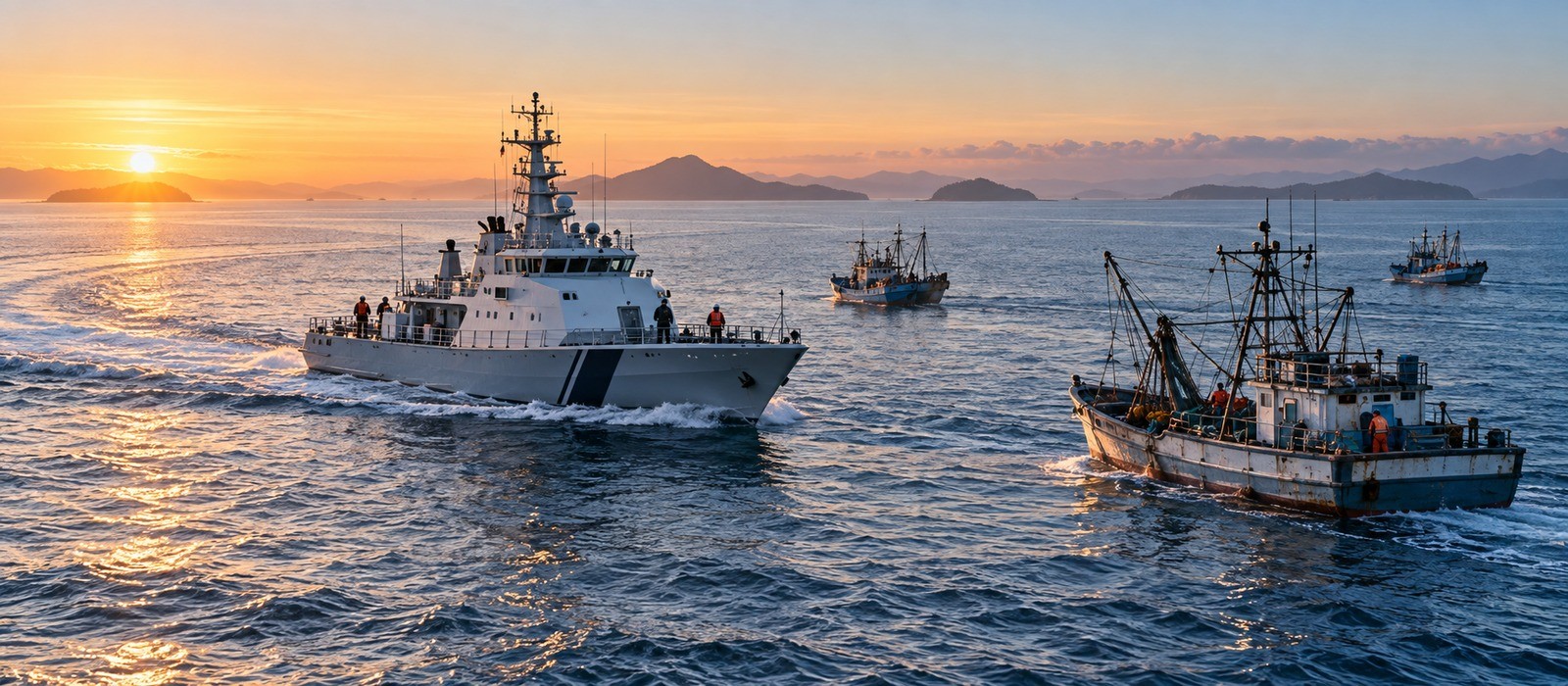
The terror attacks of 26 November 2008 commonly known as 26/11 in Mumbai compelled the Indian Government to strengthen maritime, coastal and offshore security. These measures included inter-agency coordination, increased monitoring and regulations of maritime activity in the maritime zones of India.1 The Indian Navy (IN) was given the responsibility and mandate of Coastal Security even during peacetime. IN mandate and capabilities to fulfil its constabulary role vis-à-vis the Coast Guard (CG) require synergy to arrive at efficient and effective enforcement of jurisdiction in the Maritime Zones of India. The Coast Guard or Navy on its own will be unable to fulfil the requirements of enforcing jurisdiction. The question that arises, therefore, is whether IN is mandated and empowered with present enactments and legislation to exercise such jurisdiction in maritime zones of India?
Relevance of Indian Navy in Indian Maritime Governance
The constabulary role of the Navy in complying with the requirements of maritime governance is directly linked to its mandate and capability. Indian Maritime Security Strategy (IMSS) includes this element of legal jurisdiction in maritime zones of India for the protection of the Indian coast and its offshore assets against attacks and threats emanating from or at sea.2 IN has remained one of the main players in ocean matters and this additional responsibility for coastal security and policy imperatives for Blue Economy leaves it with no other choice than to take on the constabulary role more vigorously.3 The various constituents of the strategy described in the IMSS lay down maritime security objectives and mandatory tasks of the Navy to respond to the requirements.
Coastal and oceanic space management are of great national importance. The Maritime Zones of India are nearly as large as the land territory of India but the concept of jurisdiction is not spelt out in any policy document. Although an integrated coastal management plan has been approved by the government post-2008 Mumbai terrorist attacks, there is an absence of a national framework for the management of maritime zones of India. The existing Laws of the Sea have been derived from the understanding arrived at amongst various nations for respecting use of the sea. In past, a philosophical construct was attempted to explain or justify freedom of the seas vis-à-vis the extent of coastal state jurisdiction.4
Extant Legal Provisions to IN and ICG
UN Convention on Laws of the Sea (UNCLOS) 1982 invokes principles and precedent with respect to matters of varied requirements. The convention aims to accommodate the interests of coastal states in two ways. First, it gives each state freedom to take action in pursuit of these interests. Second, the treaty limits freedom of others to take action in a manner adverse to those interests. While the jurisdiction of a country in its land territory is exclusive and absolute, boundaries in the sea are difficult to draw, and maritime jurisdiction is a complex phenomenon with varying understanding by different stakeholders. Of note is that Indian law is mostly derived from Anglo-Saxon jurisprudence. English thought and concepts have influenced Indian legal development even after independence from colonial rule in 1947.5
In May 1976, India redefined its offshore limits by the Fortieth Amendment to Article 297 of the Constitution and enacted the ‘Maritime Zones of India Act 1976.’ After passage of this Act, a requirement for a separate maritime force was felt to enforce and ensure compliance with the provision of this Act. A CG organisation under aegis of the Navy was established on 01 February 1977 and remained till 19 August 1978. A permanent Coast Guard was then constituted on 19 August 78 as an “armed force” of the Union of India through the Coast Guard Act 1978 and became part of the Ministry of Defence like the three older armed forces. Thus, the CG became the principal agency for enforcing national legislation in the Maritime Zones of India. However, in times of hostilities, it would perform duties as assigned by the Navy. The missions and responsibilities of the CG are as below: -
-
Dealing with safety and protection of artificial islands, offshore terminals and other installations.
-
Protection and assistance to fishermen and mariners at sea.
-
Preservation and protection of marine ecology and environment, including pollution control.
-
Assistance to the Department of Customs and other authorities in anti-smuggling operations.
-
Law enforcement in territorial as well as international waters.
-
Scientific data collection and support.
-
Lead Intelligence Agency (LIA) - for coastal and sea borders.
-
Being the Commander of the Coastal Commands, the Director General (DGCG) has the responsibility for overall coordination between central and state agencies for coastal security.
-
Offshore Security Coordination Committee (OSCC) and National Maritime Search and Rescue Coordinating Authority (NMSARCA). The Director-General of the CG is the Chairman of OSCC constituted by the Ministry of Petroleum and Natural Gas (MoPNG), of which the Flag Officer Defence Advisory Group is a member. He is also the NMSARCA for executing/coordinating search and rescue (SAR) missions.6
The MZI Act promulgated the requirement for foreign warships to give prior notification for passage through territorial waters of India.7 Protection of offshore installations and oil fields was entrusted to the IN, and it remained a key element of India's interest in ocean issues.8 The Maritime Zones (Regulation of Fishing by Foreign Vessels) Act came into existence in 1981 and further streamlined the enforcement jurisdiction in maritime zones of India. These enactments, along with the Water Prevention and Control of Pollution Act 1974; the Indian Ports Act 1909; the Merchant Shipping Act 1958 and various supplementary statutory notifications aid the Navy and the Coast Guard in streamlining procedures of enforcement in maritime zones, particularly within the Exclusive Economic Zone.9
The rule of constitutional law and the scope of national authority over maritime zones is a reflection of the doctrine concerning relationship between the Laws of the Sea and municipal laws of the state. The Indian system of enforcing the jurisdiction can be understood as follows: -
-
Under the MZI Act of 1976, India has claimed full sovereignty over the Maritime Zones of India. The CG is the principal agency for enforcing national legislation in the Maritime Zones of India.10
-
While this became umbrella legislation, there was also a need to suggest separate legislation to provide for regulation in greater detail for the exploration and exploitation of resources in maritime zones. Besides officers of the CG, the Central Government has notified Navy and police officers as authorised officers under Section 9/19th of the MZI Act, 1981.
-
The Act also gives power to the CG to curb poaching activities of foreign vessels, including those chartered by Indian parties in our EEZ. To protect fishermen from the harm caused by poaching vessels, the Parliament enacted the MZI Act of 1981 and also made the rules under the Act called MZI regulations of fishing by foreign vessels in 1982. Certain amendments to these rules have also been issued from time to time.
-
The rationale for forming CG was that the patrolling of maritime zones of India and protection of national interest is only a peacetime role for which defence assets should not be used more than was absolutely necessary. While IN ships manned by trained personnel would be very competent to perform various tasks within maritime zones of India, they could come at the expense of other operational and tactical combat training, maintenance and availability of naval ships and aircraft to the other roles of the Navy at the higher ends of a spectrum of conflict.11
Maritime Issues and Challenges
Maritime Zones of India. The maritime boundaries of India are categorised and defined in the MZI Act, 1976 as Territorial Seas, Continental Shelf, Exclusive Economic Zone and Contiguous Zones. Accessible charts and data have been used to demarcate the coastline in both Lakshadweep and Andaman & Nicobar Islands. In many cases, nautical charts may not be useful for this purpose. Even if used, the older charts may need to be converted to WGS 84 datum using appropriate datum transformation parameters. The existing baselines promulgated by Govt Gazette are in Everest Datum; these are required to be promulgated in the geocentric datum i.e., WGS 84. The Ministry of External Affairs, Govt. of India has notified the Latitude/ Longitude Coordinates in Indian Geodetic Datum, Everest Ellipsoid, 1956, of the points constituting the baseline for measuring the 12 nautical miles limit of territorial waters, vide Gazette Notification No. S.O. 1197 (E) dated 11/5/2009.
The Baseline corresponds to the low water coastline indicated on the official nautical charts of the coastal State. Situations arise when the coastline is not defined clearly, or where it is improperly described on official charts on account of marked variations due to recession or other phenomena, such as erosion or accretion. In that case, a new geodetic survey may be appropriate to determine positions of the points that define the low-water line. If both the normal or straight baseline systems are used, the State needs to determine the sections of the coast to which each will apply.12 The limits of such waters, shelves or zones of the mainland as well as the individual or composite group of islands constituting part of the territory of India also require updating. Areas of island territory require particular importance and the issues can be understood as follows: -
-
Andaman & Nicobar Islands. India has submitted its baseline coordinates, except for the eastern coastline of the Andaman & Nicobar Group of Islands (ANI). The MEA promulgated a notification in 2009 declaring baseline for the coast of ANI. India followed a straight baseline method, but only on the west coast of the islands. This has not been put into action yet, and if India were to establish a baseline on the eastern coast as well, it will encircle the entire group of islands.13 The baseline system for eastern A&N, once promulgated, may obviate any misunderstandings with our neighbours in the interpretation of established maritime zones and International Maritime Boundary Line (IMBL). However, if kept as it is, the advantages of ambiguity would work favourably in diplomatic negotiations and relationships.
-
Lakshadweep Islands. As India extends its maritime partnerships in both the western and eastern regions of the Indian Ocean, the islands of Lakshadweep will receive increased strategic attention.14 The closing of baselines also makes these waters internal waters of India. However, to enforce jurisdiction in the area, substantial force levels would be required. IN capability to enforce jurisdiction and the restriction on unhindered transit passage would also require to be thought of just as it might in the ANI, if so promulgated. Further, the capability of surface platforms and integration with MR aircraft, IMAC and IFC-IOR data fusion for the surface picture and generation of MDA would be a precursor for such an endeavour. Diplomatic calls may be required to be taken not to restrict the freedom of navigation of vessels passing through the sea lanes in the area.
Freedom of Navigation. The need for maintaining maximum freedom of movement for shipping is global, as all countries are dependent on it for trade. There is no provision in the UNCLOS requiring prior notification or authorisation for the passage of foreign warships through any maritime zone, or for that matter even through the territorial waters of a coastal state. The recent events leading to a different interpretation of the situation between India and USA can be understood as follows: -
-
The United States of America, without having ratified, has claimed an unrestricted Right of Passage as a practice that has existed for very long. It argues that a coastal state, cannot act arbitrarily or decide how the right may be withdrawn or modified. The US Navy’s Freedom of Navigation Operations (FONOPS) are based on adherence to these considerations.
-
India requires previous authorisation of the passage of warships through territorial waters. The case is on the thought that the passage of warships has a different functional end from that of a merchant ship and is prima facie an infringement of the sovereignty of the coastal state and if the passage of a warship is accepted without authorisation this is no more than a concession.15
Illegal, Unreported and Unregulated (IUU) Fishing. IUU impedes India’s economic growth. The Blue Economy, an ocean-based economic programme for sustainable development, requires Indian control for fishing within the EEZ, as well as for exploitation of other resources in MZI. The presence of Chinese fishing vessels just outside the EEZ complicates matters for India and makes it difficult to monitor and regulate any infringements and foray into our economic zones. The following pointers would improve the understanding: -
-
Article 73 of the 1982 UN convention sets forth provisions for the enforcement of laws and regulation of the coastal states in its EEZ.16
-
However, it imposes the limitation on enforcement of laws in regulation on the coastal state in these zones primarily for prompt release of the arrested vessel on giving of reasonable bond or security and prohibition of imprisonment or of any other forms of corporal punishment for violations of regulations. Unless there is an agreement between the concerned states and lastly wrong notification of the flag state of arrest or detention of foreign vessels and subsequently of the action taken or any penalties imposed.17
-
The CG authorities inform the Central Government of an arrest or detention of any foreign vessel or person. In turn, the Government informs the diplomatic missions concerned. These obligations, although included in the MZI Act of 1981, do not bring out any distinction between the penalty of imprisonment and fines in the territorial seas vis-à-vis the imprisonment and fines in the EEZ.
-
Therefore, there is a need to revise the MZI Act and spell out the provisions of a penal settlement or a Maritime Tribunal for the purpose.
Global Trends in Policy Reforms
The Maritime Affairs Unit of the Ministry of Foreign Affairs, Government of the People's Republic of Bangladesh, has recently enacted The Bangladesh Maritime Zones Act.18 Similarly, Pakistan has also enacted Maritime Zones Act 2020. These acts provide for the declaration and determination of the maritime zones and give enforcement jurisdiction against piracy, armed robbery and theft, to make provision for punishment for matters connected therewith. Maritime Law Enforcement is defined as an assertion of jurisdiction over the vessel or aircraft in the maritime zones. Jurisdiction, in turn, depends upon the nationality, location, status, and activity of the vessel or aircraft over which maritime law enforcement action is planned.
The principles recognised in international law used for enacting criminal laws applicable to maritime law enforcement operations are also incorporated in these Acts. A Maritime Zones Tribunal is factored in for the trial of offences under the Act. It lays down provisions for ocean governance, blue economy and maritime cooperation and these Acts complement the ocean policy of the coastal state. Basic rules of armed conflict and the law of self-defence are also incorporated, thus making it all-encompassing for enforcement of jurisdiction in maritime zones. Extending penal laws and incorporating trial of offences and authorising power to Navy as authorised officers make it an umbrella legislation to deal with all issues of jurisdiction. It is recommended that the approach as adopted in such legislation may be replicated by GOI for amending existing laws accordingly.
Some Imperatives for Future Policy and Navy
Legal Imperatives. Maritime security and jurisdiction have international ramifications, often different from land-centric territorial examples. Usually, no single coastal state has the assets, resources, or capacity to do it alone. India’s interest in UNCLOS-82 has been met on major issues. However, India did not succeed in getting acceptance of some of its proposals on the contiguous zone, archipelagic status for the Andaman & Nicobar Islands, enlarged safety zones, establishing designated areas in the EEZ, and requirement of prior notification for passage through the territorial sea of India by a foreign warship.19 As mentioned earlier, India had, in anticipation, passed the Maritime Zones Act, 1976 claiming, inter alia, an EEZ extending up to 200 nautical miles and thereafter, the MZI Act (regulation of fishing by foreign vessels) in1981.
The law to be enforced within various maritime jurisdictional zones, and the authorities designated to enforce them, are numerous and complex. At present, these laws overlap geographically, and their enforcement is difficult. The authorities have two legal aspects: the municipal law power for specific provisions and the degree of force to be applied in its exercise. Although the MZI Act authorises use of force in effecting arrest, IN has not been given criminal or civil jurisdiction for this purpose. Problems may arise in connection with identification of offenders or the delegation of these constabulary functions to IN not ordinarily invested with them and increase the legal complexity. Problems may also arise in connection with identification of offenders, pursuit and arrest, and the proof necessary for conviction, which is a matter of municipal law but must be consistent with the requirements of international law.
It is recommended that a new legislation be enacted as a new Maritime Zones Act, incorporating requirements and understanding of current international maritime law. Alternately, India’s Maritime Zones Act -1976 and MZI Act-1981 (regulation of fishing by foreign vessels) would have to be refurbished with necessary amendments. The jurisdiction and its enforcement may clearly define the following: -
-
Jurisdiction over shipping.
-
Constabulary roles of IN.
-
National jurisdiction in territorial seas, contiguous zones and the high seas.
-
Civil and criminal jurisdiction in these zones.
Structural Imperatives. The IN’s Maritime Capability Perspective Plan is required to be designed in a manner to augment and/ or build the force structure necessary to respond to all envisaged roles of Indian Maritime Security Strategy (IMSS). The adoption of UNCLOS provides the basic framework within which jurisdiction for the protection of maritime space or territory is justified. The sovereignty can only be recognised if it is asserted and exercised by enabling jurisdiction and national laws. Achieving this plan requires an improved level of awareness, effective policy and integrated governance as well as capacity and capability building. India's maritime zones are a big space and the number of assets devoted to the task of maintaining good order at sea is relatively small. The size and shape of the Indian naval fleet will reflect the extent to which it will get involved in maintaining jurisdiction in maritime zones of India. Tasks include EEZ and coastal patrols, fishery protection, maritime law enforcement, search and rescue and general ocean surveillance. Any capability gaps are required to be made good at the earliest for IN to be seen as a preferred security partner in the region. Indian maritime interests, particularly for the constabulary role, would not only require more multipurpose surface units but would also need capable MDA through the air and space-based assets along with international cooperation on information sharing mechanisms. In addition to maintenance and war reserves, additional requirements of Maritime Patrol Aircraft and Unmanned Air Vehicles should be projected to meet these requirements.
Synergy with Coast Guard. The synergy between CG and IN across tasks is an area which would require attention. Both IN and CG need to synergise and complement each other to meet the requirements of maintaining good order at sea. The rationale for raising CG was that the patrolling of economic zones of India and protection of national interest is only a peacetime role for which defence assets should not be used. Additionally, this fourth arm of the Ministry of Defence as a service has the mandate to fulfil the requirements of enforcing jurisdiction in the maritime zones of India. If the responsibility and mandate of enforcing jurisdiction in maritime zones of India cannot be handed over solely to CG in future, then IN role vis-à-vis the CG is required to be synergised to arrive at efficient and effective enforcement of the jurisdiction.
Conclusion
Maritime governance requires planned and collaborative actions to administer maritime zones under India’s jurisdiction, with a multitude of agencies and stakeholders involved. The Indian Navy has primary responsibility for maritime security and the various constituents of the strategy described in the IMSS lay down maritime security objectives and mandatory tasks, which have to be performed by the Navy to respond to these requirements. Jurisdictional issues are, however, not spelt out in any policy document. While IN and CG complement each other to fulfil the requirements of maintaining good order at sea, it is the CG which is mandated for the protection of economic resources in EEZ. The defence of offshore areas is the responsibility of IN, and the air defence for the same is undertaken by IAF. Post-2008 terror attacks on Mumbai, the Navy was given the additional responsibility and mandate of Coastal Security, for which doctrinal and legislative clarity should be addressed. This would always be a task in progress as the protectors and the transgressors would keep evolving their doctrines and strategies. The actions taken so far by the Indian government and the concerned security agencies seem to be pro-active and in concert with threat perceptions. The idea is not to be complacent and to rest on achieved laurels but to keep on one’s toes. Therein lies the safety margin.
Endnotes
-
Himadri Das, Coastal Security Policy Imperatives for India (New Delhi: National Maritime Foundation, 2019).
-
Ensuring Secure Seas: Indian Maritime Security Strategy (New Delhi: IHQ of MoD (Navy), 2015), 104-112.
-
Ensuring Secure Seas: Indian Maritime Security Strategy, Op Cit., n.2.
-
DP O’Connell, The International Law of the Sea Vol 1 (Oxford: Cladenron Press, 1984), 31- 35.
-
OP Sharma, The International Law of the Sea, India and the UN convention of 1982 (New Delhi: Oxford University Press, 2009).
-
“ICG Mission and Responsibilities”. https://www.indiancoastguard.gov.in/content/index.aspx accessed 20 October 2021.
-
Sharma, Op Cit., n. 5.
-
Sharma, Op Cit., n. 5.
-
Sharma, Op Cit., n. 5.
-
CGO 7/87, Procedure for enforcement of provisions of MZI ACT, 1981 (New Delhi: Coast Guard Officers, CGHQ).
-
Sharma, Op Cit., n. 5, 160.
-
IHO, IAG, IOC Advisory Board on Law of the Sea (ABLOS) ed., A Manual on Technical Aspects of Law of the Sea-1982 (Monaco: International Hydrographic Bureau, 2006).
-
“The Growing Significance of the Andaman and Nicobar Islands,” The Maritime Executive. https://www.maritime-executive.com/editorials/the-growing-significance-of-the-andaman-and-nicobar-islands, accessed 19 October 2021.
-
“Strategic Importance of Lakshadweep Islands,” https://www.futuredirections.org.au/publication/indias-lakshadweep-islands-to-grow-in-strategic-importance/, accessed 19 October 2021.
-
Om Prakash Sharma, “Enforcement Jurisdiction in the Exclusive Economic Zone: The Indian Experience,” Ocean Development & International Law vol. 24, no. 2 (1993), 155-178.
-
O’ Connell, Op Cit., n. 4.
-
Sharma, Op Cit., n. 15.
-
Ministry of Foreign Affairs, Government of Bangladesh. https://mofa.portal.gov.bd/sites/default/files/files/mofa.portal.gov.bd/page, accessed 03 October 2021.
-
Sharma, Op Cit., n. 15.
