


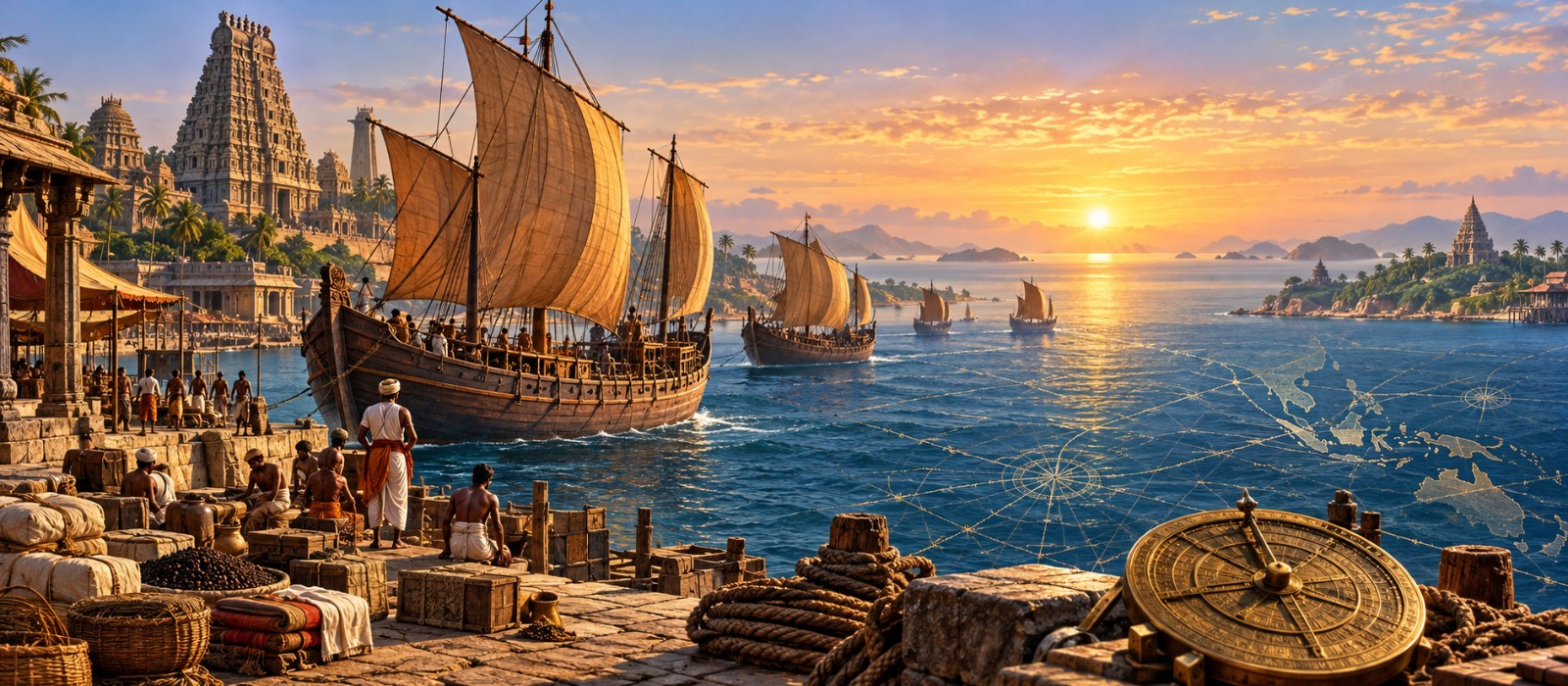


This viewpoint has been received from Prof (Dr) Utham Kumar Jamadhagni, HoD, Dept of Defence & Strategic Studies, University of Madras on the article, ‘Seapower and the Imperial Cholas’ written by Prof Sanu Kainikara, published in the Spring 2022 Edition (pp 10-28).
The objective of this review is not only to highlight the strengths and weaknesses of the arguments made by the author but also to advance the debate on ancient Indian maritime legacy and its import for the prevailing strategic environment. Since most research today, especially from the military point of view, can only be based on interpretations of historians, the author must be given the benefit of doubt for drawing points of analysis or possible explanations as presented in the article.
Dr Kainikara’s research paper is a valuable addition to the knowledge on India’s often unsung maritime legacy. His effort to highlight the particular contribution of the mighty South Indian Empire of the Cholas, especially from a maritime military point of view, is a necessary addition to our understanding of different approaches to Indian history into less explored themes.
The author has amply demonstrated the comprehensive power capability of the Cholas by providing a succinct run through Chola history using available evidences and reference. However, there are some areas for furthering the debate. His explanation of the Chola Empire not being a thalassocracy is at best tenuous. The term also means naval supremacy and it is in this context that the Cholas can be categorised as such.
In the description of Rajaraja’s ascendancy the author acknowledges the “existence of an efficient navy.” He also traces the evolution of such a naval architecture through the reigns of earlier kings. The mention of the Battle of Kandalur Salai (spelt as Kadalur in the article) needs to be elaborated. The epithet Kandalur-Salik-Kalamarutta, which precedes the name of Rajaraja in several inscriptions, is evidence of this campaign.1 Its significance in sterilising the Chera naval power parallels that of the modern concept of destroying an enemy’s war making capacity. This also was a launching pad for his conquest of the Maldives.2
The author concedes that the strong Cholan naval presence acted as a deterrent against any designs of the Southeast Asian kingdoms. Also, the fact that Srivijayas resorted to underhand means, implies that the Cholas – who played a major role in the Indian Ocean trading system – were justified in checking such attempts.
While mentioning the unfair conditions that the Srivijayas laid on maritime trade, the author fails to underscore the open brandishing of “state-sponsored piracy” that the Sailendra kingdom chose to threaten with. Retention of free and fair-trading opportunities in the Southeast Asian region could definitely be considered a strong motive for launching offensive action.
When speaking of the run up to the naval campaign, the researcher remarks that no diplomatic attempt was made by the Cholas in diffusing the tension. The fact that the Sailendras embarked upon a discrediting mission with the other significant power (China) against the Cholas, as well as the direct threat posed to overall maritime trade not just for the Cholas, probably closed any avenue for diplomacy.
The series of naval attacks are confirmed by the Tamil prasasti (laudatory inscriptions) which offers accurate geographical descriptions of each of the battle sites.3 The attempt by Arunachalam to chart the possible route of the naval expedition using navigational inputs and Tamil inscriptions and epigraphy, points to the scope for maritime-related research using other sources.4 The need for greater synergy between Tamil scholars researching on newly discovered inscriptions, or other evidence and the information that could be culled out relating to naval aspects must not be missed.
In fact, the successful publication of the edited volume Nagapattinam to Suvarnadvipa brings out the advantage that Tamil epigraphical research and history-based analysis can offer into the knowledge on the military prowess of Tamil kingdoms like the Cholas.5 The achievement of a “blue water” status by the Chola navy that enabled a successful lightning campaign, should also be highlighted. In this light, the use of the terms “meddling” and “interference” to describe Chola actions in Southeast Asia seems to be baseless. In an earlier reference, the author himself mentions the game of power politics in the region that then resulted in requests for Chola assistance. This clears the South Indian power of any wrongdoing or forcible action there.
The researcher also does not emphasise the role of contemporary bigger powers, the Chinese, the Cholas and the Egyptian regimes in maintaining the region’s stability. He rather unfairly credits the Srivijayas - the root of disruption - as a stabiliser. Further, the author contradicts himself when he states that the Chola objective was “merely to plunder and destroy the Sailendra powerbase” devoid of imperialistic tendencies, while later faulting them for not “providing a viable alternative.” If it was a benign power that only taught a lesson to the disrupting power, then regime change probably cannot be the consequence of such actions.
The researcher has done well in deducing lessons from this naval expedition; the relation between national prosperity and regional stability; the ability to exercise all resources to ensure national sovereignty; the need for littoral countries to orient national strategy towards the maritime realm; the imperative to demonstrate the will to show its strength when required without any hesitation; for alliances need to be maintained by the bigger power and lastly, adoption of a hybrid approach of employment of soft and hard power to achieve national security.
The article could also have underlined the enormous contribution made by the Cholas in administrative reforms from the local to the highest echelons of power, the systematised taxation structure and the concerted and sustained effort in nation-building that transformed them into a mighty, undisputed Empire. This in turn, strengthened their comprehensive national power which was a contributory factor in the Cholan naval projection offshore.
For the current Indian strategic scenario, another valuable guidepost the Cholas offer is that the bulwark of naval prowess rests on a need for nurturing strong maritime commerce together with a competent ship building architecture that takes into account the demands of a possible blue water navy.
In essence, the article is a noteworthy contribution in refocusing Indian strategic attention over the maritime realm through a revisit into the rich and glorious maritime tradition of this ancient peninsula. It can truly serve as a threshold that raises maritime-related research to higher standards of thought and scrutiny.
Endnotes
-
“ K.A. Nilakanta Sastri, The Cholas, University of Madras, 1955 p.169
-
Ibid., p.183.
-
As noted in ibid., p.211
-
For a detailed discussion refer, B.Arunachalam, Chola Navigation Package, Vol 6 Maritime History Society Series, 2004
-
Hermann Kulke, K Kesavapani nd Vijay Sakhuja eds., Nagapattinam to Suvarnadwipa: Reflections on the Chola Naval expeditions to Southeast Asia, Institute of Southeast Asian Studies, Singapore, 2009
