




“If we offer something to Bangladesh, it's obvious that Bangladesh is offering something to us. And why shouldn't Bangladesh be able to keep its promises? Economically it's full of resources and can stand on its feet.”
- Mrs Indira Gandhi during her interview to Oriana Fallaci in Feb 1972
Introduction
Birth of Bangladesh. The People’s Republic of Bangladesh is a littoral state slightly larger than Chhattisgarh (the 9th largest state in India) and bordered by India on three sides with a small boundary shared with Myanmar and the Bay of Bengal to its South. For centuries, the area that is now Bangladesh was ruled by the same empires that ruled India. Therefore, culture, food habits, traditions and architecture are very similar. However, religious and economic divisions fuelled Jinnah’s claim during the Partition in 1947 and it became East Pakistan. India’s contribution to the birth of Bangladesh during its struggle for independence in 1971 with the culmination of the defeat of Pakistan in the 1971 Indo-Pak war (also called The Liberation War in Bangladesh) is well documented. India provided shelter to several million refugees and provided financial and humanitarian assistance in the rebuilding of the war- torn nation.1 Pakistan’s administrative blunders coupled with resort to genocide (Op Searchlight) and aggression against India led to the surrender of Pakistani forces on the 16 December, 1971 which gave birth to the new state of Bangladesh and the return of their father figure, Sheikh Mujibur Rahman. India was the first country to recognise Bangladesh as an independent state and the two nations are celebrating 50 years of diplomatic ties. However, after the assassination of Sheikh Mujibur Rahman in 1975, relations went downhill where the Bangladesh Army took control and steered towards majoritarian politics. For a long time, Bangladesh was reluctant to address India’s security concerns and the countries were unable to settle maritime borders and river sharing agreements.
Indo-Bangla Relationship Gathers Steam. Prime Minister Indira Gandhi’s first visit to Bangladesh was marked by the signing of the Treaty of Peace and Friendship on 19 Mar 1972. It was widely considered a security and military pact.2 However, Bangladesh could not be seen leaning towards India as that would effectively keep US and Europe away due to their perception of India’s inclination towards the Soviet Bloc.3 Contrary to India’s vision, the treaty added to the apprehension of the Bangladesh Army, already reeling under a lack of adequate recognition from the Liberation War.
The assassination of Sheikh Mujibur Rahman in 1975 tipped the scales and succeeding military regimes distanced themselves from India. Despite the positive beginning where Bangla personnel from the erstwhile Pakistani Armed Forces and various liberation groups like the Mukti Bahini fought hand in hand with the Indians in 1971, the newly formed Bangladesh Army inducted nearly 28,000 officers repatriated from Pakistan and seemed to have inherited some of their predilections. The regimes in Bangladesh distanced themselves from India and aligned with China and other powers from the Organisation of Islamic Cooperation (OIC) countries. This repatriated leadership continued to hold fort till 2007 when the first indigenously trained officer took over as the Chief of the Bangladesh Army.
However, Sheikh Hasina, daughter of Sheikh Mujibur Rahman, sought to restore her father’s vision of Shonar Bangla and the Awami League leader has continued to win elections and ensure Bangladesh’s progress and economic development. As Bangladesh Prime Minister, she perceives India to be a key partner and neighbour indirectly assisting Bangladesh’s rise in the world polity. One of the early steps during her initial years as the PM was the signing of the 30-year Ganga River water sharing treaty, a perpetual thorn in bilateral relations. Ever since, Indo-Bangla cooperation has increased multi-fold in various sectors and the task lies in sustaining the mutually beneficial relationship. This push is illustrated in the exchange of visits between leaders of the two nations, as well as the conduct of training programmes, joint exercises, and Humanitarian Assistance and Disaster Relief (HADR).
With this background, this article is an attempt to study the evolution of Indo-Bangla maritime relations and the opportunities this relationship presents. It therefore, studies India’s strategic interests, Chinese influence in the Bay of Bengal and prospective future collaboration, with avenues broadly categorised under defence relations, shipping/trade and Blue Economy.
Maritime Avenues of The Indo-Bangla Relationship
India’s Interests. The Government of India has actively advocated the “Neighbourhood First” policy prioritising healthy relations with immediate neighbours. A stable neighbourhood shall enable economic progress in the region promoting our national interest. A scuffle in the Bay of Bengal region could lead, among other things, to increased freight charges of goods primarily due to increased insurance costs of global shipping triggering an increase in commodity prices. Bangladesh provides an excellent market for Indian exports and contributes 50% of India’s health tourism revenue.4 Such considerations could have been factors in India’s willingness to compromise on its maritime boundary issues with Bangladesh and resolve them amicably through international arbitration, thereby promoting bilateral relations and economic interests of the North-Eastern states.
Bangladesh Mindset. Bangladesh political circles view India differently and can be broadly classified based on their attitude towards India. Those who assert that Bangladesh is surrounded by India on three sides are reminded that North East India is locked by Bangladesh and use this to their strategic and economic advantage. Politics of trade imbalance, hegemony and other outstanding concerns play a significant role in the prevailing scepticism about India in Bangladesh. The Bangladesh Nationalist Party (BNP), presently the opposition party, are vocal critics of India with Khaleda Zia, wife of former General and President of Bangladesh, Zia-ur-Rahman, at the helm of affairs. It is pertinent to note that Zia-ur-Rahman was amongst the critics of Sheikh Mujibur Rahman and became the Chief of Army Staff after his assassination. As of 2022, wargames and exercises are conducted at the Defence Services Command and Staff College, Dhaka with India and Myanmar as the potential enemy states.5 Despite a line of credit offered for defence ties, Bangladesh has not sought military hardware from India whereas China accounts for nearly 74% of military imports in Bangladesh.6
Criticality of Maritime Connectivity. As both India and Bangladesh look toward economic growth, India’s Neighbourhood First policy and Sheikh Hasina’s reciprocation for mutual benefits, highlight how the two nations have analysed the impact of harmonious relations. India and Bangladesh share nearly 54 rivers and North East India’s landlocked states have a closer port at Chattogram, Bangladesh to facilitate trade rather than taking the land route towards Kolkata via the Chicken’s Neck and improper roads. The Kolkata - Agartala distance can be cut from 1600 km to just 500km using inland waterways and roads through Bangladesh.7 The transhipment issue is a crucial necessity for India to sustain socio-economic progress for the Seven Sisters in the North East. Establishment of such trade routes will also benefit Nepal and Bhutan by providing access to seaports for trade and providing Bangladesh with annual transit fees worth $600 million.8
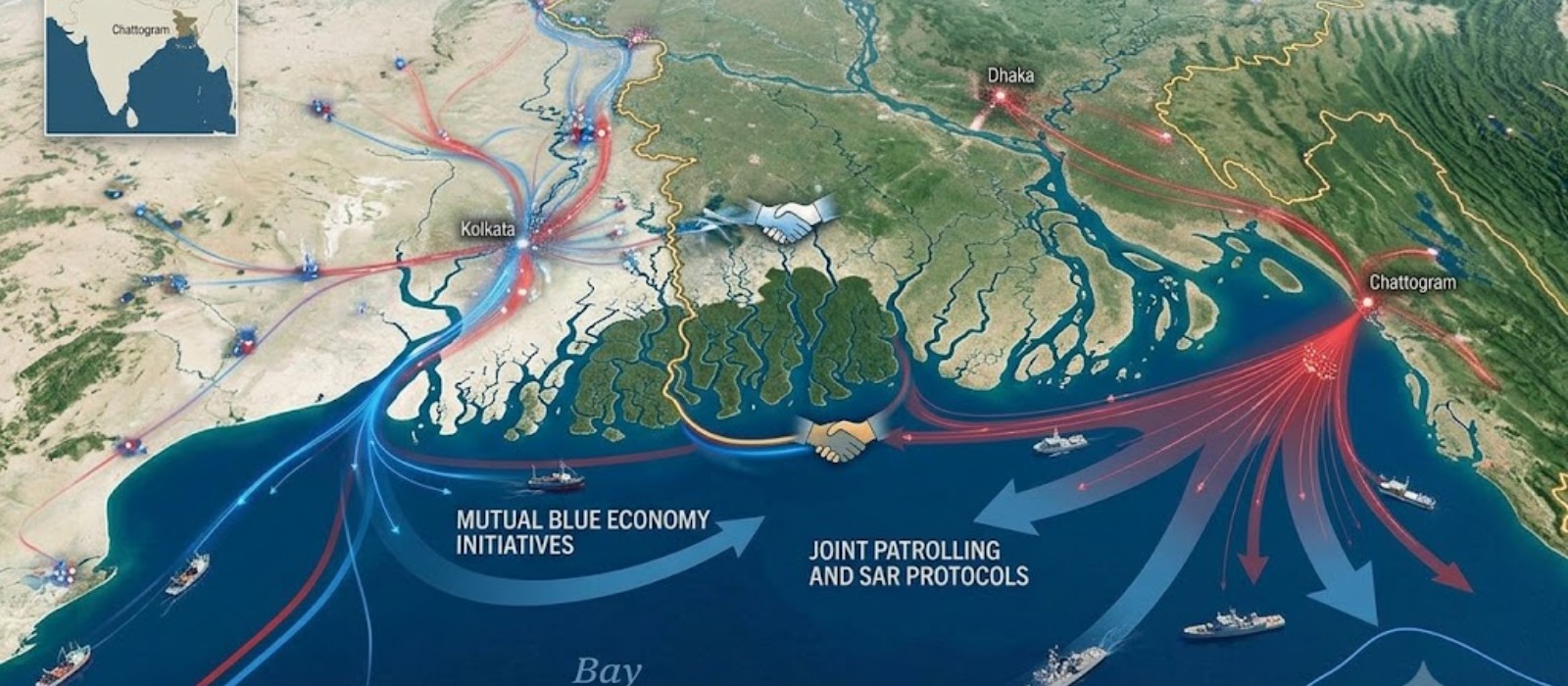
Brethren in the Bay. The resolution of the maritime boundary in 2014 and the exchange of Land Enclaves in 2015 created an atmosphere of confidence, trust and goodwill between the two states with a greater sense of optimism.9 Of the 22 agreements signed during PM Modi’s visit to Bangladesh in 2015, six were related to maritime domain ranging from cooperation in harvesting the Blue Economy to ensuring maritime security and safety. Consequently, coastal shipping service was launched between the two neighbours in 2016 and the year also marked the first transhipment from Kolkata to Tripura via inland waterways through Bangladesh. The various avenues of cooperation in the maritime domain are as follows: -
-
Defence and Security. Maritime/naval security cooperation between the two neighbours has seen a quantum jump in recent years with collaboration in various fields from joint training, to participation in multilateral exercises like MILAN and Naval Staff Talks. Conduct of Ex Bongosagar, regular CORPAT patrols in the Bay and various trainee exchanges reflect the developing relationship between the two navies. Bangladesh has been an active participant in India initiated maritime construct, Indian Ocean Naval Symposium (IONS). The Coast Guards of the two nations have collaborated to check piracy, illegal fishing and drug trafficking to keep the Bay safe. Bangladesh Coast Guard personnel are being trained on various maritime subjects like maritime law, SAR, pollution response, boarding operations, helicopter operations and anti-piracy at the Coast Guard training centre in Kochi since February 2014.10 The visit of Sheikh Hasina to Delhi in 2017 also saw the operationalisation of the MoU on Developing Regional Cooperation between the Coast Guards of both nations.11 The institutionalisation of cooperation augurs well for developing bilateral defence relations to suit the national interests of both countries.
-
Shipping and Trade. Trade is a key driver in today’s international relations and thus, cooperation is vital to developing bilateral relations, especially since both nations share a long maritime boundary. The ‘Notun Projonma - Nayi Disha’ (New Directions) Joint Declaration in 2015 heralded the onset of MoUs on Coastal Shipping, trade through inland waterways, and use of Chittagong and Mongla Ports to boost the economy in the landlocked North-Eastern states. India and Bangladesh signed the Coastal Shipping Agreement in 2015 allowing sea transport from India to Bangladesh to be treated as coastal movement, making it eligible for 40 per cent concession on vessel-related and cargo related charges.12 This agreement seeks to promote two-way trade between the two states and reduce delivery time from 25 to seven days, with an estimated savings of approximately US$300 per container.13 The Protocol on Inland Water Transit and Trade (PIWTT) has facilitated transport of up to 3.5MMT along the waterways where dry and container cargo is being shipped along established protocol routes thus paving the way for greater cooperation in this sector.
-
Blue Economy. There are about 400 fish species in the sea area adjoining Indo-Bangla maritime boundary.14 In addition, the Bay of Bengal is believed to be one of the biggest sources of offshore hydrocarbons with both India and Myanmar discovering oil and gas reserves. Under the Bay of Bengal Large Marine Ecosystem project (BOBLME), both states are collaborating to improve regional management of fisheries. Indian oil major, ONGC Videsh has partnered with Bangladesh’s BAPEX to commence drilling of the first well off Maheshkhali Island in 2020.15 In the process, it has become the first Indian entity to prospect for oil and gas in Bangladesh. Under the umbrella of the Indian Ocean Rim Association (IORA) and Bay of Bengal Initiative for Multi-Sectoral and Economic Cooperation (BIMSTEC), both states have begun collaborating for the sustainable development of Blue Economy resources. Through holistic, cross-domain effort, collaboration in this sector could usher in a Blue Economy revolution profitable to all concerned.16
Sailing in Company. Whilst both sides have taken considerable measures to maintain congenial relations, scepticism, contentious issues and the role of extra-regional powers can derail the progress made. The Bangladesh Government’s dynamism, the Navy to Navy and Coast Guard relationships and the perceptions of the business houses on both sides are the keys to unlocking the potential of bilateral maritime cooperation. The major challenges that lie ahead are: -
-
Defence and Security. The MoU on defence cooperation does not include maritime defence and there has been no upsurge in the joint responsibility of maritime security between the two navies. Although the collaboration between the Coast Guards has developed significantly, Bangladesh is China’s second largest defence customer after Pakistan accounting for 17% of Chinese defence exports.17 Chinese influence inhibits Bangladesh Navy (BN) from expanding its degree of cooperation with the Indian Navy. China has also announced the setting up of FM 90 SAM maintenance and overhaul facility in Bangladesh in Feb 22. The IN and BN engagement is steadily growing which is highlighted from the recently concluded 8th edition of IN-BN Staff talks in Apr 22 and BN’s active participation in MILAN 22. BN is a comparatively small force and therefore, places greater onus on India to take the relationship forward addressing various concerns of both parties.
-
Shipping & Trade. Bangladesh has 3278 registered vessels transporting cargo across the length and breadth of the country and is the second largest exporter of readymade garments in the world.18 The sheer volume of inland and oceangoing trade presents an excellent investment opportunity and exemplifies the growth in the shipbuilding industry. However, India’s contribution has been minimal and Indian Shipyards have failed to win major contracts with GRSE breaking the ice in Jul 21 by bagging a US$ 1,821,798 contract for six Patrol Boats for Bangladesh Fisheries Department.19 Bangladesh is concerned regarding the large bilateral trade deficit with India and the large volumes of informal imports across the porous land border so as to evade import duties. Political discontentment in Bangladesh tends to stem from the huge trade gap, supported by the fact that India has a lot of non-trade barriers inhibiting the imports from Bangladesh.
-
Blue Economy. Despite being the sector with maximum potential for collaboration, Bangladesh and India often differ over various issues including over-fishing and fishermen crossing national maritime boundaries. Hilsa is a popular trans-boundary species (national fish ofBangladesh) fished by both states and is exclusive to the Bay region. Towards protection from overfishing, the governments introduced a ban period to allow for spawning; however, the ban period is different in India and Bangladesh. This lack of bilateral cooperation has led to a depletion of the species which continues to be over-fished in the other’s waters during the ban period. Further, sharing of water resources has been a continual cause of discord and the Farakka and Teesta River disputes bear testimony to this. Despite the signing of the 30-year sharing agreement, both nations continue to debate whether the water distribution principles are mutually beneficial. Clamour for revisiting the agreement comes up before any high-level delegation visit with both nations bogged down by the five-month dry period of water-sharing rather than engaging in water quality, climate change and flood management.
Way Ahead
In terms of ability to influence in a regional context, USA for instance, may have a higher effectiveness in the Americas largely due to the involvement of relatively smaller allies and partners via cooperative ventures like NAFTA and NATO. On the other hand, India’s influence through SAARC, BIMSTEC, IORA etc. is lesser in comparison due to different factors. While both, India and Bangladesh have adequate arrangements to take the relationship forward in various sectors, certain critical issues are discussed below: -
-
Defects have been detected in the newly inducted Type 053H3 frigates for the BN and the continuing failure of missile systems and submarines highlight BN’s concerns over quality and longevity of Chinese military hardware.20 The recent collaboration with the South Korean Hyundai Shipyard and invitations to Turkish Shipbuilders indicate the growing discontent with Chinese systems. The time is ripe for Indian shipbuilders and aviation industry to harness this opportunity whilst BN is planning to improve fleet strength and their naval air arm. The appointment of a Naval Attaché to Bangladesh after 47 years aims to improve naval and maritime defence cooperation. A considerable number of BN personnel visit India for professional military education and training and the relationship is decades old. However, there is scope for improvement, especially in submarine training, ASW and aviation. The world has witnessed the economic instability in Sri Lanka brought about by the Chinese Debt Trap and Bangladesh polity is aware of the economic risks China poses. Therefore, India should utilise the opportunity to deepen partnerships and promote defence cooperation to ensure regional stability and economic growth.
-
India’s Blue Economy growth has been focused on port development under the Sagarmala project whilst Bangladesh has set up a Blue Economy Cell and identified 26 sectors for growth in this sector. The MoUs in the maritime sector can enable an exchange of scientific research and develop sustainable models for harnessing Blue Economy potential. On 29 Mar 19, Bangladesh and India started cross-border passenger and cruise services which are expected to create a new horizon for cross-border tourism. The specific measures that Bangladesh and India need to undertake to deepen and widen maritime connectivity may include: operating passenger and cruise services on protocol routes; development of fairways; cooperation on navigation; joint patrolling and sharing port facilities at bilateral and multilateral levels; sharing port development experiences, particularly by India; andorganising conferences and training for policymakers.21 Maritime connectivity and trade should not be at the expense of one state’s interests and therein lies the key to the puzzle.
Conclusion
Bangladesh-India relations started improving significantly since Prime Minister Sheikh Hasina’s visit to India in 2010 and the reciprocal visit of the Indian PM in 2011. Progress on many issues, which were stalled from 1975 to 1996, has witnessed a significant upsurge in the last decade. South Asia is India’s primary area of interest and interaction and therein our reason for improving partnerships with most neighbours. Therefore, a growing relationship between Bangladesh and China is visualised as a potentially problematic situation from New Delhi’s perspective. Bangladesh is justifiably pursuing a foreign policy to suit their national interests and thus seeks cooperation with both India and China. Bangladesh’s recent Awami League governments have been well-disposed to building a good relationship with India, unlike the positions taken by the BNP whether in government or as the main opposition party. The general mood has swung in the favour of good relations which was evident from the 50th anniversary celebrations of the 1971 Liberation War where both the Indian President and the Prime Minister visited Bangladesh separately. The Indian High Commission at Dhaka participated with authorities and organisations in Bangladesh to highlight India’s contribution in the Bangladesh story and progress various bilateral agreements. The onus is on India to further the positive sentiment and utilise harmonious cultural and people-to-people relations to improve collaboration. India and Bangladesh should realise that maritime cooperation and in turn, economic growth would lead to a mutually beneficial relationship, and help serve our mutual interests.
Endnotes
-
West Bengal Government State Portal. https://wb.gov.in/portal/web/guest/refugee-relief-and-rehabilitation.
-
J Bhattacharjee, “India-Bangla Defence Cooperation: Coming of Age, at Last?” ORF Issue Brief no. 250 (2018, July).
-
Choudhury M. Shamim, “The Bangladesh-India Friendship Treaty: A Critical Analysis,” Journal of Bangladesh Studies (2007).
-
Navtan Kumar, “Over 50% Medical Tourists to India are from Bangladesh,” TSG Sunday Guardian Live, 04 August 2018. https://www.sundayguardianlive.com/news/50-medical-tourists-india-bangladesh, accessed 28 April 2022.
-
Author’s Experience from His Time at Defence Services Command and Staff College, Mirpur 2021-22.
-
Sumanth Samsani, “China - Bangladesh Strategic Linkages,” Observer Research Foundation, 11 May 2021. https://www.orfonline.org/expert-speak/china-bangladesh-strategic-linkages, accessed 01 May 2022.
-
Rahmatuallah, “Regional Transport Connectivity: Opportunities for Bangladesh,” BIISS vol. 30 no. 1 (2010, January).
-
Rahmatullah, “$ 6000 million Estimated for Infrastructure,” The Daily Star, 29 August 2011.
-
Jaishankar, “Indian Foreign Secretary Comments during the Press Conference after PM Modi’s Visit to Bangladesh in Jun 2015”.
-
G Padmaja, “Sheikh Hasina’s Visit to India: Consolidating Maritime Cooperation,” National Maritime Foundation, 03 May 2017. https://maritimeindia.org/sheikh-hasinas-visit-to-india-consolidating-maritime-cooperation/, accessed 12 May 2022.
-
Indian Coast Guard, Ministry of Defence, Government of India, Memorandum of Understanding (MoU) between ICG and BCG. https://indiancoastguard.gov.in/content/1732_3_MoU.aspx, accessed 01 May 2022.
-
“India: The Benefits of Shipping Route with Bangladesh,” Safety4Sea, 11 February 2019. https://safety4sea.com/india-the-benefits-of-shipping-route-with-bangladesh/, accessed 22 May 2022.
-
PV Rao, “Development through Connectivity: India’s Maritime Narrative,” Journal of the Indian Ocean Region vol. 15, no. 3 (2019), 245-264.
-
ME Hoq, Bay of Bengal Bangladesh: Fish and Fisheries (Bagladesh: Bangladesh Fisheries Research Institute, 2014).
-
“ONGC Videsh Begins its Exploratory Drilling Campaign in Bangladesh,” ONGC Videsh Limited, 01 October 2021. https://www.ongcvidesh.com/ongc-videsh-begins-its-exploratory-drilling-campaign-in-bangladesh, accessed 01 May 2020.
-
S Abhijit, “Towards an Integrated Blue Economy Framework in the Bay of Bengal,” ORF Issue Brief no. 411 (2020, October).
-
“Stockholm International Peace Research Institute Report 2016-2020,” SIPRI. https://www.sipri.org/sites/default/files/2020-06/yb20_summary_en_v2.pdf, accessed 04 May 2022.
-
Secretariat of the United Nations Conference on Trade and Development, Trade and Development Report 2020: From Global Pandemic to Prosperity for all-Avoiding another Lost Decade (New York: United Nations Publications, 2020).
-
“Garden Reach Shipbuilders and Engineers Ltd Announcement Kolkata,” 02 July 2021. https://grse.in/press-releases-2021-22/, accessed 04 May 2022.
-
Sidhant Sibal, “Several Countries Concerned over Faulty Chinese Military Equipment,” WION, 07 November 2020. https://www.wionews.com/world/several-countries-concerned-over- faulty-chinese-military-equipment-341382, accessed 01 May 2022.
-
Delwar Hossain and Md. Shariful Islam, “Unfolding Bangladesh-India Maritime Connectivity in the Bay of Bengal Region: a Bangladesh Perspective,” Journal of the Indian Ocean Region vol.15, no. 3 (2019), 346-355.
