


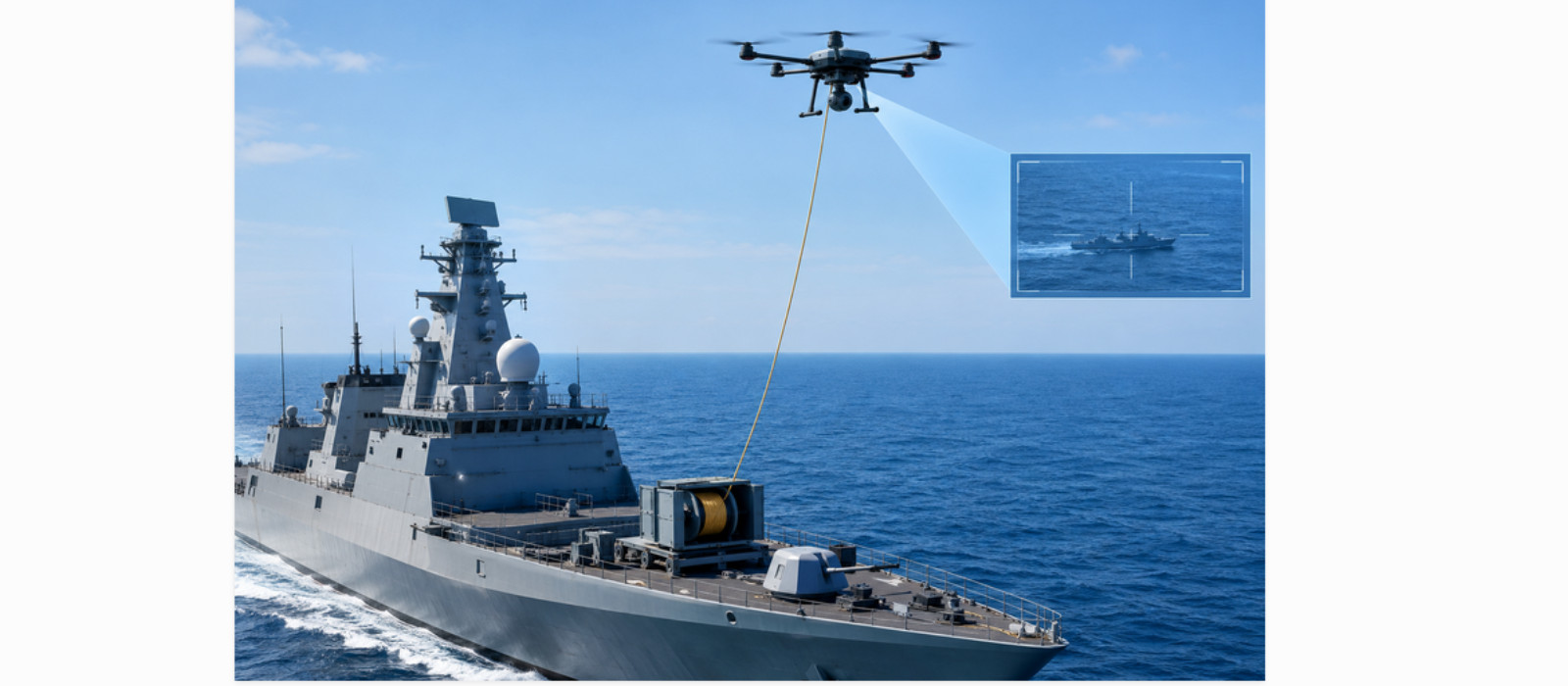


Background
The use of tethered balloons for reconnaissance onboard warships was first experimented with, as far back as the American Civil War. Unmanned Aerial Vehicles, commonly known as drones entered military service in the First World War. During the Vietnam war, the use of drones for observation became widespread. However, it is really in the last 20 years that drones have come into widespread military use. The sheer amenability of drones to technological innovations, along with advancements in camera technology, have been the driving factors for exploring wider applications of this amazing equipment. This paper is about the use of tactical drones for a largely unexplored application.
Traditional flying drones have been limited by their endurance which, especially in quadcopters, is decided by the capacity of the flight battery. Tethered drones are a more recent development that seek to overcome some of the limitations of traditional drones, while providing other advantages to military units. Here we discuss their use on naval ships and offshore platforms for extending the range of V/UHF communication and for providing a back-up / alternative to radar for near sea surveillance.
Ship Launched Observation Balloons
During the American Civil War, a balloon tethered to the steam powered gunboat Fanny was launched on 03 August 1861 with one of the pioneer balloonists of the time, John La Mountain, to observe Confederate positions. This was followed by the ascent of another balloonist from the Adriatic and later from the George Washington Custis in support of army operations along the Potomac. This boat was in fact modified for tethered balloon operations.1
Tethered balloons have also been used for civilian applications. In 2009, a tethered balloon was developed for use by the Prince William Sound Science Centre, Alaska to determine its usefulness for oil spill surveillance. The helium filled balloon was designed to be operated from a 15m ‘Purse Seine’ fishing vessel and its main objectives were to observe the area of around two nautical miles around the vessel and transmit the images to the mother ship as well as to another nearby vessel. It was designed to operate in both, fair weather and rain. A computer on the mother vessel allowed the crew to control the on-board camera in pan, tilt and zoom. A winch was used to raise and lower the balloon. In accordance with regulations, the balloon height was limited to 150 m or less, depending upon the cloud height.2
Use of Drones for Surveillance
Drones have been widely used for military surveillance since the 1980s, and even earlier. However, many of the earlier drones required a small runway or launchpad. The small platoon level drones that could be deployed by ground troops on the move, came into use only around 2005. During the last ten years, the use of multi-rotor drones for surveillance and monitoring has mushroomed. The entry of multi-rotors meant that the job of the larger fixed wing or helicopter drones could now be done by a much smaller craft. The multi-rotors brought with them the advantage of Vertical Take-off and Landing (VTOL). Not only was it feasible to launch a drone from anywhere, but controlling the motion of the drone also became much easier. Drones became more silent, which meant that they could be used for discreet surveillance.
One common limitation of smaller drones is their relatively low endurance, restricted by the capacity of the flight battery, and the energy intensive rotors they carry. On an average, a single battery gives no more than 30 minutes flying time. Greater endurance can be achieved with a bigger battery, but that means a larger, more noticeable and noisier drone with a possible compromise on the quality of camera, all of which are factors that run counter to the wisdom of covert surveillance.
One can have a tiny, barely seen drone, but then flight time and optical quality are the tradeoffs. Company and platoon-sized units prefer short-range reconnaissance drones used for determining the strength, location, and tactical weaknesses of the enemy - vital information for determining the right course of action.3
The need is to have eyes in the sky for long durations, with high resolution day and night cameras passing data in real time, on a platform that remains unobtrusive without intruding into enemy air-space and preferably one that does not fall into the wrong hands. It is to the advantage of the force deploying a drone, if the drone could observe enemy movements and positions without intruding into the target’s zones, since flying into enemy air space could be seen as a provocation. It follows that flying drones require a sufficiently skilled pilot who can provide the tactical commander with the information he desires, while preventing the craft from crashing into a hillside or trees, and in the worst case, from being captured by the adversary.
The other vulnerability of flying drones is their susceptibility to jamming and/or spoofing of their control radio signals along with their reliance on GPS for guidance, whose loss can lead to a crash. While there are pre-programmed drones that can obviate the need for GPS and command signals, these problems remain in most cases. Tethered drones do not require GPS, as they do not fly independently and remain in one place.
Combat Drones
The conflict between Armenia and Azerbaijan, in September-October 2020, over the disputed Nagorno-Karabakh region, saw the widespread use of drones as combat weapons. Drones of Russian, Turkish, Israeli and indigenous designs performed both, reconnaissance and strike missions.4 Azerbaijan had built up a fleet of Turkish and Israeli UAVs including loitering munitions, also known as ‘suicide’ or ‘kamikaze’ drones, including the ‘Harop,’ ‘Orbiter’ and ‘SkyStriker’ UAVs, as well as some modified Soviet-era ‘An-2 Colt’ biplanes with remote-control systems, to function as drones. These were used to great effect against tanks and air defence systems.5 Azerbaijan’s use of drones along with conventional weapons, contributed significantly to their victory and is a useful case study on the military use of drones.
Tethered Drones
Tethered drones are more recent derivatives of regular flying drones that have emerged during the last three to four years. A tethered drone is an unmanned aerial vehicle physically connected to a ground station. More specifically, a tethered drone system consists of a base station/ power station, drone tether and the drone/ UAV, which is connected to the power station through the tether.6

Fig 1: The Three Main Components of a Tethered Drone 7
The drone/ UAV is a standard multi-rotor drone, except that it does not have a flight battery. Power is provided by the ground station through the tether. However, it does carry an emergency battery. A tethered UAV has a reduced spatial area where it can fly. Because of flying restrictions, the tether has lesser control requirements and does not require a trained pilot. It also does not require GPS navigation, which significantly reduces technical errors that can cause a crash.
The tether cable contains thin, lightweight conductors, which reduce wind drag, enabling the drone to reach a higher altitude (around 120 m).Tethers can be made of ‘aramid’ or other lightweight synthetic materials to provide strength, with copper or plated copper for energy conduction and optical fibre for data and communications. The system can be ground-based or vehicle-based.8 The tether can also incorporate a fibre optic connection allowing for totally secure communications between the drone and its operator. This means that the drone is no longer susceptible to jamming or spoofing, as all control signals are passed via a fibre.
The ground station is basically a power supply unit and a winch that holds the tether. The power supply from the ground source is converted to DC. The tether reel has an auto-tensioned reel-in/ reel-out system, designed to simplify cable management. The drone’s altitude, operational duration in the air and the payload are determined by the type of drone and operational requirements. Input power is required to be converted, regulated and fed to the drone depending upon the drone’s needs. Hence, the ground station may include a smart power management unit, in addition to automated tether winding with Global Navigation Satellite System (GNSS) positioning to maintain flight ceiling and position even in adverse weather. Status monitoring, health checks and fail-safe procedures for the drone may also be built-in. Should the power supply fail, the drone uses its stand-by onboard battery.
Advantage Drone Commander
Thanks to the continuous flow of energy to the drone from the ground station, the drone can stay aloft almost indefinitely (upto 400 hours has been achieved) at heights of nearly 120 -150 m above sea level. Such a capability can become an advantage for reconnaissance, providing a constant aerial view of an area, without any interruptions for recharging. This concept could also be applied for the defence of static positions, where a tethered UAV could be placed at each corner of a base to provide a constant video stream of the surrounding area, helping to guard against attacks.9
The advantage becomes immediately apparent when the tactical commander realises that with his drone stationed, say, at a height of 70 m and continuously sending him visual information. With an impressive 30X zoom capability, he can see vehicles when they are nearly 10 km away, and can track approaching ground personnel long before they know they have been spotted.
According to Elistair, a leading manufacturer of tethered drones from France, their ‘Orion 2' tethered drone features IP54 ingress protection. It provides the lift to handle a two kg payload and is designed to be an in-flight tactical tower with a simple, one-pushbutton starting routine. It has gimbal stabilisation for continuous day and night, large-area surveillance. It is capable of 24 hour continuous operation at 100 m altitude, equipped with a safety battery that recharges in the air. The ‘Orion 2' tethered drone can handle digital communication rates upto 200 Mbps and is modular and man-portable, packed in a two-case transportable configuration. It is capable of 30X electro-optical zoom, with 1080-pixel High-Definition (HD) resolution and 4X InfraRed (IR) digital zoom, with 640 X 480 pixel resolution.10 In other words, almost indefinite surveillance with a dramatically increased line of sight has been made available, giving significant advantage to the drone commander.
Use of Tethered Drones on Ships
The advantages of a tethered drone are not limited to static positions on land. As said earlier, they can be used from ships as well, with some modifications. In Oct 2020, the US Navy began trials for ship-mounted tethered drones for Intelligence, Surveillance, and Reconnaissance (ISR); communications, and video applications.11 Another company, DPI UAV Systems USA, has tested its tethered UAS systems on various vessels from 15 m US Coast Guard vessels to US Navy ships and even US Army ground platforms. It is also learnt that the British MoD has selected tethered drones for a Royal Navy project.12
Tethered drones, which hover 60-80 m above a ship, overcome the limitations of visual range, which is restricted by the height of eye and curvature of the earth. Additionally, the drone stationed high above the ship can act as a high communication antenna to increase V/UHF range, since these bands too use line of sight communication. The tethered drone provides a double advantage in that the ship can see and communicate beyond visual line of sight for much longer durations than with a flying drone.13
As a rule, warships may prefer to remain silent on radio and radar as tactically necessary. Like every other technology, radar too has its limitations. Range and bearing discrimination, minimum range, blind zones are well known, as also the difficulties for radars in picking up non-metallic objects. With stealth features on warships becoming common, the strength of received echoes also reduces, making it more difficult for radar to detect stealth ships at the same ranges as non-stealth ships.
These drawbacks of radar can be overcome by optical day/ night surveillance that tethered drones provide. A tethered drone placed at say 100m height, with its high resolution cameras and optical zoom capability would have an optical range of around 30 km, which is close to what a standard navigational radar would provide. It may be argued that the latest generation of nav radars provide greater ranges. However, having visual information about a target, especially when that target is unknown, provides useful value addition. Allowing for some degradation of the farthest images, it would still provide a visual range of around 25 km during day and 10 km during night. A ship mounted tethered drone can therefore, augment radar surveillance and can substitute it, if radar silence is desired, with visual 360 degrees day and night surveillance. Further, it can increase V/UHF communication range by relaying radio signals from a payload radio set, but from a height much greater than the shipboard antennae, where the line of sight is limited by the curvature of the earth.

Fig 2: Unmanned Multi-rotor Aerial Relay14
Limiting Factors and Challenges
Power Supply. According to the firm DPI, which is working on their US Navy project, the design challenges for the tethered architecture are mainly centered around the power supply system. Power must be delivered from the host ship to the multi-rotor drone at very high voltage and low current to allow the use of thinner and lighter hardware resources, which in turn allows greater mobility of the drone and higher air payloads. The weight, dimensions and electrical properties of the tether have a direct impact on the performance of tethered drones.15
Tether Weight. The biggest challenge is to reduce the weight of the tether. A heavy tether will require more power and will place extra load on the motors. More weight will also limit the height and range of the drone. In the US Navy’s case, the requirement was to accommodate the weight of a 50 m tether and conversion modules within 400 gms.16
On-board DC Voltage Conversion. Another challenge for a tethered drone is power management involving rotor drive motors and control electronics. Having power flowing through a long cable introduces transmission losses that must be compensated. The objective of the cable (transmission line) is to keep the drone at a pre-defined height and to guarantee power and data transmission. Constraints on thickness and length are also linked to the application. In order to keep losses low, high voltage is used over the cable after which, power conversion to the desired levels is carried out inside the UAV. A high DC voltage lowers the current flowing in the tether. Obviously, weight is a critical element in the choice of DC/ DC converter components.17
Inside the multi-rotor drone, high voltage conversion must be done with the smallest footprint possible and with a form factor that reduces space and thermal effects. In the US Navy’s case, reduction in onboard weight was achieved by using small fixed-ratio Bus Converter Modules (BCM), to efficiently convert high voltage (400-800 V) to loads (20-50 V). These BCMs can achieve 98% peak efficiency and continuous efficiency of 95%.18
An Uncertain Area. There remains one important question to be addressed. This is a problem typical to ships underway at high speeds. It would obviously not be a consideration for say, an offshore platform or a stationary land-vehicle or location. Would the tether and its winch be able to withstand the pull on the tether when the ship is making way at a reasonable speed, say 15 to 20 knots in sea state 3? What would be the operating conditions of the tethered drone? Or is there a need for the drone to simply ‘fly along’ with the ship, while remaining tethered to the ship? Course and speed inputs converted to an acceptable form, could be provided to the system from the ship, should that be the case. However, at the moment, in the absence of deeper trials-based data, this remains an uncertain area.
Conclusion
Tethered drones offer significant tactical advantages to small unit commanders assigned to border guard duties and at forward operating bases. The fact that a tethered drone has a limited spatial flying envelope means that it will never be out of sight of the host unit. It does not require a pilot to fly it. The absence of radio links means that the tethered drone is ‘non-jammable’ and provides continuous 360 degrees surveillance for extended periods, of upto a few days at a time.
The same advantages are carried forward to tethered drones being used onboard naval ships and offshore platforms. Tethered drones offer a useful back up to shipboard radars when operating in crowded waters and when searching for objects like rubber rafts, fast attack craft, swimmers and any non-metallic object that may not show up on radar. It can also provide the ship with a means to monitor the surrounding sea area when radio silence is required. When used as an extended antenna, it can increase the communication range of V/UHF sets.
There do exist some technological challenges and uncertain areas that need to be studied. However, these do not seem unsurmountable. The USN and the RN have already commenced trials and while there remain some grey areas, it would be to India’s advantage to also examine this emerging technology.
Endnotes
-
Kevin Gould, “Balloon Corps: United States History,” Britannica. https://www.britannica.com/topic/Balloon-Corps, accessed 25 October 2020.
-
W Scott Pegau, “OSRI Balloon-Based Spill Surveillance System Operations and Testing Results,” Oil Spill Recovery Institute, June 2011. https://www.pwsrcac.org/wp-content/uploads/filebase/programs/oil_spill_response_operations/balloon_based_oil_spill_surv eillance_system/osri_balloon_surveillance_system_operations_and_test_results.pdf, accessed 25 October 2020.
-
“What are The Benefits of Tethered Drones,” https://elistair.com/tethered-drones-benefits, accessed 30 October 2020.
-
Shaan Shaikh and Wes Rumbaugh, “The Air and Missile War in Nagorno-Karabakh: Lessons for the Future of Strike and Defense,” Centre for Strategic and International Studies, 08 December 2020. https://www.csis.org/analysis/air-and-missile-war-nagorno-karabakh-lessons-future-strike-and-defense, accessed 20 December 2020.
-
Ibid.
-
Op Cit., n.3.
-
“Tethered System Safe-T Tethered,” Aeromotus. https://www.aeromotus.com/product/safe-t/, accessed 25 January 2021.
-
Maurizio Di Paolo Emilio, “Tethered Drones Improve Communications and Surveillance,” EE Times, 16 October 2020. https://www.eetimes.eu/tethered-drones-improve-communications-and-surveillance/, accessed 20 October 2020.
-
“Tethered UAVs: Why Wireless Doesn’t Always Mean Better,” Global Defence Technology. https://defence.nridigital.com/global_defence_technology_jul20/tethered-uav-military-drone, accessed 20 October 2020.
-
Jack Browne, “Tethered Drone Boosts Flight Time and Altitude,” Microwaves & RF, 02 December 2020. https://www.mwrf.com/markets/defense/article/21149205/microwaves-rf-tethered-drone-boosts-flight-time-and-altitude, accessed 10 December 2020.
-
Lisa Diagle, “Tethered UASs for Naval Surveillance Applications in Trial with US Navy,” Military Embedded Systems, 02 October 2020. https://militaryembedded.com/unmanned/power-electronics/tethered-uass-for-naval-surveillance-applications-in-trial-with-us-navy, accessed 05 October 2020.
-
Alex Douglas, “MoD Selects Tethered Drone Systems for Royal Navy Project,” Commercial Drone Professional, 04 March 2020. https://www.commercialdroneprofessional.com/mod-selects-tethered-drone-systems-for-royal-navy-project/, accessed 10 October 2020.
-
Emilio, Op Cit., n.8.
-
“Unmanned Multirotor Aerial Relay,” https://electronicsmaker.com/dragonfly-pictures-inc-pioneers-a-new-class-of-multirotor-drones, accessed 10 November 2020.
-
Emilio, Op Cit., n.8.
-
“Overcoming Tethered UAV Challenges with a High-Voltage, Compact, Module-Based Power Delivery Network,” Vicor. http://www.vicorpower.com/resource-library/articles/overcoming-tethered-uav-challenges, accessed 10 October 2020.
-
Maurizio Di Paolo Emilio, “Tethered Drones for Unlimited Flight Time,” EE Times, 15 January 2021. https://www.eetimes.eu/tethered-drones-for-unlimited-flight-time/, accessed 17January 2021.
-
Op Cit., n.16.
