


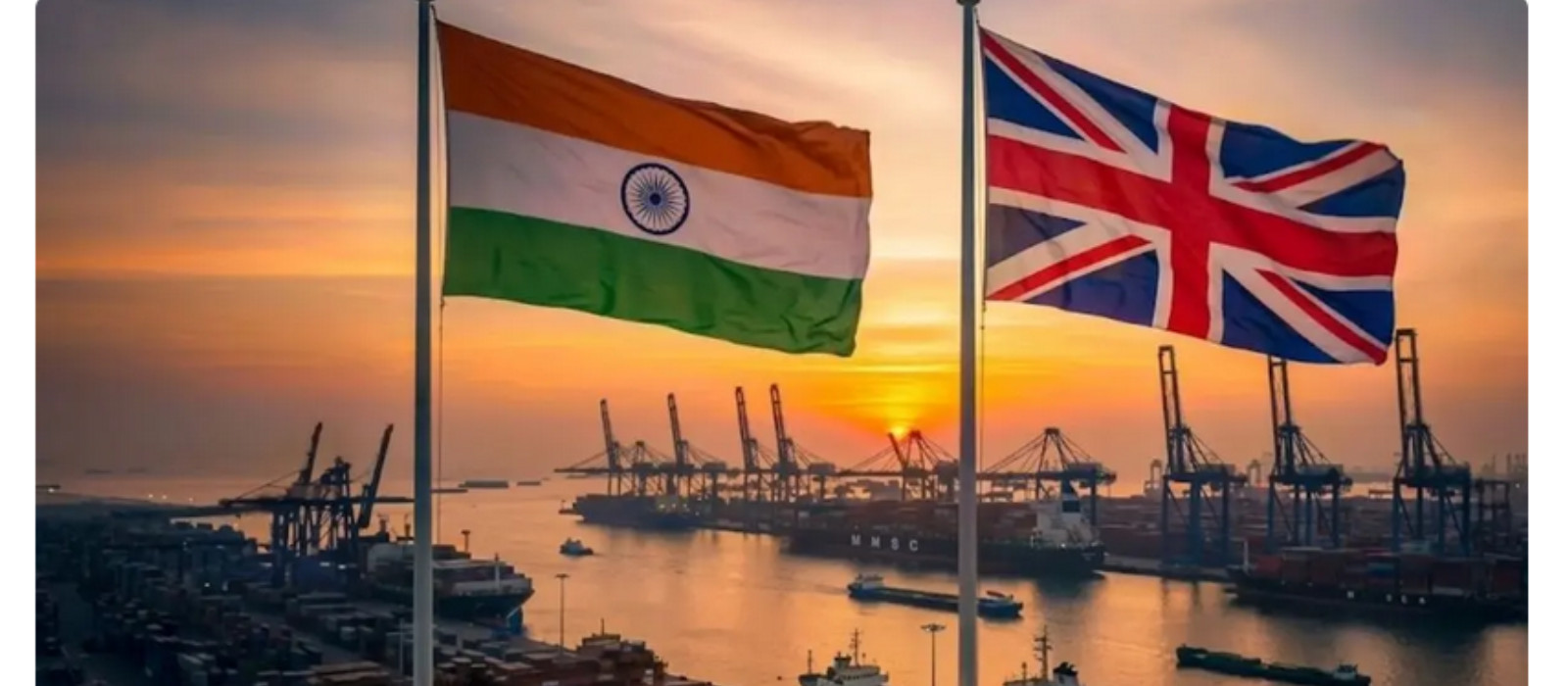


India looms large in the United Kingdom’s (UK) world view as it emerges after four years of political wrangling over its exit from the European Union (Brexit) and recovers from the shocking impact of
Covid-19 on lives and livelihood. Three prime ministerial visits between India and the UK are scheduled for this calendar year. British prime minister Boris Johnson and Indian prime minister Narendra Modi are seeking a “quantum leap” in their bilateral relations.1 A ten-year official ‘road map’ to 2030 has been finalised; five key ‘pillars’ of cooperation have been identified - trade and investment; defence, security and multilateral collaboration; climate; health; and migration and mobility. The UK has also announced a new foreign and security policy tilt towards the Indo-Pacific region in its post-Brexit world view, with a greater focus on India.
Within this context, ‘why’ is this the right time for bolstering the India-UK defence and security partnership; ‘what’ will be a key priority; and ‘how’ best to elevate their naval and maritime security ties?
Why?
Prime ministers Modi and Johnson’s rhetoric to “realise the potential” of the bilateral relationship is an acknowledgement of the unfulfilled potential their formal ‘strategic partnership’ has had for the past 17 years (since September 2004). There has been, for example, no visit of India’s Raksha Mantri (Defence Minister) to the UK during this period. Modi’s attempt to “re-invigorate” ties during his UK visit in November 2015 came to nought, as the UK referendum on Brexit took place seven months later.2
More importantly, their rhetoric signals the beginning of a sustained effort at a new and elevated bilateral strategic partnership amidst the changing political landscape and geo-strategic environment. For the UK, Brexit means that it can now begin to chart its ambition of a ‘Global Britain’ without any European Union constraints. This will now focus on building new and strong partnerships in the Indo-Pacific region for both prosperity and security reasons. India is a key partner in this endeavour.
The UK’s Integrated Review (IR) is its first comprehensive review of defence, security, development and foreign policy since the Cold War titled Global Britain in a Competitive Age - 16 March 2021. It recognised India as one of the three most important powers in the Indo-Pacific region (along with China and Japan), “the largest democracy in the world” and as an “international actor of growing importance.” It stated that the UK’s objective is to “transform bilateral cooperation over the next ten years across the full range of bilateral shared interests;” no other country is accorded such an ambitious agenda. The subsequent 69-page UK Defence Command Paper (DCP), titled Defence in a Competitive Age (22 March 2021), went further by describing India as “a key pillar” of its regional approach.3 This new perception of India within the broader geographical construct of the Indo-Pacific, rather than the traditional confines of South Asia, will be welcomed by New Delhi.
In a significant development, PM Johnson has invited PM Modi as a ‘guest’ to the meeting of an exclusive group of powerful countries, the G (Government)-7 Summit in mid-June 2021, in the UK. India will be one of only four guest countries, along with Australia, South Korea and South Africa. This is in marked contrast to India’s participation in the previous G-7 summit in 2019 chaired by France, when it was one of nine ‘guest’ countries. India’s G-7 participation takes place alongside its non-permanent membership of the UN Security Council for the two-year 2021-22 period.
And then there is the ‘Boris factor.’ PM Johnson’s reputation as a ‘colourful,’ ‘bold’ and ‘unconventional’ politician, with boisterous optimism on issues he takes a liking to (often in opposition to his bureaucracy). This reputation preceded him for the planned - but subsequently cancelled (due to the second wave of Covid in India) - first visit to India as Prime Minister by the middle of 2021. This would have been Johnson’s first substantive meeting with PM Modi, even though they had met earlier on the sidelines of international summits. PM Johnson is no stranger to India; his former wife had part-Sikh heritage and he has visited her relatives in India in the past. There is a widely-held view in India that PM Johnson’s premiership will be ‘more accommodating’ towards India than Cameron’s. In an early sign of this, the UK’s recently re-organised Foreign Commonwealth & Development Office (FCDO), raised its India profile by appointing, for the first time, a Director-level (an Indian Additional Secretary equivalent) official for ‘India and the Indian Ocean;’ this takes place in a newly-created Indo-Pacific Directorate (deliberately ‘de-hyphenated’ from the Pakistan, Afghanistan and Iran Directorate).
The UK’s outreach to India is also related to its changed relationship with China. The rhetoric of the ‘golden decade’ of UK-China relations of British Prime Minister David Cameron’s government has disappeared. The first significant shift was British Prime Minister Theresa May’s government’s security concerns over partial control of the Hinkley Point nuclear power plant by a Chinese state-owned company. This was
followed by growing concerns over the role of Chinese technology giant Huawei. In June 2020, PM Johnson’s government placed it in the bracket of “potentially hostile state vendors.”4 In November 2020, the government banned the installation of new Huawei equipment in the UK’s 5G networks from September 2021, with all Huawei equipment to be removed from its 5G network by the end of 2027, on the basis that it posed a threat to the UK’s national security. China’s enactment and imposition of the National Security Law in June 2020 led to strong UK criticism of violation of Hong Kong’s high degree of autonomy and the freedoms and rights protected by the 1984 UK-China Joint Declaration. British Ministers also publicly expressed concern over the Chinese government’s persecution of China’s Uyghur minority in Xinjiang province.
Meanwhile, the Indian government’s ‘wait and watch’ attitude towards the UK’s domestic political challenges has ended with Brexit taking place on 31 December 2020. Bilateral cooperation during the Covid-19 pandemic has been enhanced with the development of the UK (Oxford University)/ Swedish AstraZeneca Covid-19 vaccine and its manufacture in India as Covishield. Both countries are partners in GAVI, the vaccine alliance. Prime Minister Modi has also made several references to India playing an important role in a new post-Covid ‘World Order.’5
And, India’s renewed tensions with China will also be an important factor in its new and elevated bilateral strategic partnership with the UK. Its border clash with China on the Line of Actual Control (LAC) in the Galwan Valley in Ladakh in mid-June 2020 has changed its perception of China from being a ‘strategic challenge’ in the ‘long term,’ to becoming an ‘immediate threat’ in relation to their disputed land borders. For the first time in 45 years, 20 Indian soldiers were killed on the Sino-Indian border. Notwithstanding the subsequent partial de-escalation of troops that had taken place by early March 2021, China remains at the top of India’s list of neighbourhood threats.
Indeed, the UK’s concerns over China have brought about a convergence of perspectives on China’s assertive policy towards India that had not existed earlier. In June 2020, British Members of Parliament raised concerns over China's “bullying behaviour” on the border dispute with India.6 In July 2020, the new British High Commissioner to India Sir Philip Barton (currently the Permanent Secretary in the FCDO in London), discussed China with India’s Foreign Secretary Harsh Shringla.7 And, in July 2020, the UK government expressed strong concern over Chinese actions against India in the Galwan valley.8 However, even though the IR recognised China as an “authoritarian state” that posed the “biggest state-based threat” to the UK’s economic security, it also sought to engage China at multiple levels, including on economic and climate change issues.9
What?
Defence and security ties have sensibly been ‘upgraded’ as one of five ‘pillars’ of the new ten-year elevated bilateral strategic partnership ‘road map’ till 2030. Maritime cooperation is at its centre.
The IR’s vision for this is “enhanced defence cooperation that brings a more secure Indian Ocean Region;” the DCP states that the UK “will establish a maritime partnership with India in support of mutual security objectives in the Indian Ocean.”10 While the UK is expected to focus on the western Indian Ocean, where it holds long-standing historical and strategic leverages, India will concentrate on the entire Indian Ocean, which forms part of its ‘extended neighbourhood.’
For the UK, the level of engagement with the western Indian Ocean/ Gulf region, where it has retained an active area of interest, is increasing. The Royal Navy has been operating bilateral/ multinational frameworks such as the Combined Maritime Forces (CMF) coalition (where it holds the permanent deputy command post) in Bahrain and, till recently, the EU Naval Force (EU NAVFOR) task mission countering piracy off Somalia.11 In April 2018, the UK opened its Naval Support Facility in Bahrain, its first permanent base in the Western Indian Ocean, since UK armed forces withdrew from East of Suez in the 1970s.
The UK today has seven ‘permanent points of presence’ in the Indian Ocean (Bahrain, Oman, Kenya, Brunei, Singapore, Diego Garcia and Qatar) to protect sea lanes around the Western Indian Ocean region.12 And, it seeks a permanent naval force presence in the area. But, there is scepticism over UK’s capacity for a permanent naval presence in the Indian Ocean, with the UK’s Chief of Defence Staff recently referring to “regular episodic activity” in the area.13 Nonetheless, in a substantive funding boost for the armed forces, in November 2020, PM Johnson set out a $23 billion increase in defence funding over four years, making this the largest programme of investment in British defence since the end of the Cold War.
Meanwhile, the Modi government has instilled a new policy priority towards the Indian Ocean, seeking to become a ‘leading’ power by taking on greater roles and responsibilities, alongside the development of naval power projection capabilities. In March 2015, Prime Minister Modi became the first Indian prime minister in decades to unveil a vision for the future of the Indian Ocean, titled ‘Security and Growth for All in the Region’ (SAGAR). This five-pronged approach included: deepening economic and security cooperation with India’s maritime neighbours and island states; strengthening their maritime security capacities and economic strength; envisaging collective action and cooperation to advance peace and security and respond to emergencies. Three years later at the IISS Shangri-La dialogue in June 2018 in Singapore, Prime Minister Modi stated that the Indian Ocean had not only shaped much of India’s history but held the key to India’s future. And, in November 2019, at the East Asia Summit in Bangkok, he launched the Indo-Pacific Oceans Initiative to ensure the safety, security, and stability of the maritime domain.
Consequently, the Indian Navy sought to become a ‘net security provider’ in the Indian Ocean through its activities to enhance maritime security. These include anti-piracy operations in the Gulf of Aden; coordinated and joint patrols with Bangladesh, Indonesia, Myanmar and Thailand; and joint surveillance, patrols and hydrographic surveys of the Exclusive Economic Zones (EEZs) of Mauritius, the Seychelles and the Maldives. A maritime security dialogue has recently been resuscitated among India, Sri Lanka and the Maldives, with the participation of Bangladesh, Mauritius and Seychelles as observers.
Building collaborative relations with Indian Ocean littoral and island states on Maritime Domain Awareness (MDA) remains key to this effort. In December 2018, the Indian Navy inaugurated the Information Fusion Centre (IFC) for the Indian Ocean Region (IFC-IOR). Within two years, seven Indian Ocean littoral and island states had agreed to post Liaison Officers at the Fusion Centre. India has supplied coastal radar surveillance systems to Mauritius, Seychelles, Sri Lanka, Maldives, Myanmar and Bangladesh. The Indian Navy has also undertaken several Humanitarian and Disaster Relief (HADR) operations, as well as the rescue of Indian and other citizens from littoral states.
India’s maritime security ties with Mauritius remain key to its presence and access to the south-western Indian Ocean. Following its 2015 agreement, India is actively constructing a new airport (capable of hosting the Indian Navy’s new Boeing P-8I maritime patrol aircraft), new port and logistics and communication facilities on the remote North Agalega island.14 In February 2020, India provided its third defence-related Line of Credit (LoC) to Mauritius; and has provided Mauritius and Seychelles with Dornier maritime patrol aircraft, coast-guard ships and helicopters. But, a 2015 agreement with the Seychelles to similarly access one of its islands has stalled due to opposition by the new Seychelles president.
But, after five years, India has begun ‘pulling back’ from its unilateral approach of becoming a ‘net security provider’ to being a ‘preferred security partner,’ in cooperation with others, in the Indian Ocean. This is due largely to the lack of requisite capacity and funding, and realisation that mutual collaboration with partner countries is likely to be more impactful.
India’s border clash with China in June 2020 also served to exacerbate its concerns over China’s naval presence, influence and impact in the Indian Ocean. In 2017, China established its first overseas military base in Djibouti, off the Horn of Africa; which has increased the number and deployment of warships and research and fishing vessels; and expanded its influence through the supply of submarines and warships to India’s neighbours.
This resulted in a reversal of India’s policy. In marked contrast to the 1970s and 1980s, when India was opposed to extra-regional naval presence in the Indian Ocean, India today seeks to encourage cooperation with select foreign naval forces, including those of the UK, as a potential ‘counter- weight’ to China in the Indian Ocean. But, in terms of the IR, the UK could remain circumspect in this respect.15
How?
In view of the changing security policies of India and the UK towards the Indian Ocean, how best to elevate their maritime and security partnership? This can be done in seven ways, with some already being undertaken.
Strengthening Navy-to-Navy Ties
First, the Indian and Royal navies interact on a host of issues including training, doctrinal concepts and Maritime Domain Awareness (MDA). A UK armed forces officer is likely to be deployed to India’s IFC-IORshortly.16 Both navies are also progressing ‘capability partnerships’ in several areas of mutual interest; the recent induction of two Deep Submergence Rescue Vessels from the UK bolstered India’s submarine rescue capabilities.17
The 14th edition of the annual bilateral Konkan naval exercise took place in the English Channel in August 2019; this exercise is held alternately off the coasts of India and UK. But, it was limited to one warship on each side. These exercises need to be expanded, combined and made more complex. Greater sea-time together is required and port calls should increase.
With the UK’s new Queen Elizabeth, aircraft carriers and its strike group beginning its first operational deployment from May 2021, including through the Indian Ocean, a larger joint naval exercise will take place. Unfortunately, this will not be carrier-led from the Indian side. There will also need to be greater effort on joint MDA, information sharing and joint counter-piracy operations off the Gulf of Aden.
But, ‘imaginative’ thinking is also required to maximise these interactions. These could include trilateral naval exercises among India, UK and USA/ Australia/ Japan, at a time when the UK is notable for its absence in any of India’s multiple trilateral naval exercises.
Seeking Bilateral/ Multi-lateral Cooperation in the Western Indian Ocean/ Gulf Region
Second, the UK and India have longstanding and historical ties to the Gulf region. Recently, India’s diplomatic relations in the Gulf have dramatically expanded into defence and strategic partnerships with the UAE, Saudi Arabia and Oman. As India and the UK unilaterally build their ‘non-competitive’ presence and influence in the Gulf region, unique opportunities for cooperation arise.
This is particularly the case in relation to Oman’s strategic port of Duqm, where the UK has since 2018 hosted a logistics support base, and both navies, along with the US Navy, have been given much-valued privileged port access.18 Both the Indian and Royal navies could jointly use this facilitiy to host joint bilateral naval exercises (or a trilateral naval exercise with the US Navy). Coordinated or joint patrols; joint programmes for capacity-building and training for Omani/ Gulf naval forces could be part of the steps. The UK’s naval support facility in Bahrain could also provide unique opportunities to enhance bilateral naval cooperation. Both navies could work together from Oman and Bahrain to improve the safety and security of shipping, including against piracy.
Agreement on Defence Logistics
Third, in relation to port access, an India-UK Defence Logistics Memorandum of Understanding (MoU) has recently been finalised.19 This is expected to provide access to one another’s port facilities. This will be an important bilateral defence MoU serving to extend India’s strategic and naval operational reach in the Indian Ocean and beyond. In this respect, India has signed multiple logistics support agreements with the USA, Australia, Japan, France, South Korea and Singapore; and is reportedly working on two additional logistics agreements with Russia and Vietnam.
Requirement of a ‘Security-First’ Approach to Diego Garcia/ British Indian Ocean Territory (BIOT) in the Central Indian Ocean
Fourth, there continues to be considerable political controversy over the UK’s continued sovereignty over BIOT, with Diego Garcia leased to the US for the joint UK-US military base. This base supports regional counter-narcotics and counter-terrorism operations, and provides unique opportunities for MDA.20
In view of its long-standing support for de-colonisation, India firmly supports Mauritius in its quest for the restoration of sovereignty over Diego Garcia. As a result, India has consistently voted against the UK on this issue in the United Nations. But, at the same time, India’s concerns over the expansion of Chinese naval presence and influence in the Indian Ocean have intensified. In effect, both India and the UK need to ‘leverage’ the advantages that the strategic location of Diego Garcia/ BIOT provides from a ‘security-first’ perspective in order to jointly ensure the safety and security of shipping in the area. Indian naval access to Diego Garcia will be key in this endeavour.
Building Cooperation on Maritime Security Issues in the IORA and the IONS
Fifth, despite the political controversy surrounding Diego Garcia, it has provided the UK with full membership of the Indian Navy-initiated Indian Ocean Naval Symposium (IONS). The UK is also a dialogue partner of the Indian Ocean Rim Association (IORA), the single ‘permanent’ inter-governmental ocean-wide organisation for cooperation, with headquarters in Mauritius. India is a member of both the IONS and the IORA. This provides opportunities for diplomacy and cooperation on Indian Ocean matters.
Both India and the UK should seek enhanced institutional connectivity and convergences between the IORA and the IONS in relation to maritime safety and security, which is lacking. Maritime safety and security is one of six priority areas of the IORA, while the IONS has a maritime security/ HADR working group. MDA is another key issue for prospective cooperation, alongside maritime counter-terrorism cooperation and coordination. They could also encourage a rules-based framework on which all Members and Observers of IORA and the IONS could mobilise their collaboration; including respect for international rules and an international rules-based system, including the law of the sea, freedom of navigation and overflight.
Developing a New ‘Quad’ or ‘Quad-plus’ Framework for the Indian Ocean
Sixth, despite some initial hesitancy, the new Biden administration appears keen to strengthen the ‘Quad’ framework (Quadrilateral Security Dialogue) for cooperation in the Indo-Pacific region among the USA, India, Australia and Japan. The first ‘Quad’ naval exercise took place with the inclusion of the Royal Australian Navy in November 2020, after a gap of 13 years. President Biden is reportedly keen to raise the ongoing Foreign Ministers-level meeting with a summit of the Heads of Government/ State of the ‘Quad’ countries.
The Johnson government is reportedly keen to join this ‘Quad’ grouping as a ‘Quad-plus’ country.21 But, even if this is unlikely at the present time, the UK is expected to seek deeper engagement with ‘Quad’ countries.22 This could be expanded through a ‘Quad-plus’ naval exercise with the UK, as has already taken place with the Royal Canadian Navy in January 2021 and the French Navy in April 2021. A new ‘Quad’ framework for the Indian Ocean could also be encouraged, with the UK and France as partners of India and the USA, thereby including three of five permanent members of the UN Security Council. The reason for this is that neither Japan nor Australia have the ‘reach’ for the western and central parts of the Indian Ocean component of the Indo-Pacific region. In contrast, both the UK and France possess naval/ military bases and permanent/ ‘near-permanent’ naval force presence in these areas.
Mutual Consultation on Indian Ocean Matters
Seventh, the UK and India currently lack an effective mechanism for mutual consultation on the Indian Ocean; a 2015 proposal for a “new annual senior official dialogue on South Asia, including maritime issues” has not taken place. Such consultation could result in joint HADR operations towards island states such as the Maldives (where the UK opened its diplomatic mission in early 2020), thereby providing ‘value-add’ as a ‘preferred security partner’ in cooperation with the UK. Such consultation can now be led by the FCDO’s India and the Indian Ocean Directorate and the recently amalgamated and expanded Indian Ocean region division (along with the Gulf division) of India’s Ministry of External Affairs (MEA). The National Security Council Secretariat (NSCS) in the Indian Prime Minister’s Office, whose mandate includes maritime security, should also be involved. To ensure impact, such discussions should be underpinned by a ‘Track-1.5’ dialogue by think-tanks of both countries on maritime security cooperation, which currently does not exist (the last one was co-hosted by the IISS in New Delhi, in October 2019).
Way Forward
The last four-plus years of political wrangling over Brexit has meant the UK has arrived late in its tilt towards the Indo-Pacific and in seeking an elevation of its strategic partnership with India. Like other European countries, such as France, Germany and the Netherlands, the UK needs to expand its Indo-Pacific ‘framework’ into a full-fledged policy while competition with India’s other strategic partners intensifies. This will have to take place amidst the UK’s other foreign policy priorities and overcoming domestic health and economic challenges. Continuing irritants in the bilateral UK-India relationship may complicate matters.
Therefore, the UK urgently needs to implement, with high visibility, key parts of the defence and security components of its 2030 road map. This needs to take place within the next 12-18 months, after which the political momentum in India will be lost in preparations for its next general elections in the summer of 2024. An important benchmark will be the visit of India’s Defence Minister Rajnath Singh to the UK within the next 12 months; which would mark the first such visit in 20 years.
Endnotes
-
Narendra Modi, Twitter, 27 November 2020, 2:14 pm. https://twitter.com/narendramodi/status/1332326814065197056?lang=en, accessed 27 November 2020.
-
Ministry of External Affairs, Government of India, “Vision Statement on the UK-India Summit 2015,” 12 November 2015. https://mea.gov.in/other.htm?dtl/26017/vision+statement+on+the+ukindia+summit+2015+nov ember+12+2015, accessed 25 November 2020.
-
Rahul Roy Chaudhury, “British Defence Companies Primed to take and Advantage of Recent Indian Defence Industrial,” Indian Global Business, 19 April 2021. https://www.indiaglobalbusiness.com/geopolitics/uk/defence-and-security-as-a-pillar-of-uk-india-ties, accessed 25 April 2021.
-
Paul Sandle, “UK's Johnson Toughens Huawei Rhetoric: Talks of Hostile State Vendors,” Reuters, 30 June 2020. https://www.reuters.com/article/us-britain-huawei-johnson-idUSKBN2411QT, accessed 27 November 2020.
-
“Prime Minister Says, New World Order is Being Shaped Post COVID,” All India Radio,10 February 2021. https://newsonair.gov.in/Main-News-Details.aspx?id=409589, accessed 10 February 2021.
-
UK Parliament, “Xinjiang: Uyghurs,” 29 June 2020. https://hansard.parliament.uk/commons/2020-06-29/debates/513FEBBC-DB05-49FF-8903-B5FF88C4BD78/XinjiangUyghurs, accessed 27 November 2020.
-
Nayanima Basu, “India, UK to Soon Launch Talks for Free-Trade Pact, Ministers to Meet Virtually in July-end,” The Print, 10 July 2020. https://theprint.in/diplomacy/india-uk-to-soon-launch-talks-for-free-trade-pact-ministers-to-meet-virtually-in-july-end/458303/, accessed 10 February 2021.
-
Rezaul Laskar, “Chinese Actions are a Challenge for the World Community: British Envoy,” Hindustan Times, 23 July 2020. https://www.hindustantimes.com/india-news/china-has-created-challenges-across-the-world-uk-watching-lac-situation-british-envoy/story-9Ku3nsivgicqo ThebeUthL.html, accessed 27 November 2020.
-
Rahul Roy Chaudhury, “Understanding the UK’s ‘Tilt’ Towards the Indo-Pacific,” The Wire, 17 March 2021. https://thewire.in/diplomacy/uk-indo-pacific-india-us-china-japan, accessed 27 March 2021.
-
Chaudhury, Op Cit., n.3.
-
Admiral Philip Jones, “Maritime Strategy and its Contribution to the Indo-Pacific and Global Commons,” International Institute for Strategic Studies, 12 March 2019.https://www.iiss.org/events/2019/03/india-uk-maritime-strategy, accessed 11 November 2020.
-
Manish Kumar Jha, “We Move To Permanently Base Royal Navy Ships in the Western Indian Ocean: UK Defence Adviser Brig Gavin Thompson,” Business World, 11 February 2021. http://www.businessworld.in/article/We-Move-to-Permanently-Base-Royal-Navy-Ships-In-The-Western-Indian-Ocean-UK-Defence-Adviser-Brig-Gavin-Thompson/11-02-2021-376523/, accessed 11 February 2021.
-
Larisa Brown, “Royal Navy to Defy Beijing with Patrols in South China Sea,” The Times, 27 February 2021. https://www.thetimes.co.uk/article/royal-navy-to-defy-beijing-with-patrols-in-south-china-sea-ns9w0jv75, accessed 27 February 2021.
-
Samuel Bashfield, “Agalega: A Glimpse of India’s Remote Island Military Base,” The Interpreter, 02 March 2021. https://www.lowyinstitute.org/the-interpreter/agalega-glimpse-india-s-remote-island-military-base, accessed 02 March 2021.
-
Chaudhury, Op Cit., n.3.
-
“Royal Navy to Send Officer at Indian Navy's Information Fusion Centre: UK Envoy,” The Hindu, 16 November 2019. https://www.thehindu.com/news/national/royal-navy-to-send-officer-at-indian-navys-information-fusion-centre-uk-envoy/article29987916.ece, accessed 02 March 2021.
-
Admiral Sunil Lanba, “Maritime Strategy and its Contribution to the Indo-Pacific and Global Commons,” International Institute for Strategic Studies , 12 March 2019 . https://www.iiss.org/events/2019/03/india-uk-maritime-strategy, accessed 11 November 2020.
-
Richard Spencer, “British Pact With Oman Allows Aircraft Carriers into New Port,” The Times, 21 February 2019. https://www.thetimes.co.uk/article/british-pact-with-oman-allows-aircraft-carriers-into-new-port-fxz3z6bjj, accessed 11 November 2020.
-
Dinakar Peri, “India in Talks for Logistics Pacts with Russia, U.K. and Vietnam,” The Hindu, 12 September 2020. https://www.thehindu.com/news/national/india-in-talks-for-logistics-pacts- with-russia-uk-and-vietnam/article32588282.ece, accessed 11 November 2020.
-
Philip Barton, “Special Session 4: Competition and Cooperation in the Indian Ocean Region,” Shangri-La Dialogue 2018, 02 June 2018. https://www.iiss.org/-/media/images/dialogues/sld/sld-2018/documents /competition-and-cooperation-in-the-indian-ocean-region-sld18.pdf?a=en&hash=60406269BE9B3B8EF1E2C7 12F8 2E7 F457AD405D, accessed 27 February 2021.
-
Nayanima Basu, “UK ‘Not Ruling Out’ Joining Quad in Post-Brexit Era British Foreign Secretary Raab,” The Print, 16 December 2020. https://theprint.in/diplomacy/uk-not-ruling-out-joining-quad-in-post-brexit-era-british-foreign-secretary-raab/568124/, accessed 21 January 2021.
-
Press Trust of India, “UK Will Work Closely with India, Japan, US, Australia in Indo-Pacific: British High Commissioner,” The Times of India, 05 March 2021. https://timesofindia.indiatimes.com/world/uk/uk-will-work-closely-with-india-japan-us-australia-in-indo-pacific-british-high-commissioner/articleshow/81354788.cms, accessed 05 March 2021.
