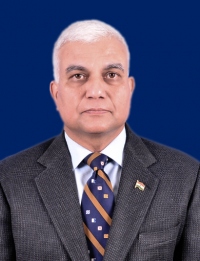


Editor’s note. At the Goa Maritime Conclave in October 2023, on behalf of the Indian Naval Despatch Foundation (INDEF), the Editor-in-Chief of the Indian Naval Despatch, Rear Admiral Sudarshan Shrikhande (Retd.), had a wide-ranging discussion with Brigadier Michael Rosette, Chief of Defence Force, Seychelles People’s Defence Forces. The gist of the discussion is carried here, edited for brevity and clarity. In the format, CDF denotes Brigadier Michael Rosette and the EIC is as above. Captain Himadri Das of the INDES team, and part of the Naval War College, Goa, facilitated recording and transcription.
EIC: Thank you, Brigadier Michael Rosette, for your time to interact with the Indian Naval Despatch, which is part of the Indian Naval Despatch Foundation. We are modestly trying to increase the reach and the depth of what our journal brings to the Indo-Pacific canvas and beyond, and hope that through its pages we help create more cooperative efforts. We will always welcome articles from the personnel of your armed forces and other agencies, as well as Seychellois scholars. So, to begin with, would you share your views on what inputs you might have brought to the Goa Maritime Conclave, and what outcomes do you see for the region as a whole, and from and for Seychelles in particular as an important player in the region?
CDF: Thank you, Admiral, for inviting me for this interview, which I think is very important. Of course, as you rightly mentioned, there is a need for contribution to this journal. Seychelles, as a small island developing state, feels that we should also be part of this global cooperation within the region, with our main focus as an island nation and an archipelagic state. Maritime security is primordial for our survival in that part of the Indian Ocean. We have seen a sharp increase over the years in many illegal maritime activities which threaten both the economy of Seychelles and its survival itself. So, this year in the Goa Maritime Conclave, we have discussed a lot about cooperation within the region, particularly to harmonise certain legislation. And of course, the courses of action that we have to undertake are either bilaterally or multilaterally, which would of course reduce the amount of illegal activities that are ongoing in our region. There are various organisations and dialogues which exist, and Seychelles is a party to some of them. I can name a few. Among them are the Goa Maritime Conclave itself; the Combined Maritime Forces (CMF) based in Bahrain; the IONS, the Indian Ocean Naval Symposium. In addition, we’ve got the Indian Ocean Commission (IOC). All these organisations have varying components of maritime security and there is some duplication. We need to have a common effort to be able to tackle the issue of illegal activities within the greater Indian Ocean; and of course India is a major player in terms of assisting some other countries and by conducting joint exclusive economic zone (EEZ) patrols, assisting smaller countries with equipment and training that enhances capacity and brings most of the smaller countries to a higher level of effectiveness. Of course, understanding what is happening in the region is very important, and a forum like the Goa Maritime Conclave gives us this opportunity to discuss these issues. We need to better understand them and how we find solutions to them. So, this is the perspective.
EIC: That was actually a big canvas which you have unfolded for us. The cooperative canvas and Seychelles’ own efforts and wide-ranging participation are indeed very valuable. Speaking of our bilateral relationship, I know you’ve been heading the Quarterly Defence Coordination Committee meetings. So, within this larger canvas, how do you see this committee, which reviews and plans quarterly tasks, and perhaps explain the satisfaction that you may derive in knowing that Seychelles and India, as part of this larger grouping, work towards overall cooperative security in the committee which you chair?
CDF: Yes, of course. Actually, this committee we’re discussing is not only about the cooperation between India and Seychelles. And I think we have moved ahead quite a long way since we started this committee. We have discussed various issues bilaterally within the larger framework. Among them are issues concerning maritime safety and maritime security; we have discussed equipment, what Seychelles requires and how India could assist. We also have discussed a lot about training, particularly training for the crew for the Coast Guard and the crew for the Dornier aircraft which was donated by India. And of course, I think it is the right forum and it is the right way to do things. We do it in a very frank and cordial manner. And we are satisfied with the way it is going.
EIC: In terms of illegal, unreported and unregulated (IUU) fishing, are the concerns decreasing or increasing? At the session yesterday some speakers and the audience spoke about the Tuna Commission and the tuna problem; but there are fish beyond tuna and, in many ways, some consumers are eating food from the bounties of the sea today that the world ought to be eating tomorrow and the day after. Those engaged in overfishing and IUU seem to be catching and eating today what may be for tomorrow. So, what are your concerns, especially with Seychelles’ very large EEZ, as you mentioned? It may be a major concern, but do you see that concern reducing because of cooperative effort, or is IUU factually increasing?
CDF: Yes, we have seen an increase in IUU. There’s a lot of effort that has been put into control of the vessels in the Indian Ocean. It is not an easy task because, as you know, normally the culprits are ahead of the law enforcement, and this is what we have seen. We have tried our best in working with our other partners to ensure that all the fishing ports within the region have control over their fishing vessels. We have introduced various means to be able to do that, meaning that any vessel that is licensed within the Indian Ocean should have a sensor, a VMS — vessel monitoring system — based onboard. Once they have a licence we can monitor the movement of that vessel. This is very well controlled right now, very well done, so that, abiding by this system, we can now easily monitor them. However, there are others that still bypass this system and are able to engage in illegal activities. And they have adapted to whatever exists. We have seen that instead of bigger vessels doing illegal activities, we now have smaller vessels which are more difficult to detect and which have no sensors on board. And as you rightly mentioned, there are other types of fish beyond tuna. This type of fishing did not exist within our EEZ before, but now it has become what I may call a very luxurious type of activity, which is sea-cucumber fishing, particularly for the East Asian market, where it is highly sought. The price of sea cucumber is very high, so there’s a big demand for that. We have seen other types of fishing using illegal nets like driftnets, which are banned worldwide right now, but also in our region some are coming for this type of fishing, and this is our main concern right now. So, it’s causing a lot of problems for the region.
EIC: As it was mentioned by some speakers yesterday — either heading navies and maritime services, or veterans, scholars and moderators — there are aspects of illegal activities that lead to larger problems of crime and terrorism. Do you see within IUU some concerns like that which are larger and require cooperative measures from everybody’s angles?
CDF: Yes, we have seen vessels conducting IUU fishing and at the same time being involved in other illegal activities. We do have a certain intelligence and information that some of them might be involved in narco-trafficking, meaning that they would come into the EEZ of Seychelles or close to the EEZ and undertake the transfer of narcotics at the same time. Once the narcotics are dropped off, they will continue with their normal IUU fishing. And of course, there are serious consequences of money raised from drug trafficking. We know where it ends, mainly funding other organisations, illegal organisations like terrorist organisations, that sort of thing. So, definitely there is a link to that.
EIC: I think Seychelles has been participating in the Colombo Security Conclave and, from what I understand, the narcotics issue is one of the major things that it flags and discusses, and I think that you have sent your deputy to represent you in the previous conference and maybe before that also. So, do you see, with the four or five members, a way ahead to try and reduce this, because this is a social problem for individual nations and this could be a social problem for all of us?
CDF: Definitely. I think we will continue this discussion in the Colombo forum. And of course, narco-trafficking is a very big business and affecting most of the countries, but small island states like Seychelles, Comoros, Mauritius and Madagascar as well. Almost a whole generation of youth has been affected by that in Seychelles and Mauritius. We have statistics coming out from UNODC, the United Nations Office on Drugs and Crime. And definitely we need to have a collaborative effort to fight against narco-trafficking. We have been discussing also with Sri Lanka and Mauritius, and we will be discussing it again today with them, particularly to see how we can share information about some of the cartels that we know of. We believe that it is the same people doing the trafficking in Seychelles, Mauritius, Sri Lanka and even the Maldives.
EIC: May I ask for your views on another theme? It relates to your own personal expertise, and years of depth and width that you’ve added to your own hydrographic experience. And not only that, it’s really impressive to see what a central role you have played in international policies that govern maritime regulations which determine EEZs and continental shelves, delimitations and limitations, UNCLOS, and so on. How do you see this sort of bilateral hydrographic cooperation between India and Seychelles going, where your personal expertise and your national interests also play a role?
CDF: Yes, we have signed an agreement with India. India has conducted a few hydrographic surveys in Seychelles and of course India has produced a few charts for us. And we believe that we should continue discussing with India for further cooperation in terms of hydrographic surveys in future. And right now, the charting authority for Seychelles is still the UK; India also wants to be a charting authority for Seychelles. We will discuss with the governments of Seychelles and India at a certain time to bring the UK in so that the three of us could sit down and find a common way forward. But definitely, as maritime traffic and maritime activities increase within the region, hydrography will be a very important component. Also, we need to ensure that Seychelles does abide by the IMO — International Maritime Organization — regulations, and SOLAS, the Safety of Life at Sea Convention, being a signatory. It has to ensure that all its navigational products, including charts and other products, are up to date. As it stands, Seychelles is a small island state, and we don’t have all this capacity to conduct large-scale hydrographic surveys and update all its navigational products; so definitely it would be best to do it within the region. And India, being one of the countries that has this capacity, can definitely assist Seychelles in the future for that.
EIC: Brigadier Rosette, thank you very much for sparing the time; we know you have a very busy schedule for the rest of the day in the Conclave and with bilaterals. On behalf of our very small team at the Indian Naval Despatch and the Indian Naval Despatch Foundation, we wish you a fruitful stay in India and a happy return home.