


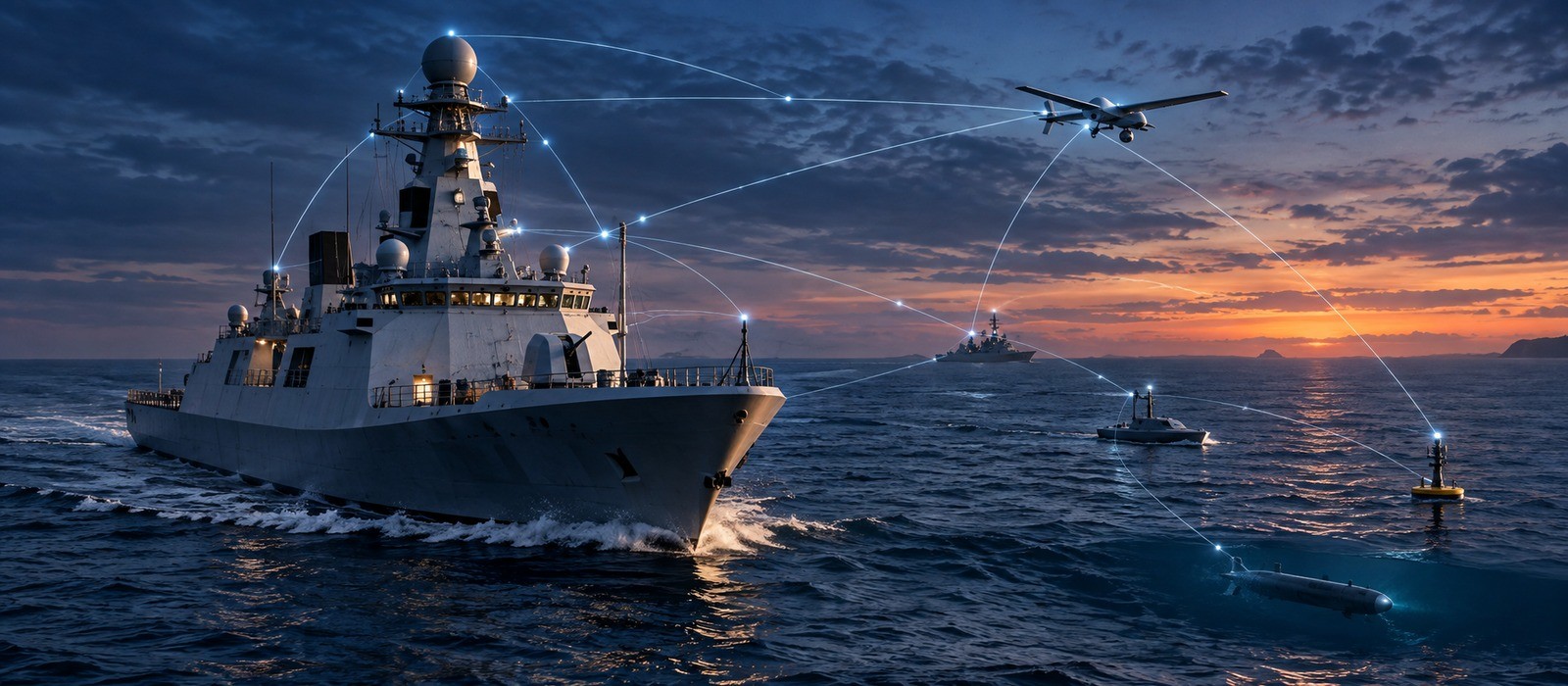


This viewpoint has been received from Capt Vikram Ahuja, an Electrical Engineer by specialisation, on the article, ‘Defence IoT Applications - Creating the Proverbial Ubiquitous Network’ written by Capt Ramraj Verma, published in the Indian Naval Despatch Monsoon 2022 Edition (pp 130-146).
The objective of this review is to further the author’s argument on the opportunities of defence applications of IoT. Rapid advancements in the IT domain have led to an internet revolution and an intellectualised environment, diminishing the limitation of time and space.
The ubiquitous roadmap for IoT networks illustrated in the article includes both Internet of Battlefield Things (IoBT) in C4ISR and intelligence gathering. A matter of consideration can be an IoT coupled with AI as a resource for the management of the Service Vehicle Fleet, augmentation of vehicle health management system, ability to quickly forecast failure in components of the fleet, facilitate location monitoring and incorporate a capability of interactive traffic route management. In furtherance of the GoI’s Defence Artificial Intelligence Council (DAIC) created as part of the Aatmanirbhar Bharat initiative, IoT applications can truly serve as an able platform for setting up smart Naval bases to provide innovative solutions for enhancing security, mobility, energy conservation, weather monitoring, healthcare and infrastructure management.
The author has amply demonstrated capabilities of various IoT enablers for omnipresent network connectivity and recommended solutions that are best suited for Defence IoT i.e. 6LoWPAN, Dash7, Wi-SUN and NB-IoT technology. Some aspects which need further understanding are the architectural framework, Security/privacy overlay and technology imperatives. Whilst the user would largely be convinced of many advantages of IoT, these three verticals require a customised application for the military and specifically for the Navy. To substantiate this, these aspects have been discussed below.
For instance, IoT is an excellent tool and has multifarious modules for application ashore. It would, however, be appreciated that the proliferation of IoT on board ships and frontline platforms will have myriad nuances which would be different from the already existing framework ashore. This would include permission to use wireless networks onboard ships necessitating a transformational change in operations.
At the technological level, certain key imperatives envisaged for IoT implementation are the sheer numbers, variety and requirements of interoperable devices which will need to be connected to the internet. Considering rapid pace of innovation in the IoT domain, it may be difficult to ensure consistent, reliable and secure communication between these devices. Hence, in order to suitably leverage various advantages of IoT, manufacturers will require to develop and adopt common standards, as well as protocols for different devices to communicate and operate seamlessly. Also, a defence IoT application will have to mandatorily incorporate access control, authentication, enhanced resilience to cyber attacks and client privacy as part of the manufacturer’s business model.
In essence, this thought-provoking article has set the tone for the Navy to invest both time and energy in this niche technology so as to harness its full potential. With a realistic understanding of the technology and impending challenges, IoT has the potential to accrue benefits by taking advantage of big data analytics, deep learning, quantum and nano technology for military operations.
