


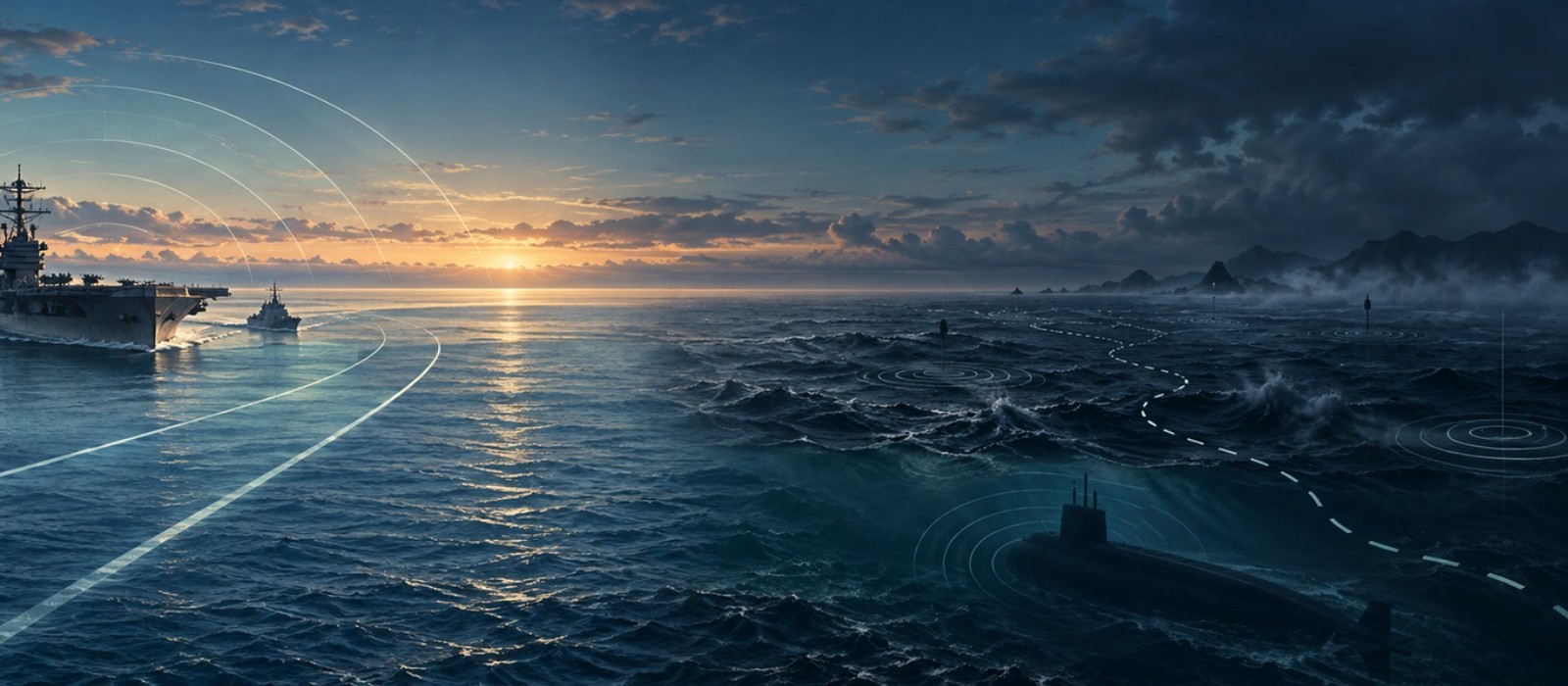


While to other countries, the Indian Ocean is only one of the important oceanic areas, to India it is the vital sea. Her lifelines (sic) are concentrated in that area. Her future is dependent on the freedom of that vast water surface. No industrial development, no commercial growth, no stable political structure is possible for her unless the Indian Ocean is free and her own shores fully protected. The Indian Ocean must therefore remain truly Indian.
-KM Panikkar1
A unique and somewhat fortuitous trait of the maritime domain is that it refuses to be conquered and controlled in the way land can be. However, this has not prevented states from attempting to exert control over large swathes of oceanic space, in a bid to maximise benefits derived from access to the seas and minimise risks that may threaten their interests. Navies have been at the forefront of these efforts, and over time, terms such as command of the seas, sea control and sea denial have entered the lexicon of naval warfare. Efforts to colonise parts of the oceanic space were often driven by the selective reading of exhortations, as that of Panikkar’s above, without taking into account the contexts in which they were made, or subsequent explanations and caveats offered by the author on its interpretation.² The terms sea control and sea denial have also been subject to numerous misinterpretations; a lack of clarity around the meaning and significance of these terms is evident in contemporary literature and commentary on navies and contemporary naval warfare.
This essay examines the evolving context in which the terms “command of the sea,” “sea control” and “sea denial” have been used. The paper acknowledges that interpretations of these terms may vary, and, therefore, does not attempt to offer an authoritative, unified understanding of them. However, it underlines how these terms have been, on occasion, conflated and confused with other concepts related to warfare, and demonstrates how such usage may be counterproductive. In effect, the paper proposes some boundaries around the interpretation of these terms, which could enable their meaningful adoption by navies and nations to achieve their objectives, and for students of naval warfare to draw the right inferences.
Evolution of the Terms Command of the Sea, Sea Control, and Sea Denial
As with many concepts of warfare, the terms command of the sea, sea control, and sea denial were in wide use before they were defined. Of these, command of the sea has the oldest provenance.
Command of the Sea
For whosoever commands the sea, commands the trade; whosoever commands the trade of the world commands the riches of the world, and consequently the world itself.3
The concept of command of the sea has existed at least since the Peloponnesian War of the 5th Century BCE.⁴ Historically, it has characterised a condition where the navy of one nation enjoyed a significant superiority over others, such that it had nearly unhindered freedom of manoeuvre, whilst being able to deny such freedom to other nations. The freedom of manoeuvre thus obtained, extended to the use of seas for purposes of trade, commerce, and warfare.
Alfred Thayer Mahan, the American naval historian and theorist, did not use the term command of the sea directly, but he acknowledged the importance of the concept and described its influence on maritime commerce.⁵ He also identified the challenge of sustaining command of the seas in an increasingly complex maritime environment and stated:
[I]t is the possession of that overbearing power on the sea which drives the enemy’s flag from it or allows it to appear only as a fugitive; and which, by controlling the great common, closes the highways by which commerce moves to and from the enemy’s shores. This overbearing power can only be exercised by great navies, and by them (on the broad sea) less efficiently now than in the days when theneutral flag had not its present immunity.6
Sir Julian Corbett, the British naval historian described command of the sea as “establishing ourselves in such a position that we can control the maritime communications of all parties concerned.”⁷ He further elaborated that the object of all naval warfare was to secure command of the sea and to prevent the adversary from securing it.⁸ Numerous other historians and naval strategists, from Thucydides to Theodore Roosevelt wrote about command of the seas and its importance to success in military campaigns.⁹
Many contemporary commentators often conflate the terms command of the sea and sea control. They are, however, in good company, as even Mahan and Colomb used the terms control of the seas, and command of the seas, interchangeably.¹⁰ Milan Vego attributes the lack of clear understanding between the terms to conflicting and contradictory usage by theorists, as well as the inability of these terms to “convey all its variables in terms of the factors of space, time and force.”¹¹ There is a perception that sea control has displaced command of the sea as a concept since the latter is no longer attainable, or sustainable. While this will be discussed later in the paper, there is no doubt that sea control emerged as a concept, closely related to the idea of command of the sea.
Sea Control
The concept of sea control was first “codified” within the US Navy (USN). When Admiral Elmo Zumwalt took over as the Chief of Naval Operations in July 1970, he initiated Project SIXTY, indicating his intention to present a strategy for the USN within sixty days of assuming office.¹² In September 1970, Zumwalt presented his plan for the Navy to the political executive and the Navy’s leadership. As per this plan, The USN had four primary capabilities, one of which was “Sea Control by our attack submarines, dual-mission carriers, escorts, and patrol aircraft.”¹³ The concept of control of the seas had assumed the avatar of sea control.
Captain Stansfield Turner, the principal author of this strategy explained the rationale behind the transition from “control of the seas” to sea control.¹⁴ He clarified that the term sea control represented a more realistic state of control of a limited maritime area, for a limited period.¹⁵ He stated that with the advent of technology, mainly submarines and aircraft, it had become inconceivable to exercise absolute control of the seas for one’s use or to entirely deny the use of the seas to the adversary. Captain Turner thus articulated the enduring definition of sea control as the ability to assert one’s right to use the seas, whilst denying that right to the adversary within the same time frame and in the area.
Sea Denial
If sea control finds its origins in the concept of command of the sea, sea denial emerges from what Corbett described as “disputing command of the sea.” He elaborated that “a power too weak to win command by offensive operations may yet succeed in holding the command in dispute by assuming a general defensive attitude.”¹⁶ Command of the sea was disputed with two possible objectives. First, to buy time to rectify a temporary shift of naval balance, and second, to undertake a protracted campaign of attrition as a decidedly inferior naval force.
For Mahan, securing command of the sea through battle was the primary role of navies. Whilst he did not use the term disputing command of the sea, he described commerce raiding by single ships and smaller forces - a form of disputing command - as secondary operations.¹⁷ The primary purpose of sea denial is to contest sea control.¹⁸ While it has been rightfully posited as an operational choice for relatively weaker naval forces, it is not the only recourse for such navies. As the next section of this paper will argue, the perception of sea control as the sole prerogative of a stronger navy, and sea denial as the only viable option for a relatively weaker naval force, is disingenuous.
Contextualising Command of the Sea, Sea Control and Sea Denial in the Contemporary World
It is evident that through the history of the study of sea power, the terms command of the sea, sea control and sea denial have been interpreted in different ways. A uniform interpretation in the contemporary environment, is, therefore, unlikely to materialise. However, in determining what these concepts mean for a particular state or its navy, it is important to avoid certain pitfalls that conflate doctrine with strategy, the operational and tactical level of warfare with strategy, and peacetime naval operations with those undertaken in times of war.
Arguably the most common misuse of the terms sea control and sea denial is in advocating for a particular country or a navy to have a “strategy” of sea control or sea denial.¹⁹ Mahan, Corbett and almost every naval strategist of repute since, have agreed that the pursuit of command of the seas, sea control or sea denial is a means to an end - the achievement of a condition that allows other, more important developments to occur.²⁰ Achieving sea control allows the exercise of sea control, for instance, allowing safe passage for trade, and military movements, or gaining the ability to project power ashore through an amphibious landing. Similarly, the conduct of effective sea denial operations achieves subsequent objectives such as denying the free flow of trade to the adversary. Another point of agreement amongst sea power theorists is that sea control, in particular, is heavily constrained by space and time, that is, it can be exercised in a limited area for a limited period.²¹ Sea control and sea denial are, therefore, operational functions that contribute to the achievement of strategic ends.
While there is no doubt that strategy informs the type of naval operations undertaken in a theatre, to conflate them is a critical misunderstanding of these concepts. For instance, a strategy of denial does not imply that the navy only requires to undertake sea denial operations. As Colby explains in detail, strategies of denial seek to deter conflict by convincing the adversary that they are unlikely to succeed.²² For militaries, it means demonstrating the capability and intent to defeat the adversary, thereby preventing them from initiating a conflict in the first place, and if such deterrence fails, then be able to impose significant costs on them. In peacetime, capability and intent are signalled, among other things by “presence.” Naval fleets do not exercise sea control in peacetime, as no other entity contests it; just as naval forces do not exercise sea denial in peacetime unless they seek to initiate conflict by disrupting the free flow of trade, and freedom of navigation in the global commons. The ability to deny the adversary the use of the seas in times of war is, without doubt, integral to the strategy of denial, but so is the ability to exercise sea control, where and when required. A strategy of denial, therefore, is not the same as sea denial, and neither is a strategy of punishment the same as sea control. Within the ends, ways and means articulated by strategy, operational concepts such as sea control and sea denial are just two of the assorted means that a state may employ to achieve its security objectives.
The misplaced notion of sea control and sea denial as strategies further engender the erroneous belief that navies should be designed around either sea control or sea denial abilities and that preference for one exists at the expense of the other.²³ Such pronouncements are most visible when debates on the acquisition of certain naval capabilities arise, such as while discussing India’s investment in aircraft carriers, or Australia’s decision to invest in nuclear-powered submarines over conventional ones. The main reason for this misunderstanding is probably the perception that sea control and sea denial are opposite to each other, rather than complementary tasks that a navy may simultaneously undertake in conflict. Navies are generally not designed around tasks that they may be asked to perform, but around capabilities that they can bring to bear in an area of interest. The most efficient and effective manner of delivering such capabilities is to design balanced navies. Balanced naval forces, as Goldrick and Shrikhande point out, are not those that can offer a little of everything, but those that present the most options for a nation to employ, and which have platforms with inherent flexibility to contribute to multiple types of offensive and defensive missions.²⁴
Yet another misinterpretation of the concepts of naval warfare is evident in the frequent categorisation of platforms as sea control or sea denial assets.²⁵ For instance, aircraft carriers are commonly described as sea control vessels, and submarines as sea denial platforms. Admittedly, each type of platform has its unique attributes, which makes it more suitable for certain types of naval operations over others. Submarines, with their unmatched stealth, are highly suitable for covert surveillance of relatively small areas, and interdiction of shipping within their weapon ranges. Aircraft are excellent platforms for surveillance of large maritime spaces, and aircraft carriers are unmatched in their ability to project force on land from seaward. However, submarines are frequently employed in sea control missions, and to project power ashore with land attack missiles. Similarly, large surface combatants may be the best platforms for sea denial operations in some circumstances. As Goldrick and Shrikhande observe, “It is important not to confuse the instruments with their use.”²⁶ Balanced navies, when directed by creative planners, can achieve outcomes that would otherwise have never eventuated, had the view of platforms being either sea control or sea denial assets prevailed. The creative use of short-range missile boats and towing consorts by the Indian Navy to target the Pakistani coast in the war of 1971, is a stellar case in point.
Finally, there is the belief that concepts such as command of the sea and sea control are no longer practicable in an age of asymmetric capabilities, and long-range, land-based and air-launched anti-shipping missiles.²⁷ Admittedly, command of the sea and sea control has been deeply influenced by developments since the age of the sail that Mahan analysed, or the early days of steam, U-boats, and aircraft at sea that Corbett witnessed.
However, before dismissing the contemporary relevance of these concepts, it may be useful to reflect upon some basic characteristics of command of the sea and sea control. A nation may exercise command of the sea in times of peace, such as the British did in the colonial period, and the United States in the post-World War II era. Command of the sea enables but is not a necessary pre-condition for sea control missions in times of war. Both command of the sea and sea control are relative, and will generally be contested. Over time, the ability to contest command of the sea, and sea control, has evolved faster than the ability to exercise them. Therefore, achieving sea control in a particular area and for a given period may be harder now, but that does not make the concept unnecessary, irrelevant or indeed impossible. As McCranie highlights, “command of the sea indicated the degree of leverage a state possessed in the naval domain.”²⁸ It is a strategic condition that affords a significant advantage to a particular navy in times of conflict. In the current environment, China is contesting the United States’ command of the sea, particularly in the Western Pacific. Even as China’s abilities increase, the United States will strive to retain command of the sea, which will be critical to its ability to exercise sea control, should a conflict arise. Therefore, the increasing ability to contest command of the sea in peacetime, and sea control in times of war, does not render these concepts obsolete. Rather, it makes it even more important for countries, particularly those that may not be “sea powers,” to invest thought and resources in the exercise of “sea power.”²⁹ In this context, Rubel states:
“Command of the sea” is a descriptive term. What it describes is a strategic condition, as the world geopolitical environment evolves, so does the nature of the condition that the term describes. Great and broad strategic conditions are not easily encapsulated by a four-word term, so it is both necessary and useful to inquire more deeply into its definition and thus into the parameters of the condition. Such inquiry as we have outlined reveals important relationships between strategic conditions and the nature and use of naval forces.
The Indian Navy and its Perception of Sea Control and Sea Denial
Unsurprisingly, the Indian Navy avoids most pitfalls surrounding the perception of the concepts of sea control and sea denial in its doctrinal articulations.³⁰ India’s Naval Doctrine and its Maritime Strategy document contextualise sea control and sea denial as operational missions for the force, and not as overarching strategies.³¹ India’s Maritime Security Strategy acknowledges the need for the Navy to be capable of conducting both sea control and sea denial operations in its areas of interest and identifies the likely purposes for which such missions may be required, such as developing domain awareness and force protection.³²
There are, however, two potential points of dispute, arising from the perceived role of the operational concepts of naval warfare on force structure. The Indian Navy’s doctrinal documents describe the relationship between force structure and the ability to conduct sea control operations. The wording used in the maritime doctrine and strategy documents has minor but interesting variations. While the Indian Naval Doctrine states, “sea control is the central concept around which the Indian Navy is structured” (emphasis added), the maritime strategy document says, “sea control is the central concept around which the Indian Navy will be employed” (emphasis added).³³ This view of sea control as the main “operational philosophy” of the Indian Navy has been reiterated in multiple public statements.³⁴ The doctrine’s statement on “structuring” the navy around sea control, is also, possibly, a manifestation of this view. While the strategy document is right in identifying sea control as one of the “ways” in the ends-ways-means trifecta, whether it needs to be defined as the central concept is debatable. These statements may also be viewed as the Indian Navy’s attempts to sensitise the domestic civil-political establishment to the need for acquiring large and expensive surface fleet assets, an issue which, rightfully, engenders robust debates across the country.
However, a significant aberration in India’s maritime strategy document is somewhat self-defeating in this endeavour. The document actively associates large surface combatants, such as aircraft carriers, with sea control operations, and submarines with those of sea denial.³⁵ It may be argued that linking the Indian Navy’s core “operational philosophy” of sea control to a fleet designed around aircraft carrier battle groups, is also part of the grand plan to advocate for large surface combatants. However, as this essay argues, such pronouncements tend to constrain the creative and flexible use of platforms for different types of missions. Moreover, by creating a mutually exclusive binary of options for the civilian leadership (sea control and large surface combatants vs. sea denial and submarines), a failure of the navy’s push for acquiring large surface combatants may lead to over-investing in the alternative option of submarines. This is likely to jeopardise the balance within the Indian naval fleet. Therefore, it may be useful for the Indian Navy to disambiguate instruments from their use, and highlight the role of each type of platform in achieving the effects that the country’s political leadership seeks in the maritime domain.
Conclusion
Much has changed in the global maritime environment, and in the means of conducting warfare within this environment, since the concepts of command of the sea, sea control and sea denial were first theorised. In applying these concepts to contemporary naval warfare, we need to acknowledge the altered contexts in which these may be practised, whilst ensuring that their principal elements are not distorted. Command of the sea, as a strategic endeavour, and sea control and sea denial as instruments of operational art, are vital not only for navies to understand and act upon, but more so for policymakers, the academia, and political leadership, all of whom shape a state’s sea power.
The most common misperceptions of these concepts revolve around the conflation of strategy with operational concepts, the tendency to classify navies as sea control or sea denial forces, and the inclination to rigidly view platforms as being suitable for either sea control or sea denial. It is important to understand that sea control and sea denial are two of the many means available to a naval force and that the most effective navies are those that can execute both types of missions adroitly where required.
Author’s Note: This article is dedicated to the memory of the late Rear Admiral James Goldrick, AO, CSC, RAN (Retd.) (1958-2023), with whom I had the benefit of discussing these issues on numerous occasions. Admiral Goldrick had long encouraged me to put my thoughts in writing. Regardless of whether he agreed with my arguments, he would have been most pleased to see this in print. I only regret that I did not complete it in his lifetime and that this paper won’t benefit from his erudite, insightful, and ever-encouraging comments. Fair winds, Sir!
Endnotes
-
KM Panikkar, India and the Indian Ocean: An Essay on the Influence of Sea Power on Indian History (London: Allen and Unwin, 1951), 84.
-
Panikkar goes on to clarify that he does not suggest an imperialistic outlook to the seas, but rather that the Indian Ocean required to be “free” in order for India’s trade and security interests to be preserved. See Ibid.
-
Sir Walter Raleigh, “A Discourse on the Invention of Ships, Anchors, Compass & C,” The Works of Sir Walter Ralegh (Vol. III: Miscellaneous Works) (Oxford: Oxford University Press, 1829), 825.
-
Kevin D. McCranie, Mahan, Corbett, and The Foundations of Naval Strategic Thought (Annapolis, Maryland: Naval Institute Press, 2021), 106.
-
Robert C. Rubel, “Command of the Sea: An Old Concept Resurfaces in a New Form,” Naval War College Review vol. 65, no. 4 (2012), 22.
-
Alfred Thayer Mahan, The Influence of Sea Power Upon History 1660-1783 (12th Ed) (Boston: Little, Brown and Company, 1918), 138.
-
Julian S. Corbett, Green Pamphlet, CBT 6/16, as quoted in McCranie, Op Cit., n.4, 107.
-
Julian S. Corbett, Some Principles of Maritime Strategy (1st Ed) (London: Longmans, Green and Co., 1918), 91.
-
McCranie, Op Cit., n.4, 106-7.
-
McCranie, Op Cit., n.4, 106-7.
-
Milan N. Vego, Maritime Strategy and Sea Control: Theory and Practice (London: Routledge, 2016), 38.
-
For complete details of Project SIXTY see John B. Hattendorf, ed., U.S. Naval Strategy in the 1970s: Selected Documents (Rhode Island: Naval War College Press, 2006).
-
Ibid., 4-6.
-
Turner later rose to be a Vice Admiral and was president of the US Naval War College as well as Director of the CIA.
-
Stansfield Turner, “Missions of the U.S. Navy,” Naval War College Review vol. 27, no. 2 (1974), 7.
-
Corbett, Op Cit., n.8, 188.
-
McCranie, Op Cit., n.4, 155.
-
Milan N. Vego, Maritime Strategy and Sea Denial: Theory and Practice (Boca Raton, FL: Routledge, 2018), 104.
-
See, for instance, Suyash Desai, “India’s Approach to the Indian Ocean Region: From Sea Control to Sea Denial,” The Diplomat, 09 March 2020, https://thediplomat.com/2020/03/indias-approach-to-the-indian-ocean-region-from-sea-control-to-sea-denial/; Abhijit Singh, “What should India’s Maritime Strategy Be?,” https://navalinstitute.com.au/what-should-indias-maritime-strategy-be/, accessed 20 February 2023; Ajai Shukla, “Sea Control, or Sea Denial? Defining India’s strategic intent in the Indian Ocean,” 05 September 2022, https://www.ajaishukla.com/2022/09/sea-control-or-sea-denial-defining.html, accessed 20 March 2023.
-
See, for instance, McCranie, Op Cit., n.4, and Robert C. Rubel, “Talking about Sea Control,” Naval War College Review vol. 63, no. 4 (2010). https://digital-commons.usnwc.edu/nwc-review/vol63/iss4/6; Vego, Op Cit., n.18. Milan N. Vego, Exercising Control of the Sea: Theory and Practice (London: Routledge, 2021).
-
Richard Dunley, “Is sea denial without sea control a viable strategy for Australia?,” The Strategist, 10 August, 2019. https://www.aspistrategist.org.au/is-sea-denial-without-sea-control-a-viable-strategy-for-australia/, accessed 20 March 2023.
-
For a detailed description of the strategy of denial, see Elbridge A. Colby, The Strategy of Denial: American Defense in an Age of Great Power Conflict (Yale: Yale University Press, 2021).
-
Desai, Op Cit., n.19; Singh, Op Cit., n.19.
-
James Goldrick and Sudarshan Shrikhande, “Sea Denial is not Enough: An Australian and Indian Perspective,” The Interpreter, 10 March 2021. https://www.lowyinstitute.org/the-interpreter/sea-denial-not-enough-australian-indian-perspective, accessed 20 March 2023.
-
Suyash Desai, “Sea Control or Sea Denial: Does India Really Need Another Aircraft Carrier?,” News 18, 07 September 2022. https://www.news18.com/news/opinion/sea-control-or-sea-denial-does-india-really-need-another-aircraft-carrier-5905615.html, accessed 20 March 2023.
-
Goldrick and Shrikhande, Op Cit., n.24.
-
See, for instance, Hugh White, “How to Defend Australia,” The Strategist, 02 July 2019. https://www.aspistrategist.org.au/how-to-defend-australia/; Abhijit Singh, “Aggressive Sea Control isn't an Option for India,” The Interpreter, 17 March 2021. https://www.lowyinstitute.org/the-interpreter/aggressive-sea-control-isn-t-option-india-s-navy; Rahul Bedi, “Why Indian Navy's Proposal to Acquire a Third Aircraft Carrier May Not Materialise,” The Wire, 05 December 2020. https://thewire.in/security/navy-third-aircraft-carrier-proposal-materialise-submarine, accessed 20 March 2023.
-
McCranie, Op Cit., n.4, 110.
-
For the distinction between “Seapower” and “Sea Power”, see Andrew D. Lambert, Seapower States (Yale: Yale University Press, 2018).
-
The Indian Navy has been described as the “Most Strategic-Minded of the Three Services,” and has been credited with producing quality doctrine despite being somewhat of a “Cinderella-service.” See Iskander Rehman, “India's Aspirational Naval Doctrine,” The Rise of the Indian Navy: Internal Vulnerabilities, External Challenges, ed. Harsh V. Pant (London: Routledge, 2016), 55.
-
Indian Navy, Indian Maritime Doctrine (New Delhi: IHQ MoD (Navy), 2015), 77; Indian Navy, Ensuring Secure Seas: Indian Maritime Security Strategy (New Delhi: Directorate of Strategic Concepts and Transformation, 2015), 60.
-
Ensuring Secure Seas, Op Cit., n.31, 72.
-
Indian Maritime Doctrine, Op Cit., n.31, 77; Ensuring Secure Seas, Op Cit., n.31, 72.
-
Sanjib Baruah, “It is Important to Achieve Balanced Force Mix- Admiral R Hari Kumar,” The Week, 22 January 2023. https://www.theweek.in/theweek/cover/2023/01/14/indian-navy-chief-admiral-r-hari-kumar-interview.html, accessed 20 March 2023.
-
Ensuring Secure Seas, Op Cit., n.31, 72-73.
