


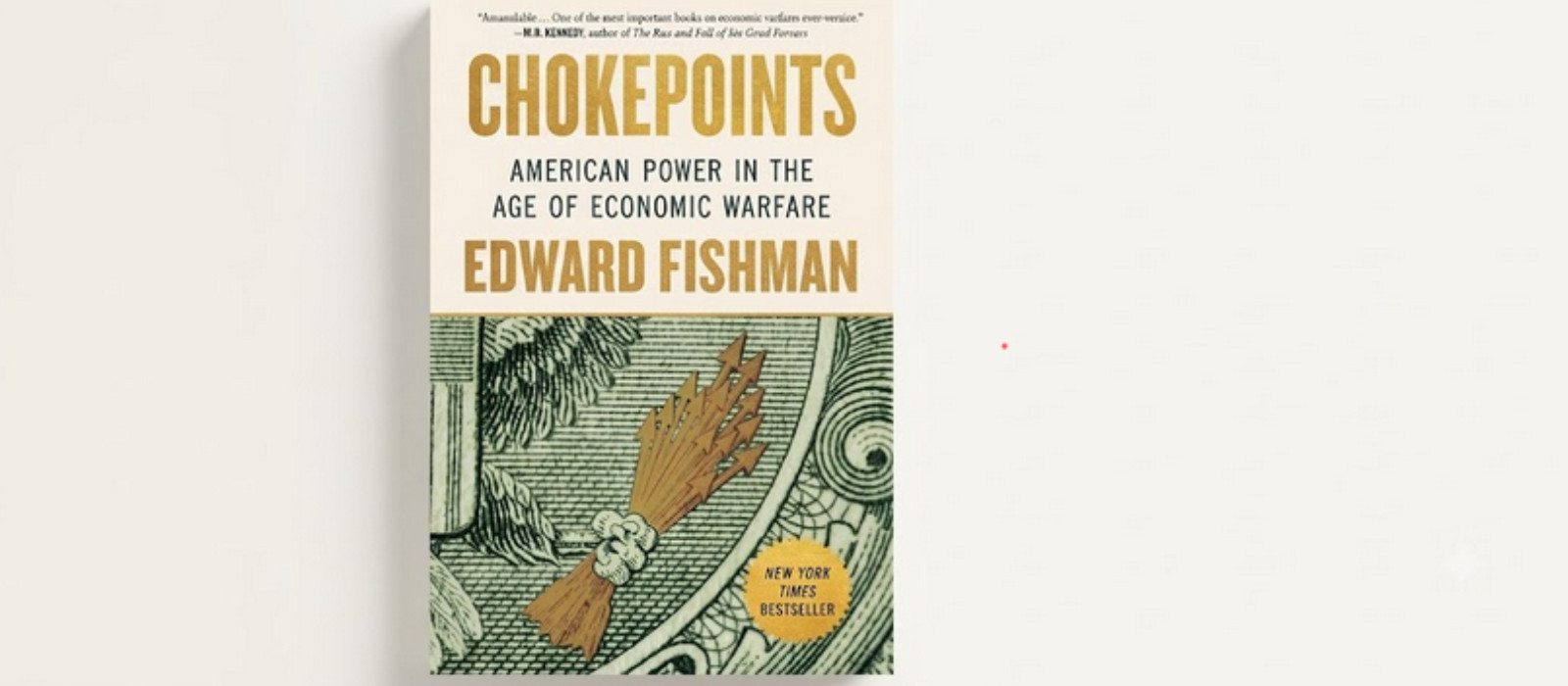


Chokepoints – American Power in the Age of Economic Warfare
Author: Edward Fishman Published by: Penguin Group, Edition: 2025
ISBN: 9780593712979 Pages: 560
Book Review by Rama K Rao
Book for the Age of Economic Contest Edward Fishman’s ‘Chokepoints: American Power in the Age of Economic Warfare’ (2025) is a timely and gripping exploration of how nations—particularly the United States—wield economic tools as weapons of war. With economic warfare (aka Tariffs and Sanctions), now a daily feature of international headlines from semiconductor bans to dollar-based sanctions, this book arrives as both a history and a handbook for modern policy practitioners and geopolitical strategists. Historian Paul Kennedy described it as “one of the most important books on economic warfare written” (p. xv). Fishman’s argument is lucid and urgent: economic instruments are now as powerful as military weapons in shaping geopolitical realities. His work is a bridge between finance, strategy, and geopolitics.
Clausewitz II: Economic Warfare as War Without Bloodshed
Clausewitz’s famous maxim, “War is a continuation of policy with other means” is another way of describing the theme of this book. Another great strategist (p7) Sun tzu “The acme of skill is not to win one hundred victories in one hundred battles but to subdue the enemy without fighting” and extends it to suggest that economic warfare is the newest, bloodless battlefield of political power. The stealth, precision, and deniability of these instruments make them uniquely suited for 21st-century conflict. Sanctions, export controls, tariffs, market access barriers, and currency warfare substitute for missiles, warships and tanks. And yet, their effect is often equally devastating. Fishman’s analysis is both strategic and moral: he warns against the unchecked expansion of these tools, cautioning that overuse can generate global blowback and systemic mistrust (p. 417).
Historical Precedents: Oil Embargoes and Boycotts
The reviewer had a personal experience from the 1990s, when working in a U.S. Pharma company, as the customer service manager managing shipping logistics, in navigating the Arab boycott of Israel. Vessels that had docked in Israeli ports faced refusal from Arab nations. This was a powerful, non-violent “chokepoint” used for geopolitical leverage. This illustrates Fishman’s key argument that chokepoints need not be physical, like the Suez Canal or the Strait of Hormuz; they can be bureaucratic, financial, or diplomatic. India, too, has faced similar measures, from the Super 301 sanctions, access rights after its 1998 nuclear tests to more recent tariff threats over Russian oil purchases. These experiences lend credence to Fishman’s thesis that chokepoints are now deeply embedded in the global economic order and is part of the arsenal of the US National Security apparatus
The Architects of Contemporary Economic Warfare: Levey, Cohen, Singh
A compelling thread in the book follows three architects of U.S. economic coercion: Stuart Levey, David Cohen, and Dalip Singh. Fishman chronicles how these policy mandarins crafted and fine-tuned sanctions mechanisms that have shaped global finance. Given the audience, the reviewer has chosen Daleep Singh, one of the most prominent, combining technical acumen (ex-MIT Graduate) with political savvy. His warnings to India in 2022—urging New Delhi not to deepen ties with Moscow—are cited in the book as indicative of America’s hardening stance (p. 361). Singh’s insight into the Russian financial sector allowed for devastatingly targeted sanctions that crippled capital inflows, restricted banking channels, and exploited Russia’s dependence on dollar markets. When Singh visited India (p 361), he remarked to the Indian policymakers, “America has been on the wrong side of history many times and he had come to urge India– my ancestral home- not to be on the wrong side of history now”. He offered Washington’s support in replacing the arms and energy bought from Russia. In a more pointed comment, he “warned countries not to circumvent American sanctions against Moscow”, hours before Sergei Lavrov’s visit. Some media folks in India gave him the moniker, “Sanctions Singh”.
Weapons of Choice: The U.S. Dollar, SWIFT, and Silicon
Fishman outlines an arsenal that includes dominance over SWIFT, exclusion from US capital markets, and technological restrictions, particularly in semiconductors. By targeting firms like Huawei and weaponising export licenses for NVIDIA’s advanced GPUs, the U.S. has created strategic bottlenecks for its rivals. Fishman explains how Russia’s economic collapse post-2014 was precipitated by restricting Gazprom, Rosneft, Sberbank, and others from accessing Western finance (pp. 295–303). The sanctions led to a near-instantaneous collapse of the rubble, exposing the fragility of economies built on global interdependence. Fishman is particularly insightful in showing how these chokepoints are not merely reactive but are engineered with intent and precision. It was not surprising that China, in turn, weaponized its monopoly over rare earths and delivered its own message to the US in its tariff battle.
Reactions and Countermeasures: Russia, China, and India
Fishman notes that every chokepoint invites innovation in evasion. Russia has turned to alternative clearing houses; China has advanced CIPS (Cross Border Interbank Payment System) to rival SWIFT and is aggressively pursuing yuan/renminbi internationalization. India, meanwhile, has showcased the reach of its UPI digital payment platform, now active in the UAE. These efforts are not merely technical; they are political statements of sovereignty and resilience. Fishman’s strength lies in unpacking these complexities with clarity. As the reviewer observed at Dubai airport, the rise of UPI in a foreign jurisdiction signals the shifting sands of payment geopolitics and the potential for loosening of the dollar’s grip.
The Impossible Trinity: Fishman’s Core Takeaway message
At the heart of ‘Chokepoints’ is a provocative thesis: states cannot simultaneously enjoy economic interdependence, economic security, and geopolitical rivalry. Two may coexist; all three cannot. This ‘impossible trinity’ is the conceptual contribution that elevates the book beyond a journalistic account. Fishman compares sanctions to antibiotics, useful when applied correctly, but dangerous if misused. Policymakers in Washington, Brussels, and Beijing must recognise that excessive economic warfare may erode the very foundations of the global financial system (p. 417). Sanctions could lead to debilitating changes.
A Narrative of Strategy and Statecraft
What distinguishes Fishman’s book is its literary flair. He constructs his arguments like a strategist and writes like a Bollywood storyteller. The dramatis personae—Singh, Levey, Cohen—emerge not just as technocrats but as US crusaders wrestling with the weight of their decisions. His prose, taut yet evocative, transports the reader from boardrooms in Washington to shipping lanes in the South China Sea. Even complex issues like capital controls and semiconductor policy are rendered comprehensible through narrative and metaphor. This is not merely a book about economic policy; it is a study in raw geopolitical and modern power.
Conclusion: Why India and Others Must Read This Book
Fishman’s ‘Chokepoints’ is essential reading for any Indian policymaker, academic, or strategist. As India deepens its global footprint, be it through its “Vishwa guru/Vasudeva Kutumbakam” or G20 leadership, digital diplomacy, or trade diversification, it must anticipate and design solutions around possible chokepoints. The U.S. may wield them today, but others may do so tomorrow. For nations in the Global South, understanding these tools is the first step toward building resilient systems. Fishman’s work is both a diagnosis and a blueprint. His final message is “Every age contains its seeds of destruction.” Perhaps we all have a responsibility to avoid that outcome, don’t we?
