


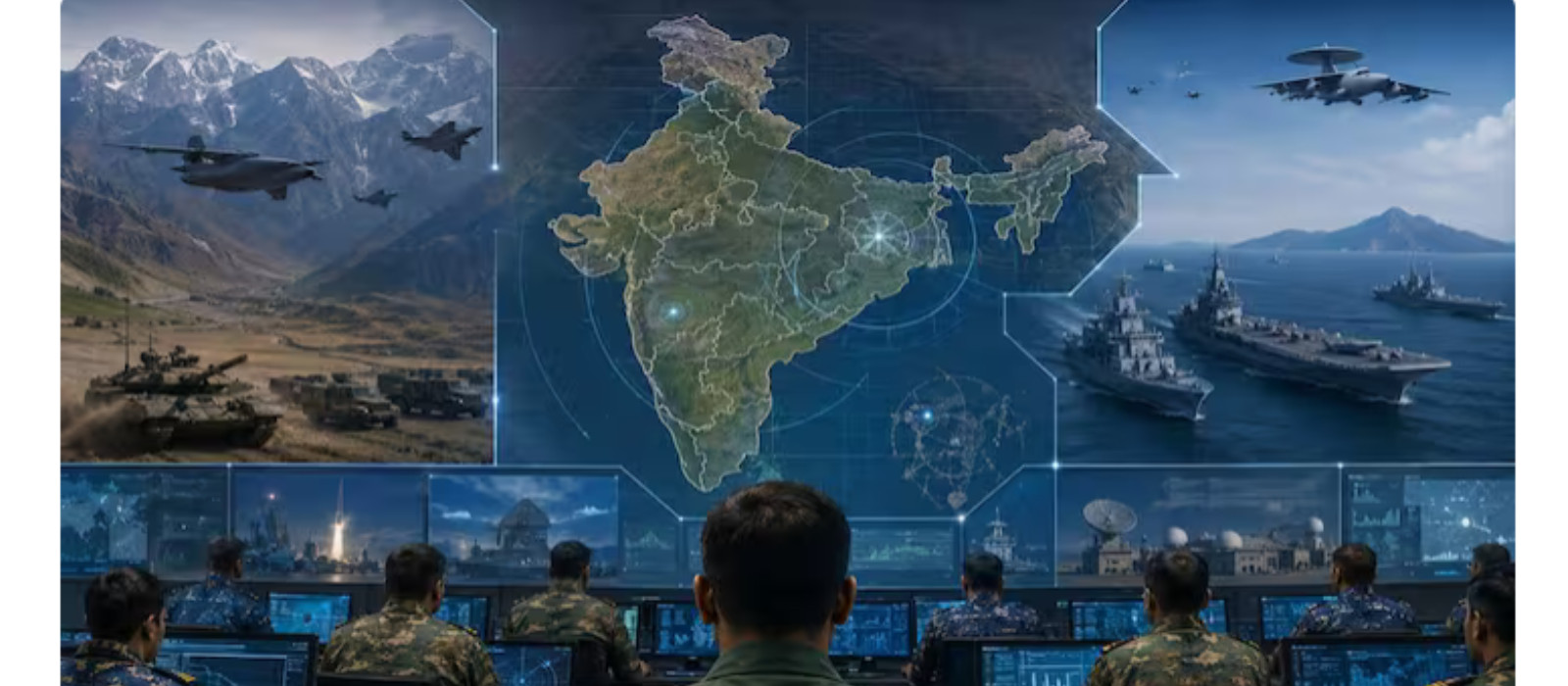


“Some of our leaders want to build a wall against the hurricane…my argument is that you have to build an eye that moves with the storm.”
— Thomas Friedman, Jan 10, 20171
Abstract: Disruptive technologies have always been instrumental in reshaping the armed forces' capabilities worldwide. The latest disruptor, Artificial Intelligence (AI), integrated with conventional warfare, autonomous and cyber weapons, and space weaponisation, can mean the difference between victory and defeat. Although initially slow to adopt AI, India is rapidly advancing to harness AI for national security.
This paper explores the need to incorporate AI into the Indian defence ecosystem. It examines how AI can revolutionise Intelligence, Surveillance, and Reconnaissance (ISR), enhance data management, bolster counterterrorism, and protect personnel. It addresses AI deployment's challenges and ethical implications and proposes governance strategies for transparency, accountability, and fairness. The paper also underscores the importance of building synergy within the Armed Forces and fostering collaborations between the defence industry, the AI research community, and policymakers.
Introduction
AI offers opportunities to augment human intelligence profoundly, making all the outcomes of intelligence, from new medicines to solutions for climate change and even technologies to reach the stars, more agile and precise. However, there must be a concerted effort to understand AI more deeply. This is particularly relevant when considering the integration of this disruptive technology into the armed forces. In 2018, the first comprehensive roadmap for AI implementation in the Indian Armed Forces was developed with the active participation of industry leaders. The Ministry of Defence established a task force to explore how AI could be effectively leveraged in defence. Over the past five years, the Indian defence has taken the first measured steps in becoming AI-prepared, establishing a robust foundation for future advancements. A roadmap prepared by the Defence AI Project Agency (DAIPA) kick-started the development of AI-driven applications in Defence Public Sector Undertakings (DPSUs). Over 75 products were showcased in the July 2022 event, AiDef (Artificial Intelligence in Defence), an ambitious transition model for defence-private partnerships in technology development.
This paper outlines the imperative for integrating AI into the Indian defence sector, positioning it as a global leader in AI-powered armed forces. We address the need for AI adoption amidst potential conflicts, emphasizing a maturity roadmap for establishing a cutting-edge AI ecosystem. The exploration extends to autonomous weapon systems, which could revolutionize Intelligence, Surveillance, and Reconnaissance (ISR), combat strategies, data management, counter-terrorism, and personnel protection. Ethical considerations are paramount, and we propose governance strategies for transparency, accountability, and fairness. Additionally, fostering synergy within the armed forces, promoting defence industry collaborations, and encouraging international knowledge exchange in military AI are key objectives.

Fig 1: Roadmap of AI Adoption in the Indian Armed Forces2
The Impact of Emerging and Disruptive Technologies (EDT) on India’s Defence
The military lens provides a fascinating perspective on Emerging Disruptive Technologies (EDTs). According to the NATO Science and Technology Organisation, EDTs encompass technologies or scientific discoveries expected to significantly impact NATO’s defence, security, or enterprise functions. Among the key disruptive technologies are quantum tech, AI, robotics, autonomous weapons, big data analytics, hypersonic weapons, space tech, advanced materials, energy weapons, biotechnology, neuroscience, telecom, the metaverse, and blockchain. Notably, China, Russia, and the US have pioneered their adaptation for military use. For the Indian Armed Forces, robust cybersecurity infrastructure and high-performance computing systems are essential for swift, deep, and secure AI adoption. Equally critical are advanced data analytics capabilities, cutting-edge machine learning algorithms, and reliable, scalable networks. AI presents novel opportunities to enhance resilience and effectiveness. To gain a comprehensive perspective on AI’s current state and future potential in the Indian defence ecosystem, the authors engaged thought leaders from the armed forces, senior industry professionals, policymakers, AI consultants, and Ethical AI researchers. These conversations, free from inherent biases, have enriched our collective knowledge, enabling us to chart a prudent and pragmatic path toward building an effective AI ecosystem for our forces.
AI offers the Indian Armed Forces new opportunities to enhance resilience and effectiveness. To gain a comprehensive perspective on the current state and future potential of AI in the Indian defence ecosystem, the authors conducted a survey involving thought leaders from the Indian armed forces, senior industry professionals, policymakers, AI consultants, and researchers focused on Ethical AI. Conversations with these thought leaders have balanced innate biases and augmented the individual knowledge base, enabling us to elucidate a prudent and pragmatic perspective plan for building an effective AI ecosystem in the Indian Armed Forces.
Emergence of Asymmetric Threats
In a 2007 speech at the French Institute of International Relations, General Bernard Thorette, former Chief of Staff of the French Army, said, "Our armed forces now face fragmented, even atomised states and societies, with complex ramifications that encourage the emergence of small, determined groups. These threats are far from primitive, as evidenced by the widespread use of Improvised Explosive Devices (IEDs) in stabilisation operations."3 The use of technology in asymmetric threats has revolutionised modern warfare. Using autonomous vehicles for precision strikes further complicates the threat landscape, enabling non-state actors to conduct targeted attacks with minimal risk, reshaping conventional warfare and testing defence strategies.
The Houthis in Yemen exemplify asymmetric warfare by non-state actors, leveraging drones for intelligence gathering, precision strikes, and blockading the Red Sea, effectively disrupting global trade and challenging traditional military forces.4 Their ability to conduct high-impact attacks with relatively low-cost technology has been reportedly supported by Iran.5 Similarly, the Russia-Ukraine conflict has witnessed the innovative use of AI and drones by civilians for reconnaissance and tactical operations. Civilians in Ukraine have employed commercial drones for real-time intelligence and coordinating artillery strikes, significantly impacting battlefield dynamics.6
These developments highlight a significant shift in warfare, where advanced technologies enable smaller non-state groups and civilian actors to influence battlefield outcomes, reshaping global security dynamics and blurring the lines between combatants and non-combatants. Hackers can also act as auxiliary forces, targeting infrastructures and causing damage. Information wars exploit networks to destabilise societies, while deep fakes and cyber-attacks pose significant challenges. These threats disrupt critical infrastructure, compromise data, and spread misinformation.
To counter these, the Indian Armed Forces must adopt AI swiftly, investing in autonomous systems for precision strikes, advanced counter-drone technologies, and robust cyber defences. Building a highly skilled cyber workforce through targeted recruitment and continuous training is crucial. While the Armed Forces provide basic cybersecurity training, the rapid evolution of threats outpaces their current capabilities. Therefore, advanced education through established certification programs such as the ones offered by the Information Systems Audit and Control Association (ISACA), SysAdmin, Audit, Network and Security (SANS), and International Information System Security Certification Consortium (ISC2) are recommended to ensure deeper and more comprehensive expertise.
The Catch-Up Game
India urgently needs to accelerate AI adoption in its armed forces. However, as far as AI algorithms and applications are concerned, the domains of Indian defence, viz. sea, land, air, space and cyber, operate in silos, with individual goals and needs that are not always aligned, even within each force. Overcoming this fragmentation requires a unified approach to integrating new technologies and creating a cohesive AI adoption strategy. Common Qualitative Requirements (QRs) and, before that, a convergence of needs will allow common engines to be built, which can then be trained on different data sets, keeping in mind the three forces' unique roles, strategies, and tactics.
To ensure that AI adoption within the Indian Armed Forces is neither cost-prohibitive nor excessively time-consuming, it is essential to leverage and adapt commercial products and applications for defence purposes. Given that AI has advanced more swiftly and achieved greater penetration in the civilian sector, a strategic approach is necessary to bridge this gap. This entails a concerted effort to identify and adapt valuable components from the commercial world, including engines, algorithms, storage solutions, and expertise.
By integrating proven commercial AI technologies and solutions, the Indian Armed Forces can expedite the deployment of advanced AI capabilities. This approach reduces development time and costs and ensures access to cutting-edge innovations that have already demonstrated their effectiveness in civilian applications. Allocating investments and resources to expand the AI-EDT portfolio necessitates well-researched decisions, starting with improving AI awareness among defence personnel through frequent training. The culmination of these efforts should result in the creation of a specialist AI cadre. The responsible use of AI also demands introspection, debate, and alignment within the forces and, more importantly, with the political leadership. With India being a long-time proponent of 'Vasudhaiva Kutumbakam' and the 'No First Use' policy for nuclear weapons, the Armed Forces must consider whether a similar philosophy will guide our AI use cases or if the approach will change given the constantly lowering costs of asymmetric warfare.
Deep consideration is needed for the decision matrix of AI engines. What level of autonomy is acceptable for autonomous lethal weapons? Will the 'kill decision' be delegated to AI, or will it remain with human operators? AI's role in the military is often highlighted for its ability to distance humans from the battlefield, both physically and psychologically. Deploying highly autonomous AI agents thus involves significant socio-technical and psychological challenges. Using anthropomorphic terms like 'ethical, intelligent, and responsible' for machines can create the misleading notion that AI possesses moral reasoning, compassion, empathy, and mercy. This misconception risks leading to the belief that AI could act more ethically and humanely in warfare than humans, shifting AI from a support tool to a perceived moral authority.7
Humans must make the first level of decisions while designing and training engines. For example, what probability level will be set in a hypothesis test that determines ‘friend’ or ‘foe’? Most judicial systems operate at a 95% confidence level, accepting type II errors (an innocent person should not be punished, even if a guilty person might go free).8 Should AI systems follow a similar logic and 'err on the side of caution', or would they need to 'err on the side of aggression'?
For defence purposes, 'erring on the side of aggression' is preferable, but the final 'kill decision' must rest with a human operator. Clear accountability between manufacturers and operators is crucial, emphasising transparent human-machine handover procedures and documented activity timelines. Explainable AI is essential for operators to understand decision-making logic, fostering greater trust between humans and machines. Adopting global standards for safety, privacy, and ethics and prioritising indigenous development of LAWS to avoid foreign dependency are essential measures. These steps ensure the ethical deployment of AI in the armed forces, upholding human dignity and values even in machine operations.9 However, deeper introspection and debate with all concerned stakeholders are necessary before achieving alignment.
AI Adoption – Possibilities and Challenges
The AiDef event in July 2022 showcased significant advancements in AI adoption for the Indian armed forces. This was a natural extension of the Hon’ble Prime Minister’s call for developing a vibrant ecosystem encompassing research, design, development, and manufacturing within the country for a strategic edge.10 The event featured 75 products spanning various areas such as AI platform automation, unmanned robotic systems, blockchain-based automation, C4ISR systems, cybersecurity, human behaviour analysis, intelligent monitoring systems, lethal autonomous weapon systems, logistics and supply chain management, manufacturing and maintenance, operational data analytics, perimeter security systems, process flow automation, simulators and test equipment, and speech/voice analysis systems using NLP.11
A 2021 IBM survey revealed that 49% of global defence organisations had already implemented AI solutions in real-world operations, and they were actively deployed in military operations in Afghanistan, Iraq, and Syria. 59% of these organisations had an AI strategy, 67% had a data or information strategy, and, most importantly, 42% had a framework for deploying AI.12
Indian Defence understands that AI has the potential to revolutionise military operations by replacing large war-fighting machines with smaller, more agile alternatives, thereby enhancing strategic mobility, responsiveness, and adaptability. However, to bridge the technology and time gap with the leading nations, there’s an urgent need for the Indian armed forces to redefine resource allocation and reshape the conventional military paradigm. The impact of AI-driven autonomous weapon systems is increasingly significant, transforming ISR, combat strategies, counter-terrorism measures, and personnel protection. Rapid deployment of AI technologies in defence hinges on investments in R&D, digital infrastructure, and data pipelines.
Challenges in AI adoption include data security, limited digital infrastructure, and a talent-skill gap. Andrew Ng, a pioneer in the field of machine learning, advocates for a "data-centric" approach to AI. He argues that the quality and quantity of data are critical to the success of AI systems. This shift in focus towards data rather than just algorithms highlights the importance of large, high-quality datasets in training effective AI models.13 The biggest challenge for Indian defence would be to make this data available to AI engines. This journey will begin with a common data framework and end at the crossroads that forces us to think beyond ‘Secret’ and ‘Confidential’ stamps.
The Journey So Far
The Ministry of Defence (MoD) has invested significantly in AI, allocating INR 100 crores to each service for AI implementation and setting development targets for the Defence Public Sector Undertakings (DPSUs). An additional INR 100 crores has been given to DAIPA to establish standards, SOPs, IP policies, and select strategic AI partners. Two DRDO labs, CAIR and DYSL, focus on application-oriented AI research, with AI technology groups in all DRDO system labs to integrate AI into existing products. The Innovations for Defence Excellence (iDEX) initiative promotes self-reliance and technological innovation in defence and aerospace with a budget of INR 500 crores over five years (2021-2026).
The Indian Armed Forces have indeed embraced the potential of artificial intelligence (AI) across their branches.
Indian Navy
-
The Indian Navy recognizes the importance of AI in enhancing its capabilities. As part of the ‘2015-2030 Indian Naval Indigenisation Plan (INIP),’ the Navy prioritizes AI adoption.
-
INS Valsura hosts a Centre for Excellence and Big Data Analysis lab, emphasizing data-driven insights.
-
An MoU with Bharat Electronics Limited (BEL) established a Technology Incubation Forum. This collaboration aims to develop AI, quantum computing, autonomous platforms, robotics, and cognitive radio under the Atmanirbhar scheme.
-
The Navy’s AI Incubation Cell at BEL, Bengaluru, focuses on researching AI features for future weapon systems and implementing best practices for maintenance management.
Indian Air Force (IAF)
-
The IAF employs AI semi-autonomously in Unmanned Aerial Vehicles (UAVs). Future plans include advancing to Unmanned Combat Aerial Vehicles (UCAVs) for Intelligence, Surveillance, and Reconnaissance (ISR).
-
The 2022 inauguration of the IAF’s Centre of Excellence (CoE) for AI under UDAAN signifies a strategic move toward integrating AI into operational strategies.
-
AI applications within the IAF will support threat monitoring, data intelligence, training, and decision support. However, challenges remain in training models for unpredictable combat scenarios.
Indian Army
-
The Army’s Army Technology Board (ATB) actively introduces emerging technologies, including AI. Their focus areas include situational awareness, sensor fusion, and autonomous weapons systems.
-
The Defense Research and Development Organization (DRDO) has developed AI-enabled systems like the Remotely Operated Vehicle (ROV) Daksh, UAV Netra, Surveillance Remotely Operated Vehicle (SROV), and Unexploded Ordnance Handling Robot (UXOR).
-
The Military College of Telecommunications Engineering (MCTE) houses an AI Center for Excellence, emphasizing situational awareness, sensor fusion, autonomous weapons systems, and faster decision-making.
-
These efforts underscore India’s commitment to leveraging AI for defense and security, fostering innovation, and staying at the forefront of technological advancements.
Priority areas for AI adoption in the Indian Armed Forces include enhancing hardware scalability and performance and increasing system adaptability in dynamic environments. Currently, efforts focus on basic Large Language Model (LLM) engines due to their cost-effectiveness, immediate benefits, and alignment with global trends. However, LLMs face challenges like scalability, context awareness, pattern detection, and limited performance in multimodal data environments. These constraints underscore the need for more advanced and versatile solutions to meet the growing demands and complexities of future applications.
Missing Synergy Within the Defence Ecosystem
While the initial steps taken by all three services are promising, there is a clear lack of convergence in ideas, cross-pollination of requirements, and efforts to find common ground that could lead to economies of experience and scale. Despite the shared goal of integration, persistent challenges have hindered the synergy among India’s armed forces. Varying Standard Operating Procedures (SOPs), disparate technologies, and divergent organisational cultures have all contributed to the slow progress in achieving true collaboration.
Considering these challenges, advocating for effective collaboration among the three services in AI—a nascent and unproven technology—may seem ambitious. However, since data is the cornerstone of any successful AI system, all three services could significantly benefit from establishing a common data centre. This is crucial as most armed forces' data is classified and typically accessible only on-premises to preserve strategic autonomy. Establishing common data centres and secure data pipelines would optimise resources and foster integration among various services, with data sharing being the driving force behind this collaboration. This integration could address the critical infrastructure gap of data availability, which currently hinders the advancement of AI in India for both civilian and military applications.
Numerous capable MSMEs showcased on platforms like iDEX, designed to bridge start-ups, academia, and the military, have demonstrated products with significant potential. However, the ‘big breakthrough’ leading to a fully realised AI product or technology remains elusive. Developing AI enterprise solutions with high-end GPU servers and cutting-edge sensors requires substantial capital investment, causing considerable hesitation among MSMEs. Many products custom-developed for the military lack a direct customer in the broader market, making MSMEs reluctant to invest without assurances. A significant issue is the absence of dedicated funds for exploratory AI technologies, which may not always result in a marketable product. This is starkly highlighted by the comparison of expenditure on R&D as a percentage of the total defence budget; India spends less than 1%, whereas China allocates 20%, and the United States 12%.14
The Roadmap for AI adoption Building Tri-Service Synergy
As highlighted in the preceding section, establishing a common data centre would optimise resources and foster essential integration among various services, with data sharing being the driving force behind this collaboration. This integration could address the critical infrastructure gap of data availability, which is currently one of the main obstacles hindering the advancement of AI in India for both civilian and military applications.
The syndicate also advocates for establishing a common ‘AI command’ or ‘tri-service centre of excellence’ for the armed forces. This initiative could significantly enhance AI incubation by consolidating the Army, Navy, and Air Force domain expertise, ensuring that best practices and cutting-edge research are shared and implemented across all branches. By developing a unified data framework, the centre would facilitate seamless data integration and analysis, overcoming the current silos that impede progress.
Furthermore, creating Joint Services Qualitative Requirements (JSQRs) would standardise AI applications, ensuring that they meet the specific needs of each service while promoting interoperability. This structured approach would streamline processes, reduce costs and redundancy, and foster a culture of collaboration and innovation. Such a centre would accelerate the development and deployment of AI technologies and ensure that advancements are made with agility and efficiency to keep up with evolving defence needs and global technological trends.
Self-reliance through Collaboration with Academia and Industry
Military requirements have often driven significant technological advancements that shape global technology. Innovations such as the internet, GPS, and jet engines, originally developed for military use, have found widespread civilian applications, democratising technology. However, the revolution of AI has followed a different trajectory, with its development predominantly driven by industry for commercial reasons. Companies across various sectors, from tech giants to startups, have spearheaded AI research and applications to enhance their products and create new business opportunities.
In light of industry-led innovation, direct collaboration between the military, academia, and industry is essential to adapt and tailor existing AI technology to specific defence needs. While initiatives like AiDEF primarily rely on DPSUs/DRDO for military applications, there’s a compelling case for introducing Public-Private Partnerships (PPPs) with leading technology companies. These partnerships should involve shared resources, co-investment in AI infrastructure, and collaborative development projects, enhancing overall effectiveness.
The imminent overhaul of DRDO, driven by recommendations from the K. Vijay Raghavan Committee, underscores the importance of direct partnerships. The committee has proposed several institutional reforms to address significant delays in over two-thirds of audited projects, including bringing DRDO under PMO oversight, streamlining projects, fostering industry-academia collaboration, and promoting digitisation.15
Given that the Ministry of Electronics and Information Technology (MeitY) is leading AI efforts in the country, it is highly advantageous for the Ministry of Defence (MoD) to collaborate closely with them. The MoD can significantly bolster its AI capabilities by leveraging MeitY's initiatives, policies, and established measures.16 This strategic partnership allows the military to benefit from the existing groundwork, accelerating the integration of cutting-edge AI technologies into defence applications.
Constructing Coherent AI Vision over Time Frames
The concept of artificial intelligence (AI) has intrigued humanity since the mid-20th century, with pioneers like Alan Turing and John McCarthy envisioning intelligent machines. The journey from these foundational ideas to today's advanced AI technologies has seen significant milestones, with recent rapid advancements, particularly in Large Language Models (LLMs), capturing global attention. Given the rapid advancements in AI, creating a long-term vision document for AI adoption may be impractical. Therefore, it is proposed that the Indian Armed Forces develop a vision document with a short-term horizon of up to two years and a medium-term horizon of two to four years. This document should be periodically reviewed with input from industry and academic experts, outlining clear priority use cases for AI in military applications and providing broad guidelines for academia and industry. This approach ensures alignment of service expectations with technological advancements and research, fostering a cohesive and forward-looking AI strategy for the military.
We can learn from countries that are ahead in the AI game. For instance, the United States has long been at the forefront of AI research and development, driven by extensive collaborations between the government, military, academia, and industry. Initiatives like the Defence Advanced Research Projects Agency (DARPA) have consistently pushed the boundaries of AI, resulting in innovations that benefit both military and civilian sectors.
China’s State Council unveiled its AI roadmap in the "New Generation Artificial Intelligence Development Plan" of 2017 to underscore the importance of a well-defined strategic vision. This document outlined the country’s approach to AI technology and applications, establishing broad objectives through 2030. 17 These initiatives, coupled with the integration of civil and military AI development entities, have yielded significant dividends for China, solidifying its position as one of the top two global leaders in AI alongside the USA.
Global Norms in R&D Investments
Leading global R&D organisations, such as the DARPA in the United States and DD R&D in Israel, have set high standards and are recognised as among the best in the field. The Indian defence ecosystem would benefit greatly by adapting elements of the DARPA model, which emphasises collaboration with the private sector and academia and is driven by a substantial innovation budget, exceeding USD 4.4 billion (INR 36.5k crore) in 2024.18 In its most recent budget request, DARPA specifically sought increased spending19 for several key AI projects, including human-machine teams, LLM-based chatbots, AI reasoning, and highly autonomous systems.20 Tailoring these aspects to India's context could significantly enhance our defence research capabilities and ensure we remain at the cutting edge of technological advancements.
Enabling Policy and Regulatory Environment
The swift adoption of AI in the defence sector necessitates streamlined procedures beyond traditional procurement methods. These procedures should facilitate rapid prototyping and leverage the abundant talent within the country's startup AI ecosystem.
Current regulations need updating to include provisions for engaging with small but promising vendors on mutually beneficial terms. The authors propose collaborative contracts between the armed forces and private sector entities, ensuring shared risks and rewards and fostering a culture of innovation and trust. An open solicitation process will ensure that the best ideas, regardless of origin, are considered and funded. Additionally, sustainment programs should be established to support successful projects, encouraging ongoing innovation and development. This approach, combined with updated regulations to engage promising vendors on mutually beneficial terms, such as guaranteeing minimum order quantities upon meeting quality requirements, will alleviate financial risks for the industry and encourage investment in defence technologies.
Conclusion
Artificial Intelligence is significantly transforming warfare, and militaries that fail to adopt it risk becoming technologically inferior. Military superpowers are heavily investing in AI integration. In this dynamic environment, India, driven by its aspirations, rapid growth, and emerging leadership in the global South, must not fall behind. The military that best employs AI will reap the most benefits. Embracing AI is an ongoing journey requiring continuous effort, training, and adaptation. AI is not a plug-and-play technology; fully leveraging its potential requires overhauling data management practices, infrastructure, organizational structures, and workforce training. Careful consideration is needed for AI implementation. Rigorous debates with all stakeholders must address ethical considerations and the country’s stance on defensive strategies, including No First Use (NFU). The ethical implications of delegating lethal decisions to AI also require deep introspection. Cultivating various tiers of expertise through customised training within the organisation is crucial to accommodate diverse needs and challenges. Distinct elements such as users, leaders, acquisition experts, maintainers, and designers vary in their practical AI technical proficiency and level of engagement with military AI- enabled systems.21 This necessitates diverse yet focused AI training requirements tailored to each group's specific roles and responsibilities.
While initiatives like AiDef and iDEX have made significant strides in connecting the defence sector with private innovators, the primary challenge is effectively leveraging the defence industry corridor to enhance military capabilities. A streamlined and transparent procurement process that encourages participation from industry, SMEs, and startups is essential. Simplifying regulatory procedures and providing clear guidelines can reduce barriers to entry and attract innovative solutions from diverse sources. Collaborative contracts between the armed forces, academia, and private sector entities ensure shared risks and rewards, fostering a culture of innovation and trust. An open solicitation process will ensure that the best ideas, regardless of origin, are considered and funded. Additionally, sustainment programs should support successful projects continually, encouraging ongoing innovation and development. Updating current regulations to include provisions for engaging promising vendors on mutually beneficial terms, such as guaranteeing minimum order quantities upon meeting quality requirements, will alleviate financial risks for the industry and encourage investment in defence technologies.
As AI revolutionises modern warfare, India's strategic adoption and implementation of AI will be crucial in maintaining its military edge and securing national sovereignty. Embracing this transformative technology is not just an option but a necessity for India's defence forces to stay ahead of adversaries and safeguard the nation's future.
Endnotes
-
Zach St. Louis, “Thomas Friedman on Human Interaction in the Digital Age,” Aspen Institute,10 January 2017, https://www.aspeninstitute.org/blog-posts/thomas-friedman-human-interaction-digital-age/, accessed 27 May 2024.
-
Ministry of Defence, The New Age of Defence, 2022, https://www.ddpmod.gov.in/sites/ default/files/ai.pdf, accessed 25 May 2024.
-
Richard Robert, “Guerrilla 2.0: Asymmetric warfare in the tech era,” Polytechnique insights, 27 October 2021 , https:// www. polytechnique- insights. com/ en/ braincamps/ geopolitics/asymmetrical-warfare-new-strategies-on-the-battlefield/guerrilla-2-0-asymmetric-warfare-in-the-tech-era/, accessed 29 May 2024.
-
“Evolution of UAVs employed by Houthi forces in Yemen,” Conflict Armament Research, n.d., https://storymaps.arcgis.com/stories/46283842630243379f0504ece90a821f, accessed 01 June 2024
-
Ahmad Majidyar, “New Report Suggests Iran Smuggling Drones to Houthi Rebels in Yemen,” Middle East Institute, 22 March 2017, https://www.mei.edu/publications/new-report-suggests-iran-smuggling-drones-houthi-rebels-yemen, accessed 01 June 2024.
-
Elias Yousif, “Drone Warfare in Ukraine: Understanding the Landscape,” Stimson Centre, https://www.stimson.org/2022/drone-warfare-in-ukraine-understanding-the-landscape/, accessed 01 June 2024.
-
James Johnson, “Is there a human in the machine? AI and future warfare,” War on the Rocks, https://warontherocks.com/2024/05/is-there-a-human-in-the-machine-ai-and-future-warfare/, accessed 30 May 2024.
-
Tom Rogers, “Amazing Applications of Probability and Statistics - Making Mistakes in the Justice System)”, Intuitor, http://www.intuitor.com/statistics/index.html, accessed 28 May 24.
-
Alekh Agrawal, “An Ethical Approach to Lethal Autonomous Weapon Systems,” Indian Naval Despatch, vol. 4 no. 2, 42-58.
-
“Prime Minister emphasized the importance of connecting & contributing for creating an ideal research ecosystem at the VAIBHAV Summit,” Department of Science and Technology, https://dst.gov.in/prime-minister-emphasized-importance-connecting-contributing-creating-ideal-research-ecosystem, accessed 29 May 2024.
-
Ministry of Defence, “First ever ‘Artificial Intelligence in Defence’ exhibition & symposium to be held in New Delhi on July 11,” Press Information Bureau, https://pib.gov.in/PressReleaseIframePage.aspx?PRID=1840142, accessed 28 May 2024.
-
IBM Center for the Business of Government, Deploying AI in Defense Organizations — The value, trends and opportunities, 2021, https://www.ibm.com/thought-leadership/institute-business-value/en-us/report/ai-defense, accessed 29 May 2024.
-
“How The Training Of The AI Models Works,” The Data Scientist, https://thedatascientist.com/how-the-training-of-the-ai-models-works/, accessed 28 May 2024.
-
“India's spending on Defence R&D less than 1%; far less than US, China”, Business Today, 17 Mar 2022, https://www.businesstoday.in/latest/economy/story/indias-spending-on-defence-rd-less-than-1-far-less-than-us-china-parl-panel-326299-2022-03-17, accessed 30 May 2024.
-
SN Mishra, “Proposed Reforms for DRDO: Debates and the Way Forward,” India Defence Review, https://www.indiandefencereview.com/news/proposed-reforms-for-drdo-debates-and-the-way-forward/, accessed 30 May 2024.
-
“Ministry of Electronics and Information Technologies: Artificial Intelligence Committees,” Ministry of Electronics and Information Technology, https://www.meity.gov.in/artificial-intelligence-committees-reports, accessed 31 May 2024.
-
European Parliamentary Research Service, “China's ambitions in artificial intelligence,” European Parliament,https://www.europarl.europa.eu/RegData/etudes/ATAG/2021/696206EPRS_ATA(2021)696206_EN.pdf, accessed 29 May 2024.
-
“Fact Sheet: President Biden’s 2024 Budget Invests in American Science, Technology, and Innovation to Achieve Our Nation’s Greatest Aspirations,” The White House, https://www.whitehouse.gov/ostp/news-updates/2023/03/13/fy24-budget-fact-sheet-rd-innovation, accessed 31 May 2024.
-
US Department of Defence, Department of Defence Fiscal Year (FY) 2025 Budget Estimates: Defence Advanced Research Projects Agency, Defence-Wide Justification Book Volume 1 of 5, 74-76, https://comptroller.defense.gov/Portals/45/Documents/defbudget/FY2025/budget_justification/pdfs/03_RDT_and_E/RDTE_Vol1_DARPA_MasterJustificationBook_PB_2025.pdf, accessed 31 May 2024.
-
Patrick Tucker, “The big AI research DARPA is funding this year,” Defense One, 13 March 2024, https://www.defenseone.com/technology/2024/03/big-ai-research-darpa-funding-year/394924/, accessed 31 May 2024.
-
Cruickshank, Iain, "An AI-Ready Military Workforce." Joint Force Quarterly, no. 110 (3rd Quarter, July 2023), 46-53, https://ndupress.ndu.edu/JFQ/Joint-Force-Quarterly-110/Article/Article/3449468/an-ai-ready-military-workforce/, accessed 31 May 2024.
