




(This article is adapted for INDES from a version previously published on social media and is reproduced with the author's permission.)
During a recent media conclave, the Navy Chief, Admiral DK Tripathi, while stressing the need to enhance maritime consciousness in India’s hinterland, humorously remarked that after all these years in the Navy he had still not been able to convince his mother about what exactly he did. It is a question that many of us, especially from small-town India, would have heard from well-meaning but sceptical relatives.
In a similar vein, some years ago, I had written that my mother addressed me by various appellations—much like Boman Irani did with Shah Rukh Khan in Main Hoon Na—from Cadet to Sergeant to Major, blissfully unaware of my actual rank, designation, or role.
It was a situation that endured till the very end. To my mother, I was simply a ‘big officer’ in the Indian Navy—someone who was at once entirely unimpressive in practical terms, yet, in her mind, ‘high and mighty’.
It was not always so. Initially, my mother imagined that Navies functioned like extended families where everyone knew everyone else. Once, she was rather overawed by an acquaintance in our hometown, Bijapur, who mentioned that their relative was a very ‘senior navy officer’ in Port Blair, where I had just been posted. She promptly wrote asking me to call on him and seek his blessings. I had to explain, with some amusement, that the said individual was a Senior Sailor at headquarters whom I knew well, but not someone senior in rank. She remained unconvinced.
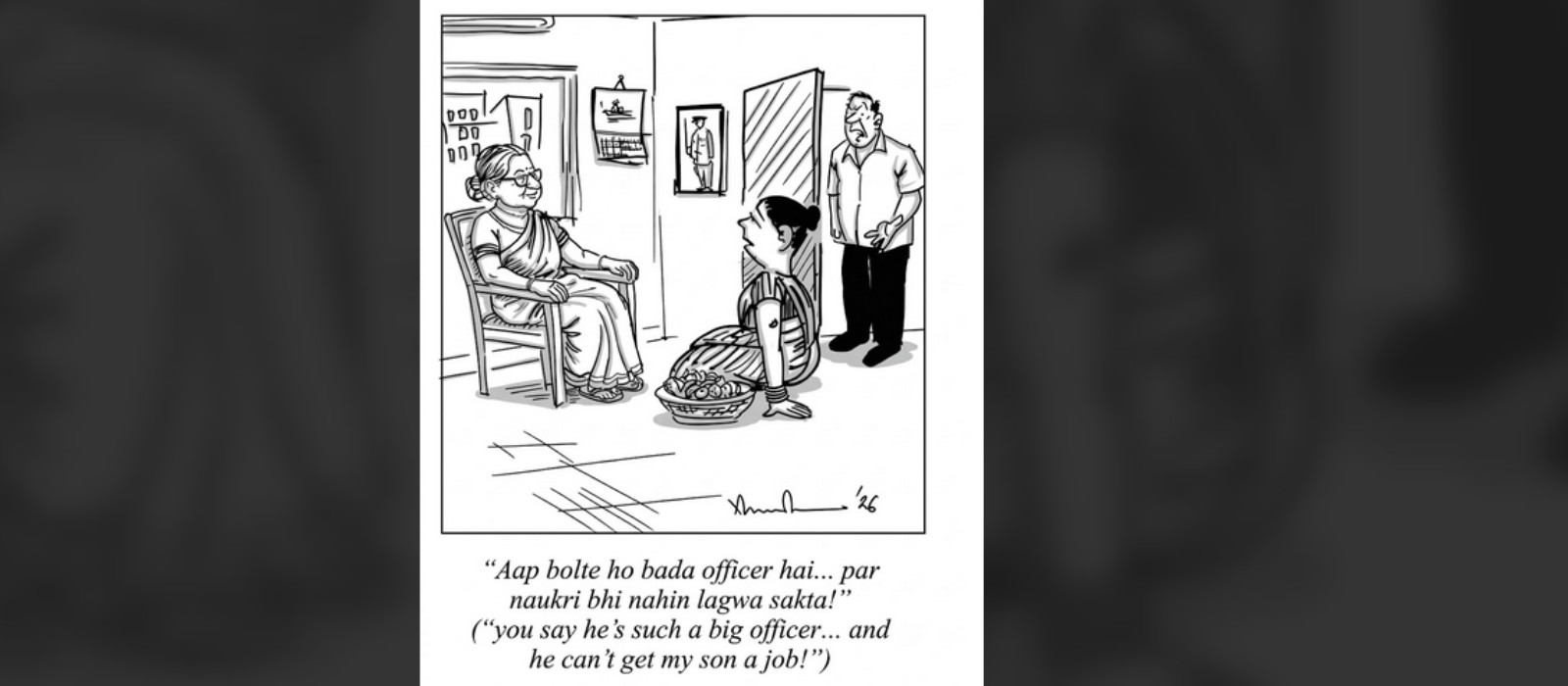
On the other hand, she would attempt to impress the vegetable seller who visited our home daily. After the usual bargaining, the lady would settle down for a cup of tea and indulge in friendly conversation.
On one such occasion, my mother introduced me as a very senior officer in the Navy. The lady immediately asked if I could get her son a job. I explained, as gently as possible, that recruitment was based on merit and formal selection processes. She looked at my mother with a mixture of sympathy and disbelief and said, “What sort of senior officer is he if he cannot get a job for my son? The local constable has promised him one—he is much better.” It was a withering assessment from which I have yet to fully recover. That naval officers are terrible at securing jobs for anyone else is corroborated by someone who has been a shipmate twice. While living in government housing in Delhi as a flag officer, he was chided after a third attempt by an incredulous postman who wanted his son recruited. This shipmate, he said, “was uncaring, and also unconvincing that as such a senior officer, he was unable to do such a small thing for someone in need.” He reached back into the time he was a Sub Lieutenant in a Leander-class frigate. He was asked the same question in the title for this yarn, perhaps a bit paraphrased, by a great aunt. When he explained he was in a ship, he asked if he knew “Patwardhan” who also was in a “steamer”! He had no idea of this person, and the grand old lady telling him that he, like this great-nephew, could also swim, didn’t help narrow down the search for “Patwardhan”. The lady had made a well-informed guess, though. The frigate did have steam propulsion!
Unlike the Army, whose presence is visible and immediate, or the Air Force, whose aircraft dominate the skies during national events, the Navy largely operates beyond public view. Ships do not sail up the Yamuna. Much of what we do remains out of sight, and therefore, often out of mind. To many, our profession continues to be something of an enigma—occasionally reduced to clichés or popular imagination.
This leads to a recurring question—what exactly do we do, and how do we explain it to our fellow citizens? On a bus journey from Bijapur to Mumbai, a fellow passenger asked if I was from the Navy. With a sense of quiet pride, I prepared to elaborate on life in uniform.
His response, however, was disarming. Pointing to my baggage tag, he said, “It is written there.” After a pause, he added, “Which Navy? Like in Rustom?” That rather settled the matter.
Such encounters underline a larger reality. While we often speak of the distinctiveness of the white uniform, we are frequently mistaken for the Merchant Navy, Coast Guard, or even Customs. In many parts of the country, these distinctions are not immediately evident. None of this, of course, mattered to my mother. I have heard of a story-- quite reliable-- that a very, very high constitutional functionary, being introduced to his official staff, asked a naval ADC “which airports had he worked at?”
My father, on the other hand, had a clearer understanding of the Services. Having taught at a Sainik School, he appreciated hierarchy and progression. Like many fathers, he had his aspirations for his children. For me, he hoped I would, first, complete a PhD, and second, rise to the rank of Admiral. He passed away in 2013, just as I had enrolled for my doctoral studies. He did not live to see me become a ‘Doctor’, nor to see how far I progressed in service. Yet, his philosophical outlook remained a guiding influence.
When I was awaiting promotion to Captain while serving as faculty at the Defence Services Staff College, Wellington, I once spoke to him about the competitive selection ratios. Sensing my anxiety, he said, “Your grandfather was a teacher in a village school. I taught in a high school. You are teaching in a college. Is that not progress enough?” It was perspective, simply and effectively delivered.
In her later years, my mother stayed with us, including through the Covid period. The warmth at home, the courtesy extended by colleagues, and the exceptional care provided by the staff at INHS Asvini gradually reinforced her belief that her son was someone of great importance. No amount of clarification that I was just another ‘single-striper’ altered that perception. Even if she never fully understood what I did. Mothers are perhaps like that—they see what they wish to see and believe what they choose to believe. Today, 12 March, marks four years since she passed away. Time has a way of both moving on and standing still. I remember her with a quiet tear and a smile.
For the Navy, this also reflects a broader challenge—communicating maritime roles and relevance to a largely continental audience. Enhancing public understanding of naval operations, particularly in the hinterland, remains an important imperative.
