


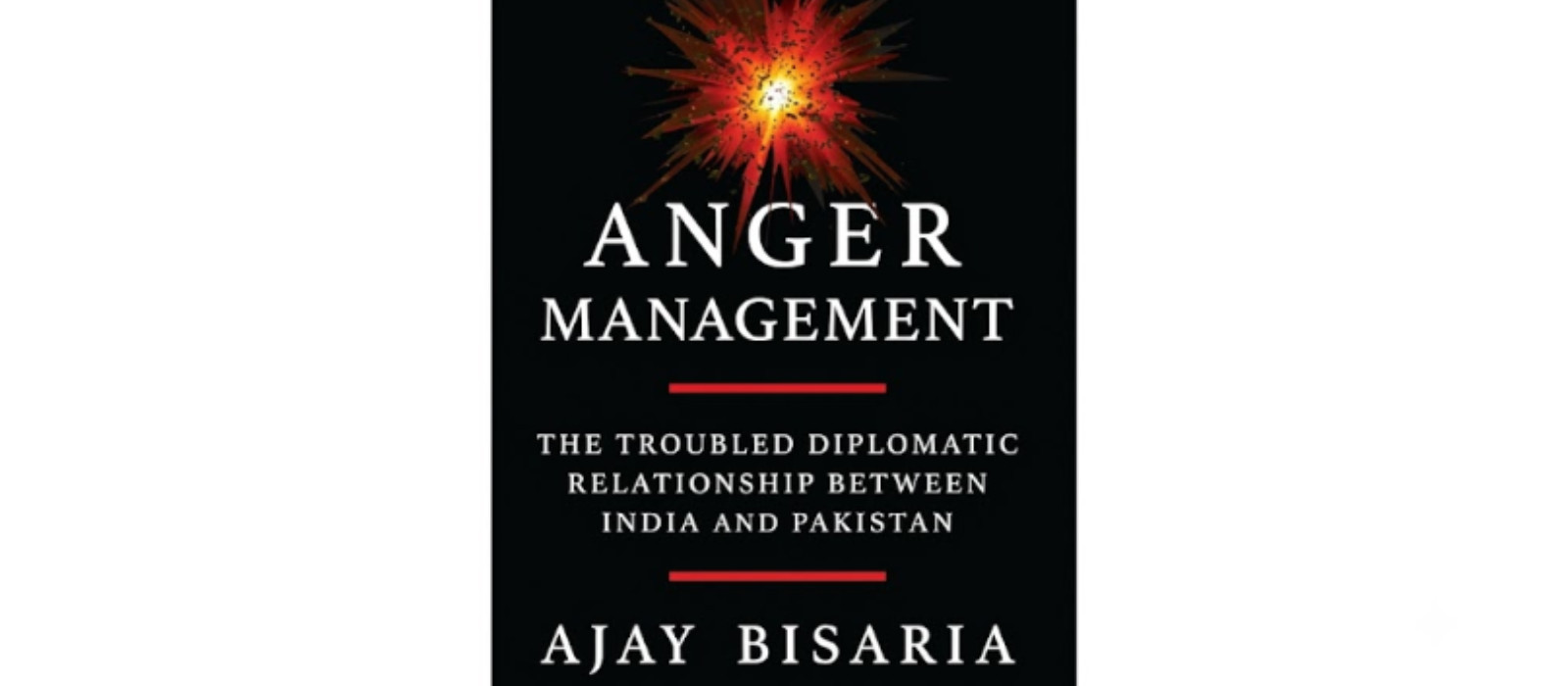


Anger Management
The Troubled Diplomatic Relationship Between India and Pakistan
Author: Ajay Bisaria
Published by: Adelph, Edition: 2024 ISBN: 978-93-93852-75-5 Pages: 481
Book Review by Commodore Amit Gurbuxani, NM,
Is i t a self- help or self-improvement book? This is a question that could immediately come to mind on reading the title of the book. However, the seriousness of t he subject i s immediately apparent on reading the full title. Another question also comes to mind: Has the India - Pakistan relationship now reached a stage where it needs self-help or therapy? There could be nobody better to answer these questions other than the author, Shri Ajay Bisaria who India’s High Commissioner to Islamabad from Dec 2017 till the abrogation was of Article 370 by Government of India on 07 Aug 2019. The relationship was immediately downgraded to Charge de’Affairs and remains so almost six and a half years later.
He writes from the perspective of a seasoned diplomat with a varied career in the Indian Foreign Service. To the theme of the book, he also falls back on an earlier tenure as the Private Secretary to Prime Minister Vajpayee from 1999 to 2004 wherein he had ringside view of Kargil conflict and the famous bus ride to Lahore. He is well placed to examine this tumultuous relationship and provide new approaches on the way forward.
Needless to say, the India- Pakistan relationship is one of the most complex relationships between any two nations over the last seventy-five years. Many politicians, diplomats, scholars and journalists have offered their perspectives over the years and have suggested various solutions to this very vexed problem. However, the relationship has only become more complicated and has reached a stalemate with almost no viable options in sight. The author tries to trace the relationship from the perspective of twenty-five High Commissioners who have worked in Islamabad since independence in 1947. He has also parallelly brought out the attempts made by fourteen Prime Ministers of India who have all sincerely tried to achieve peace and find solutions for a better future in their own unique ways.
Throughout the narrative a few common threads clearly emerge. Firstly, every Prime Minister of India and every High Commissioner of India has taken the initiative to engage with the leadership in Pakistan (be it a political leader or a dictator) to move the relationship forward in a positive direction. Secondly, all agreements and treaties, be it the Tashkent Agreement after the 1965 war, the Shimla Agreement of 1972, the Lahore Declaration in Feb 1999 post the bus journey have not been able to withstand the onslaught of negativity and counter- productive actions that have followed in the wake. Only one exception was the Indus Water Treaty of 1961, which withstood the test of time. However, this has also come under strain in last few years and was finally suspended by India in the wake of the cross-border terrorist attack in Pahalgam on 22 April 2025, of course after this book was published.
Thirdly, even at the many low points in the relationship, like after the attempted invasion of Kashmir in 1948, the 1965 & 1971 wars, post- Kargil in 1999 and even after the Uri and Pulwama incidents, dialogue and diplomacy have been given a chance and interactions have taken place at diplomatic as well as political levels to find common ground and resolve issues. Fourthly, the leadership in Pakistan, whether political or military, has almost always fallen short of expectations and failed to keep their end of the bargain due to their own domestic compulsions. This has led to loss of trust and confidence on the Indian side. Lastly, the ‘people to people’ contact as well as connect including Track II diplomacy has continued throughout the entire duration despite challenges of crests and troughs of Indian Naval Despatch Vol. 6 No. 2 April 2026 the relationship. Even both these avenues have become increasingly difficult to progress due to the prevailing strong negative public sentiment. A case in point is Cricket (no handshake matches) at neutral venues to no engagement even at the sidelines of various international summits/ conferences and the verbal spat between the diplomats annually at every UN General Assembly meeting.
According to Bisaria, as both countries move towards celebrating their century of Independence in 2047, three scenarios could unfold. The first possibility is that the same level of animosity continues and a similar ‘no war no peace’ situation prevails. The second option is that this deteriorates into a catastrophic situation leading to an all-out conflict much to the detriment of both the countries. (The ongoing ‘Operation Sindoor’ being an indicator of this harsh reality). The third option is that the prevalent terrorists’ incidents abate, and some common ground can be achieved for lasting peace between the two countries. The author has strongly advocated that despite the challenges and the recent hiatus in the relationship of ‘No talks and terror’, diplomacy matters; and dialogue and engagement is the only way forward. He has ended with the hope that there would be change for the better sooner rather than later. These options and many more vexed issues were part of the daily discourse during various meetings and discussions whilst this reviewer served alongside the author (then High Commissioner) as his Naval Adviser at our mission in Islamabad in 2017 to 2018.
The author’s flowing style and involved narrative makes it easy to connect with the pages and also identify with the mixed nature of the ebb and flow of the relationship. The title of the book certainly holds true to the extent that the relationship does need the therapeutic treatment of ‘Anger Management’ for the national leadership to display maturity and manage the pulls, pressures and surprises which are omnipresent on any given day of India-Pakistan relationship.
The book makes interesting reading and is an easy read over a few days. To the keen watchers of India and Pakistan, and to the general enthusiast in this field, it provides a kaleidoscopic view of the dynamics of the ups and downs of this complex relationship.
