


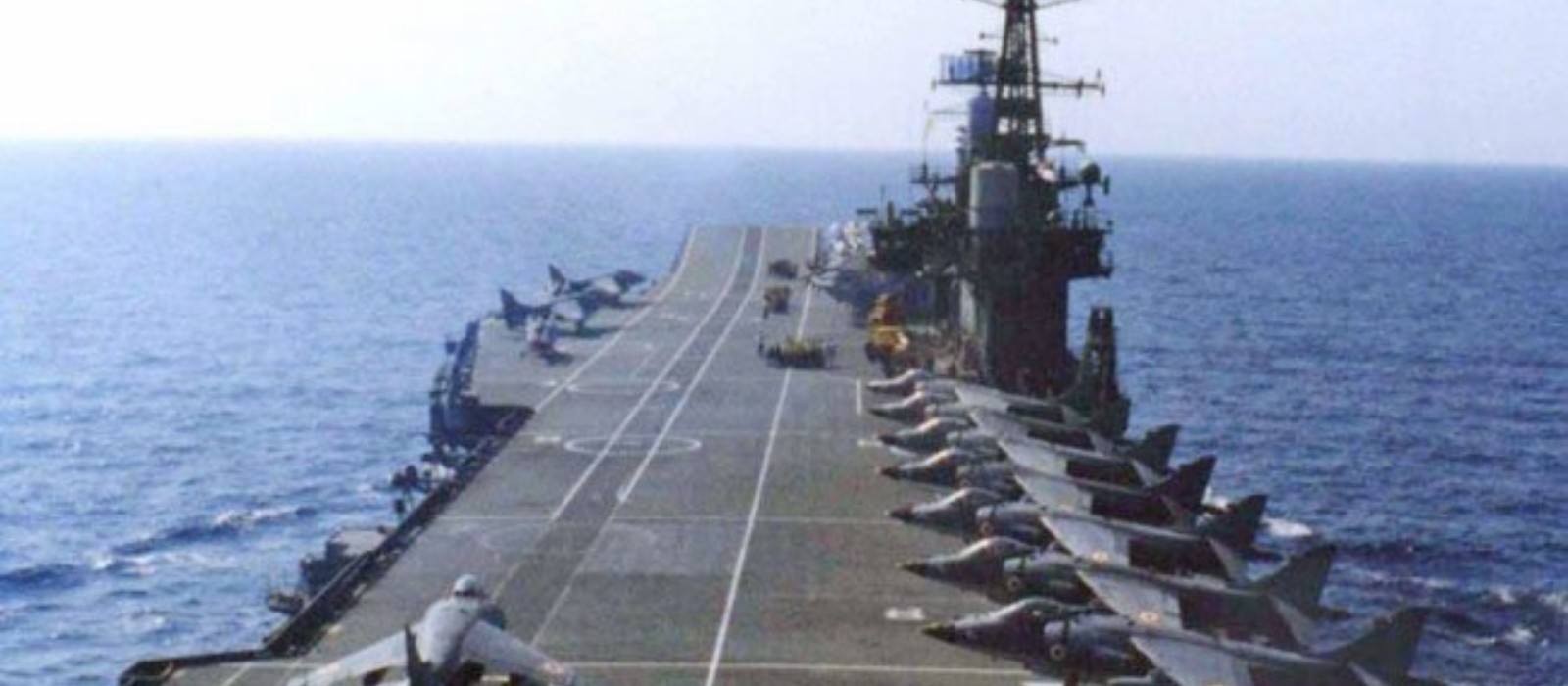


This commentary by Dr Joshi counters some of the arguments put forth by Cdr Karthik Balaji in his article ‘Vikrant’s Operations in the Eastern Theatre during the 1971 War: A Case Study on the Centrality of Aircraft Carriers to India’s Maritime Security.’ Since Dr Joshi leans into his own recent in-depth studies, based on archival research, it has been necessary to include end-notes. These could, in fact, help the curious reader to study the matter closely.
The debate on the utility of aircraft carriers in India’s naval force structure has been extended. Commander Karthik Balaji’s article titled “Vikrant’s Operations in the Eastern Theatre during the 1971 War: A Case Study on the Centrality of Aircraft Carriers to India’s Maritime Security” in the latest issue of the INDES wades into this significant but highly polarised territory. Cdr Balaji leans on the side of aircraft carrier optimists, those who believe that such platforms provide multiple advantages to India’s naval power and force projection capabilities. Carrier Battle Groups (CBGs) have the power and resources to influence operations on land, protect India’s international shipping lanes by exerting sea control, and help New Delhi project a more robust and sustained maritime presence in the Indian Ocean region. Yet, the arguments favouring aircraft carriers, at least in the Indian case, are primarily academic. Except for the 1971 Bangladesh War, there is no other historical experience of their usefulness in war and crises.
These arguments are also familiar. Ever since the first plan paper produced by the Naval Headquarters in August 1947, aircraft carriers have captured the imagination of India’s naval planners.¹ The intellectual arguments made by the Navy, at least in the early decades after independence, did not synchronise with how Indian decision-makers contemplated the role of the Navy in their understanding of the use of force. Of course, the Navy acquired an aircraft carrier in 1961, but by appealing to Nehru’s pride rather than India’s military requirements. Even then, given its modest role in India’s conflicts, the Navy had little to show as an independent vector of force projection.
Therefore, the Bangladesh liberation war, particularly Vikrant’s role in the Bay of Bengal, is essential in the Navy’s narrative to rationalise its carrier-centric force structure. Commander Balaji’s argument is built on the same set of historical evidence. However, the opening of Indian archives punctures a hole in the folklore of Vikrant’s actual utility during the 1971 war.
If Vikrant exuded India’s power and pride, it also exposed it to significant risks on the battlefield. The pre-eminent punisher of the Indian Navy required adequate protection during wartime. No other military hardware in Indian inventory was so indispensable; naval strategy mainly focused on protecting the fleet’s crown. During the Goa operations of 1961, Vikrant hardly played a role. The possibility of a submarine threat forced the Indian Naval Command not to employ Vikrant in the warzone. As Admiral Krishnan, the Captain of INS Delhi who later became Vice Chief of Naval Staff, recalled in his autobiography, “Incredibly, INS Vikrant, our latest and newest acquisition was not taking part in the operation, but was going to be deployed somewhere in the middle of the ocean where she would be safe.”² INS Delhi’s mission was first to support Army operations off the coast and then protect Vikrant. In 1965, the ailing ship was docked in Bombay Harbour for a refit.
Though the Navy claims that the 1971 war had finally proved the worthiness of fleet carriers and Vikrant’s contribution to Indian naval might, there was significant trepidation within the naval high command over the threat Pakistani submarines posed to the carrier. Deploying Vikrant on wartime duties was, to begin with, an agonizing decision for the Navy because of the fear that if the ship “gets torpedoed or sinks, Navy, and India will lose a lot of prestige.”³ Therefore, the Navy removed Vikrant from the Western coast, where Pakistani Daphne-class submarines posed a “great potential threat to the carrier.”⁴ The Commander-in-Chief of the Western Naval Command, Vice Admiral Surendra Nath Kohli, was livid. Since the “main naval battles and activity would take place in the North Arabian Sea,” Kohli later reminisced, “the depletion in Western Command’s fleet and firepower was not justified.”⁵ Yet, Vikrant’s removal from the Western coast did not eradicate the submarine threat.
Given their low endurance, the Daphnes could only operate in the North Arabian Sea; the Ghazi, however, could be employed even in the Bay of Bengal and torpedo Vikrant in a pre-emptive strike. The entire carrier task force was stationed off Andamans until the eve of hostilities. Two unforeseen events facilitated Vikrant’s role during the 1971 operations: The sinking of Ghazi on 3rd December and the Indian Air Force’s destruction of Pakistani air assets in East Pakistan. Notwithstanding the bravery and courage of service personnel who operated the carrier suffering an underpowered engine, Vikrant’s success owed significantly to such fortunate circumstances. As Admiral Hiranandani writes in the official history of the Navy, “Had this (sinking of the Ghazi and destruction of the Pakistani air force) not occurred, the entire pattern of Eastern Fleet’s operation would have been different.”⁶ Most of the Eastern naval fleet would have bogged down in protecting Vikrant, the mobility of the Navy would have been highly constrained, and the tempo of naval operations would have significantly slowed down.⁷ Vikrant’s role in the 1971 war, therefore, owed as much to serendipity as it did to the tireless bravery of the crew who manned it and the captain who commanded it.
The Navy used Vikrant’s contributions to advance its organisational prejudice towards aircraft carriers. The success of the naval operations in the East only confirmed the Navy’s bias towards fleet carriers, even when platforms like the Osa-class missile boats and special operations by a mix of the Navy’s frogmen, mining, and Mukti Bahini swimmers and divers trained by them had a very significant direct and indirect impact (in what was called Operation X, so well-recounted in Unnithan’s book by that name) and in combination levied significant punishment on the Pakistan Navy, its shipping, and territorial targets. Citing Vikrant’s success after the war, the Navy requested a significant upgrade of its aircraft complement with new VSTOL aircraft, such as the Sea Harriers, replacing the obsolete Sea Hawks.⁸ However, the Navy’s self-congratulatory assessment of the platform’s utility was hardly shared by Indian decision-makers. As one of the defence ministry post-mortems of the 1971 war concluded, the operational role of the Vikrant was far more “imagined” than actual, given the need for “morale.”⁹ In 1973, the Apex Group on Defence Planning, under the Planning Commission Chairperson DP Dhar, was “not able to determine the utility of the Aircraft Carrier as an effective operational craft against the strength of the Navy.”¹⁰ Dhar’s personal observations were far more scathing: “The Navy has made this more of a question of prestige than the utility. The utility of the aircraft carrier in the Bangladesh war was next to nothing.”
The missile revolution in naval warfare, which the Navy itself demonstrated in the Arabian Sea during the 1971 war, had raised serious questions on the survivability of the platform. Chief of Naval Staff, Adm SN Kohli, accepted Vikrant’s increasing “vulnerability” from Pakistani aircraft carrying Exocet anti-ship missiles.¹¹ Yet, if pride was the rationale for Nehru's acceptance of the aircraft carriers, Adm Kohli’s pitch was now on preserving the glorious legacy of fleet carrier operations the Navy had built. In a manner of speaking, the Navy became a prisoner of its dreams: “India, which has developed its Carrier operating techniques and expertise over many years, can ill afford to take a retrograde step such as winding down the Carrier aviation.”¹² The fear of “wasting Vikrant’s potential” would become the oft-repeated rationale for India's continuing tryst with aircraft carriers. It continues to inform the Navy’s thinking even today when the operational environment has become far more punishing.
It is, therefore, time for India’s naval planners to disassociate organisational biases and bureaucratic interests from building an optimum force structure. A dispassionate analysis of India’s military objectives, available resources, and naval strategy should inform force structures rather than vice-versa. It also requires an objective historical analysis of Vikrant’s military contributions during the 1971 war.
Endnotes
- See, Yogesh Joshi, “Yogesh Joshi, “Nehru’s Navy: India’s Tryst with Aircraft Carriers,” ORF Occasional Paper No. 379, November 2022, Observer Research Foundation, https://staging.orfonline.org/research/nehrus-navy-indias-tryst-with-aircraft carriers/. Also see, Yogesh Joshi, “Sailing through the Cold War: Indian Navy’s Quest for Conventional Submarines,” India Review, Vol. 17, No. 5 (December 2018), 476-504.
- Adm. N. Krishnan, A Sailor’s Story: The life and times of Vice Admiral N. Krishnan, (New Delhi: Krishbooks LLC, 2020), 182.
- Vice Admiral GM Hiranandani, Transition to Triumph: History of the Indian Navy 1965-75 (New Delhi: Lancer, 2005), 119.
- 4 Ibid.
- Ibid, 120.
- Ibid, 128.
- Ibid.
- Nehru Memorial and Museum Library, “Apex Committee Report 1973: Chapter-II- Urgent Requirements of the Defence Forces,” PN Haksar Papers, 3rd Instalment, Subject File 299 (Top Secret)
- Nehru Memorial and Museum Library, “Note by DP Dhar,” 04 November 1974, PN Haksar Papers, 3rd Instalment, Subject File 284 (Secret).
- Nehru Memorial and Museum Library, “Note by DP Dhar,” 04 November 1974 , PN Haksar
Papers, 3rd Instalment, Subject File 284 (Secret). - Nehru Memorial and Museum Library, “Extract of the Apex Committee Report,” undated, PN
Haksar Papers, 3rd Instalment, subject File 297-I (Secret). - Nehru Memorial and Museum Library, “Chief of The Naval Staff: Role of the Aircraft
Carrier,” 03 May 1975, PN Haksar Papers, 3rd Instalment, subject File 297-I (Secret)
