


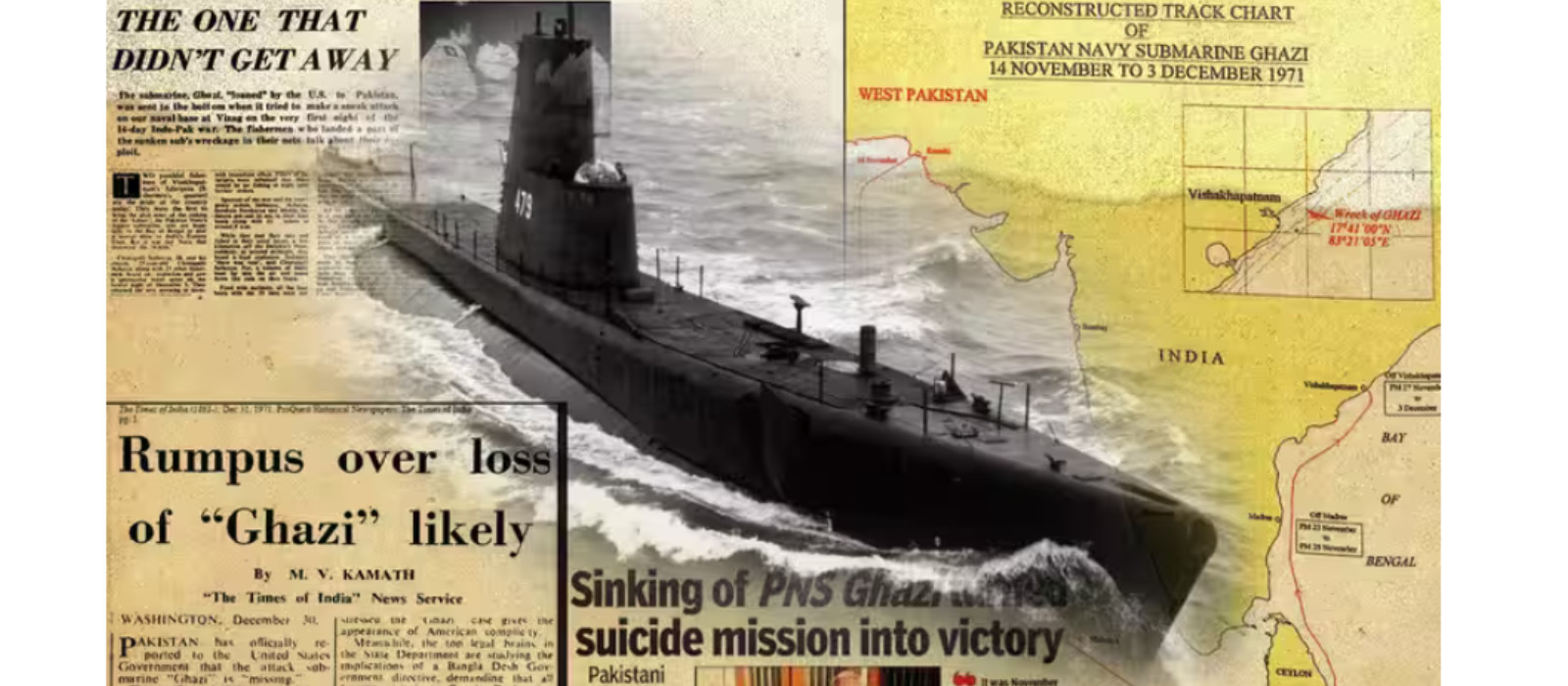


The 1971 Indo-Pakistan war, fought a half-century ago, remains one of the few post World War II conflicts with a distinct naval element. It was an even rarer instance where both belligerents deployed submarines.
At the outbreak of the war on 03 December, 1971, both India and Pakistan were equally matched with four conventional submarines each. Both navies deployed their submarines in an identical ratio in the two theatres of the war: three in the Arabian Sea and one in the Bay of Bengal. The Indian Navy’s new submarines (NATO class code-name Foxtrot - Soviet name project 641) were acquired from the Soviet Union between 1967 and 1969. They outmatched the three French-built Daphne class submarines in Pakistan’s inventory in terms of range, endurance and weapon load. The Foxtrots displaced 2,475 tons and had a range of 20,000 nautical miles and carried ten 533mm (the standard 21 inch) torpedo tubes (6 forward, 4 aft), with 22 CET-65E/CAET-60 active or passive homing torpedoes each with a range of eight nautical miles.
On the other hand, the 1,038-ton Daphne class made up for their small size by packing a punch in its armament comprising a dozen 21 inch E-15 anti-ship torpedoes and a range of 10,000 miles. Each torpedo had a passive acoustic homing head, a speed of 25 knots and a range of 7500 metres. They were contained in 12 externally mounted torpedo tubes, which eliminated the need for a torpedo room and reloads. The Pakistan Navy also operated six 70 tons, SX-404, Italian-built midget submarines.
The Indian Navy’s submarine arm did not draw blood in the 13 day war that ended on 16 December, 1971. However, a Pakistani submarine, Hangor, sank an Indian ASW frigate, Khukri. This was the first kill by a conventional submarine since the Second World War. With the loss of Ghazi off Visakhapatnam on the night of 03 December 1971, Pakistan also became the only nation to lose a submarine in war since WW2.
The Beginning
The submarine was a late arrival in South Asia. Both India and Pakistan had operated them for less than a decade when war broke out in 1971. Pakistan was the first to field a leased submarine in South Asia - the ex-USS Diablo, and renamed it as Ghazi in 1963. Its arrival coincided with a phase of Indian military expansion following the 1962 Indo-China border war and thus, triggered an Indian acquisition quest. This quest, among others, led to a transformation of Indian military’s buying preferences and eventually, its strategic alignments.
Briefly recounting the history of the submarine may be in order at this stage. Several nations had experimented with submersible craft through the 18th and 19th centuries. The first military submarine to successfully sink a ship in battle was the Confederate submarine Hunley which sank USS Housatonic - a steam propelled sloop - with a spar torpedo on 17 February 1864 at Charleston, South Virginia. (The Hunley too sank after the attack with the loss of its eight man crew). Submarines truly arrived as a weapon of war only in the 20th Century. In the First World War, Germany made extensive use of U-boats to sever Britain’s maritime lines of commerce. German U-boats sank almost 5,000 ships with nearly 13 million gross register tonnage, losing 178 boats and about 5,000 men in combat.
In the Second World War, Germany fielded a growing force of U-boats because surface ships were not as effective at commerce raiding.1 In the Atlantic Ocean, German submarines sank 3,500 merchant ships and 175 warships for the loss of 783 U-boats.2 There was a time when it seemed that they might nearly choke Britain of food and armament supplies coming from North America. The Battle of the Atlantic led British PM Winston Churchill to write in his memoirs that, “the only thing that ever really frightened me during the war was the U-boat peril.”
In the Pacific campaign, the US Navy submarines sank 200 Japanese warships and 1,300 merchantmen contributing in great part to the Empire of Japan’s eventual defeat. Both these were examples of what is called ‘unrestricted submarine warfare.’They violated the protocols established in 1936 by Western powers establishing the laws of naval warfare for targeting enemy merchant shipping.
Article 22 of the 1930 London Naval Treaty, reaffirmed in the London Protocol of 1936, states:
The following are accepted as established rules of International Law:
-
In their action with regard to merchant ships, submarines must conform to the rules of international law to which surface vessels are subject.
-
(2) In particular, except in the case of persistent refusal to stop on being duly summoned, or of active’ resistance to visit or search, a warship, whether surface vessel or submarine, may not sink or render incapable of navigation a merchant vessel without having first placed passengers, crew and ship’s papers in a place of safety. For this purpose the ship’s boats are not regarded as a place of safety unless the safety of the passengers and crew is assured, in the existing sea and weather conditions, by the proximity of land, or the presence of another vessel which is in a position to take them on board.3
-
At the Nuremberg trials of 1945-49, Admiral Karl Doenitz, the last Chancellor of Germany and its wartime Navy Chief was charged with waging unrestricted submarine warfare.
The International Military Tribunal did find Doenitz guilty of violating the London Protocol by declaring submarine operational areas within which German U-boats could attack neutral merchant ships without prior warning.4 The Tribunal without question ruled that Doenitz had violated the Protocol. Because of the Allied practices however, his sentence was “not assessed on the ground of his breaches of the international law of submarine warfare,” including among these “breaches” unrestricted submarine warfare against neutral shipping.
The clear implication is not that the Tribunal had found some sort of customary practice changing the rules of the Protocol, but that all parties had violated these rules. The partial clemency granted to Doenitz was due to its application of a version of the “unclean hands” doctrine and not to any recognition of the lawfulness of unrestricted commerce warfare.
After WWII, the great powers built upon their wartime designs to field a newer series of submarines that were quieter and could travel submerged for greater periods of time. The need to develop a true submarine as opposed to better “submersibles” was a race that culminated in the development of nuclear-powered submarines with the first one, Nautilus, inducted into the US Navy in 1954.
Submarine construction remained the preserve of a handful of countries for several decades after the war. Technology was used as a lever of great power by the ‘Great Powers’ to carefully further their interests.
The Royal Navy, the ideological parent and the naval hardware supplier to the navies of both India and Pakistan, however, would not give any submarines to the inheritors of the formal Royal Indian Navy. The handful of sloops, frigates, minesweepers, trawlers and harbour defence motor launches it left behind, had been partitioned between the two navies. The post-Independence Indian Navy had ambitious plans to create a balanced, three-dimensional navy comprising four aircraft carriers, four cruisers, 16 destroyers and 16 submarines by 1963. This was never realised due to budgetary constraints and the unwillingness of western powers to supply submarines. The cost benefit analysis of fielding a fleet of submarines was known by then. A seminal paper in the USI journal by Sub Lieutenant (later Admiral) Vishnu Bhagwat in 1962 made the case for submarines as the most cost-effective means for the Indian Navy to exercise maritime power in its area of responsibility. Backed by an analysis of history, and with incredible prescience from such a young officer, he wrote:
“For the seaward defence of India and to fulfil our natural responsibilities with regard to the Indian Ocean, the submarine is the ideal ship. Like the Air Force HF-24 project, it may be feasible to start building submarines in this country.”5
Towards the 1971 War Beneath the Waves
It would be at least two decades before India would build submarines under license, but as mentioned earlier, Pakistan made the first move when it acquired South Asia’s first submarine in 1963 - the Ghazi, a Tench class fleet submarine. These American boats were purpose built for long range patrols in the Atlantic and Pacific Oceans. They had a range of 16,000 nautical miles and a formidable sea endurance of 75 days. The transfer did not happen unexpectedly. Diablo had served the US Navy since 1945. Pakistan’s prominent westward tilt in the 1950s - it was a key ally of the West leaning Central Treaty Organisation (CENTO) - had eased up the lease.
Indian Navy Tries Catch up to Match up
The arrival of Diablo accelerated India’s attempts to acquire submarines. In May 1964, an inter-service defence delegation led by then Defence Minister YB Chavan proceeded to the USA with the intention of getting on loan, two or three fleet submarines and also a few destroyers. The requests were cold shouldered by the Lyndon B Johnson administration who advised India to channel their requirements to their traditional naval supplier, Great Britain.6
The Royal Navy had begun training the nucleus of the Indian Naval submarine arm in 1962. By 1966, 15 Indian Navy officers and 20 sailors had completed their submarine training at the Royal Navy Submarine School in the UK. But a geopolitical twist would see these personnel operating Soviet built submarines. In 1964, Great Britain reneged on an offer to supply a modern Oberon class boat. They instead offered a Triton class sub which had entered service in the 1930s before the Second World War. The British offer was quickly rejected and India turned towards the Soviet Union. An Indian delegation led by Defence Minister YB Chavan had already visited the Soviet Union in September 1964 and seen a range of Soviet Naval hardware including a submarine, a submarine depot ship, missile boats and patrol boats. The delegation which included the Deputy Chief of Naval Staff, RAdm SM Nanda, visited Leningrad (now St Petersburg), the headquarters of the Soviet Baltic Fleet and were given a two hour submerged sea sortie in a submarine (of unspecified make).
In September 1965, a defence delegation led by the Defence Production Secretary GL Seth and RAdm SN Kohli, visited the USSR and concluded a contract for four ‘Foxtrots’ whose delivery would commence from 1967. The deal also included a submarine depot ship, five Petya class anti-submarine corvettes and two Polish built Landing Ship Tanks (LSTs).
How significant these contracts were, was summed up by SB Chavan’s Private Secretary RD Pradhan. “Till that time, right from top to bottom, the Navy appeared to be so strongly pro-British that no one could imagine acquiring anything outside the United Kingdom,” Pradhan wrote in his memoirs Debacle to Revival.
The delegation was in the Soviet Union negotiating, even as India and Pakistan were at war (between August and September 1965). The Pakistan Navy deployed the Ghazi off Bombay (now Mumbai) where she falsely claimed the ‘kill’ of an Indian frigate, the Brahmaputra. As the war raged, Indonesia despatched two of its Soviet built Project 613 Whiskey class submarines and four Komar class missile boats to Pakistan. The submarines and warships arrived in Karachi after a ceasefire had been declared on 23 September 1965.7 This unexpected transfer - the Soviets had forbidden their transfer to a third country - no doubt created a fresh dilemma for Indian planners.
On 25 February 1966, just five months after the war, Pakistan signed a deal to purchase three Daphne class submarines from France.8 Hangor, Shushuk and Mangro were delivered between 1969 and 1971. South Asia’s undersea game was now truly afoot.
Action Stations in December 1971
Ferment in East Pakistan began with Pakistan’s first general elections of December 1970. Sheikh Mujibur Rahman’s Awami League won the elections to the National Assembly by a landslide win of 167 of the 169 seats in East Pakistan while Zulfiqar Ali Bhutto’s Pakistan Peoples’ Party won 83 out of 144 seats in West Pakistan. The results were a setback to the ruling military junta led by General Yahya Khan who were loathe to hand over power to a party from its eastern wing. The election results were held in abeyance, prompting increasing unrest in East Pakistan. On 26 March 1971, a day that is now observed as Bangladesh’s Independence day, the Awami League replaced Pakistani flags with Bangladeshi flags. Two days later, the Pakistan Army began its crackdown in the eastern wing, arresting Sheikh Mujibur Rahman and rapidly killing thousands of people including officers and men of the East Bengal Rifles, which had mutinied.
They then, began a genocide in its eastern wing, selectively targeting interests they believed were inimical to its rule. These atrocities triggered a flood of refugees into India. By the end of May 1971, 4.3 million refugees had flooded India and by the end of July, the figure was 7.2 million, creating an enormous socio-economic burden on India as a whole and particularly for the states bordering East Pakistan
In November 1971, when war seemed imminent, the four Pakistan Navy submarines moved to their operational areas. As the Story of the Pakistan Navy notes:
“A critical element of the war at sea was the correct and timely deployment of the submarines. As tensions with India continued unabated, hostilities were inevitable. The Navy ordered the submarines to slip out of harbour quietly on various dates between 14 and 22 November. They were allocated patrol areas covering the West coast of India while Ghazi was despatched to the Bay of Bengal with the primary objective of locating the Indian aircraft carrier INS Vikrant, which was reported to be operating in that area. Interdiction of merchant shipping was however, not permitted due to lack of Government approval for this form of warfare.”9
22 November 1971, when all four boats were in their patrol areas, was also the day after the Indian and Pakistani forces had clashed at the Battle of Boyra in East Pakistan and IAF and PAF jets had dueled in the skies over the eastern province. The three Daphne class submarines, Hangor, Mangro and Shushuk were in three patrol areas codenamed - Papa One Two Three Four, Papa Five Six Seven Eight, Bravo One Two Three Four Five Six. (‘Papa’ possibly was a patrol area off Porbandar, a port city on India’s western coastal state of Gujarat; ‘Bravo’ was between Diu and Bombay). Even as the Pakistani submarines sailed into their patrol areas, much of Indian Navy’s Western Fleet was already sailing out to their battle stations in the North Arabian Sea.
Eastern Theatre
Recall that the Ghazi had sailed from Karachi on 14 November towards the Bay of Bengal. Her deployment was anticipated because in November, the Indian army’s Eastern Command had intercepted a signal addressed from Naval HQ, West Pakistan to Chittagong requesting information on a grade of lubrication oil used by submarines and minesweepers. As minesweepers and the Daphne class submarines did not possess the range to operate in the Bay of Bengal, it was assumed that Ghazi was stalking the Vikrant. This surmise was correct. Vikrant and her escorts had been moved to a sheltered anchorage in the Andaman and Nicobar islands in late November. Ghazi operated off Madras until 26 November when she received a signal, “Intelligence indicates carrier in port, proceed to Zone Victor with despatch.” The submarine arrived in Zone Victor, Visakhapatnam, on 27 November and proceeded to lay mines at the mouth of the harbour.
The “Hot” Conflict Starts
On 03 December, Pakistani fighter jets attacked Indian airfields in Amritsar, Pathankot, Srinagar, Avantipur, Uttarlai, Jodhpur, Ambala and Agra. That evening Prime Minister Indira Gandhi made her broadcast to the nation announcing the commencement of hostilities. Shortly after midnight, a massive explosion was heard outside Visakhapatnam. On 04 December, the command clearance diving team was sent to a spot a short distance away from the mouth of the harbour. The team discovered PNS Ghazi on the seabed 30 metres below, lying perpendicular to the shipping channel. She might have had a catastrophic explosion and had sunk with all its 93 man crew. It is still unclear what caused it. The Indian Navy claimed depth charges fired by INS Rajput the previous night had destroyed the submarine, but a study of the damage sustained by the submarine by naval divers suggested the explosion was internal. It is highly likely that one of the submarine’s weapons, either a torpedo or mine lodged in the torpedo tubes, had exploded destroying the submarine.11
Western Theatre
On the night of 04 December, the Indian Navy launched Operation Trident. Three Osa-1 class missile boats of the Western Fleet, Nirghat, Veer and Nipat carried out a missile attack on Karachi. They sank the destroyer Khaibar, the Adjutant-class minesweeper Muhafiz and a merchant vessel Venus Challenger approaching Karachi harbour. Operation Python three days later saw Vinash launching missiles that sank the Panamian fuel tanker Gulf Star and damaged the merchant vessel Harmattan and the Pakistan Navy fleet tanker Dacca. These remain the largest successful use of anti-ship missiles in naval history.
The Western Naval Command’s submarines were not as lucky. It had deployed two of its three submarines Kursura and Karanj (Kalvari was in refit through the war in war patrols off the Pakistan coast). To exclude the possibility of mistaken identity, the Western Fleet had demarcated corridors in the Arabian Sea which were not to be crossed. It had also stipulated that its submarines were required to ‘positively identify a target before attack.
This would be easier in the case of a warship, but difficult while shadowing a merchant ship. Kursura sailed from her base port on 13 November 1971 and arrived in her waiting station in the forenoon of 18 November. She stayed on patrol till 25 November and was signalled to shift to another area, where she remained till 30 November, when she was ordered to rendezvous Karanj at sea to pass necessary information and instructions, which she did. Thereafter, she entered Bombay on 4 December. Karanj thus, became the longest deployed naval unit during the 1971 Indo-Pak conflict. She had been out on patrol between 30 November to 20 December 1971. “On four different occasions during this patrol, the submarine almost released her weapons on merchantmen. The requirement to positively identify these precluded any firings.”
Khanderi also had a similar story to tell. She was deployed across the shipping lane from South of Ceylon to Chittagong. She was tasked to attack Pakistani merchant ships and naval ships and provide intelligence of Pakistani maritime forces. She sailed to her patrol area in mid-November and had orders to return by 14 December. She too was tied down to the requirements of positive identification and informed that Pakistani merchantmen were masquerading as neutrals. Like the others, her patrol was uneventful as well and she returned to harbour on 14 December 1971.
So, while the missile boats and fighter aircraft of the Fleet Air Arm saw action; attacking, bombing and strafing enemy warships and merchantmen in both theatres of the war, the submarine arm did not draw blood. The two submarines in the West were placed directly under the C-in-C West, Vice Admiral Kohli, who reflected on this lost opportunity in his autobiography
“The stipulation of “positive identification” prior to attacking any enemy ships deprived our submarines of any real action. The correct line of action would have been to have declared ‘War Zones’ and sink any ship transiting through these, after a suitable warning period. Only the submarines could have achieved this with impunity in enemy waters.”12
Of note is that Admiral Kohli had also opposed the missile boat attack on Karachi while in its planning stage in early 1971. He had recommended caution because the Pakistani port city was too heavily defended by enemy air and surface forces. Had he not been overruled by the CNS, Admiral SM Nanda, wartime operations in the western maritime theatre might have achieved very little overall.
Meanwhile, Hangor deployed off the Indian West coast was looking for targets of opportunity. On the evening of 07 December, D/F intercepts were obtained from an area Southwest of Diu Head and classified as a submarine transmission. The war room in Delhi flashed the bearing cuts of these intercepts originating 35 miles South West of Diu Head to the Maritime Operations Room in Bombay. The 14th Frigate Squadron consisting of Khukri (Captain MN Mulla) and Kirpan (Commander Rishi Raj Sood) were designated as the Search and Attack Unit (SAU) to prosecute the contact in an area 55 miles by 50 miles in a datum, which was already 24 hours late and in Sea State 4, with the knowledge that the sonar detection range of the Daphnes was almost twice that of the Type 14 frigates.13
The two frigates departed Bombay on 08 December and commenced operations south of Kathiawar on 09 December. They had already been picked up by the Hangor which closed in for the kill. She fired her first torpedo, which sped on a straight course towards Kirpan, passing under the ship without exploding. She then fired a second torpedo which hit the side of Khukri and exploded. Within minutes her bow pulled out of the water as sea water gushed into the gaping hole left by the torpedo, and then the ship began to slide into the water. Even as the crew of Khukri began abandoning ship, Hangor fired a third torpedo at Kirpan. Deftly avoiding it, the frigate dashed away into the night. One hundred and ninety-four crew of Khukri died that night. Among them was her Captain, Mahendra Nath Mulla who pushed his crew to abandon ship, gallantly gave his life vest to a crewman and opted to go down with his ship. Only 67 survivors were pulled out of the sea when Kirpan returned the following morning.14
Conclusion
The 1971 war was a watershed moment in the growth trajectory for both navies. In subsequent years, Pakistan laid greater emphasis on its underwater arm, consistently fielding underwater force multipliers from missile firing submarines to air independent propulsion - technologies it believed would give it the edge over the larger Indian Navy. The 1971 war marked the transformation of the Indian Navy from a largely coastal navy with limited combat experience into one that had the capability to conduct distant naval operations and thus, aspire to become a blue water navy. Submarines, both conventional and nuclear, would go on to form an important part of this new fleet.
Endnotes
-
Jasper Copping, “Secrets of Kent's WW1 German u-boat,” The Telegraph, 20 December 2013. https://web.archive.org/web/20131221210750/http://www.telegraph.co.uk/history/world-war-one/10531084/Secrets-of-Kents-WW1-German-u-boat.html, accessed 02 September 2021.
-
“Major British & Dominion Warship Losses in World War 2: British Losses & Losses Inflicted on Axis Navies,” Naval History, http://www.naval-history.net/WW2aBritishLosses10tables.htm, accessed 30 August 2021.
-
Jon L Jacobson, “The Law of Submarine Warfare Today,” The Law of Naval Operations, ed. Horace B Robertson, International Law Studies vol. 64 (Newport: Naval War College Press, 1991)
-
Ibid.
-
Vishnu Bhagwat, “Role of the Submarine: A Statistical Study,” USI Journal (1962, October-December).
-
Mihir Kumar Roy, War in the Indian Ocean (New Delhi: Lancer Publishers, 1995), 109.
-
History Section Naval Headquarter, comp., Story of the Pakistan Navy: 1947-1972, (Karachi: Elite Publishers, 1991), 229.
-
Ibid., 231.
-
History Section Naval Headquarter, Op Cit., n.7, 333.
-
Sandeep Unnithan, “New Pictures of 1971 War Pak Submarine Ghazi Renew Debate on Cause Behind blast on Vessel,” India Today, 26 January 2004. https://www.indiatoday.in/magazine/defence/story/20040126-new-pictures-of-1971-war-pak-submarine-ghazi-renew-debate-on-cause-behind-blast-on-vessel-790669-2004-01-26, accessed 25 July 2021.
-
GM Hiranandani, Transition to Triumph: Indian Navy 1965- 1975 (New Delhi: Lancer Publishers, 2000), 84-96.
-
SN Kohli, We Dared: Maritime Operations in the 1971 India-Pakistan War (New Delhi: Lancer International, 1989), 80.
-
Roy, Op Cit., n.6, 233.
-
Sandeep Unnithan, “Indian Navy Locates INS Khukri Sunk During 1971 Indo-Pak War,” India Today, 07 June 2004. https://www.indiatoday.in/magazine/defence/story/20040607-after-33-years-wartime-casualty-ins-khurki-navy-found-resting-place-789898-2004-06-07, accessed 25 August 2021.
