


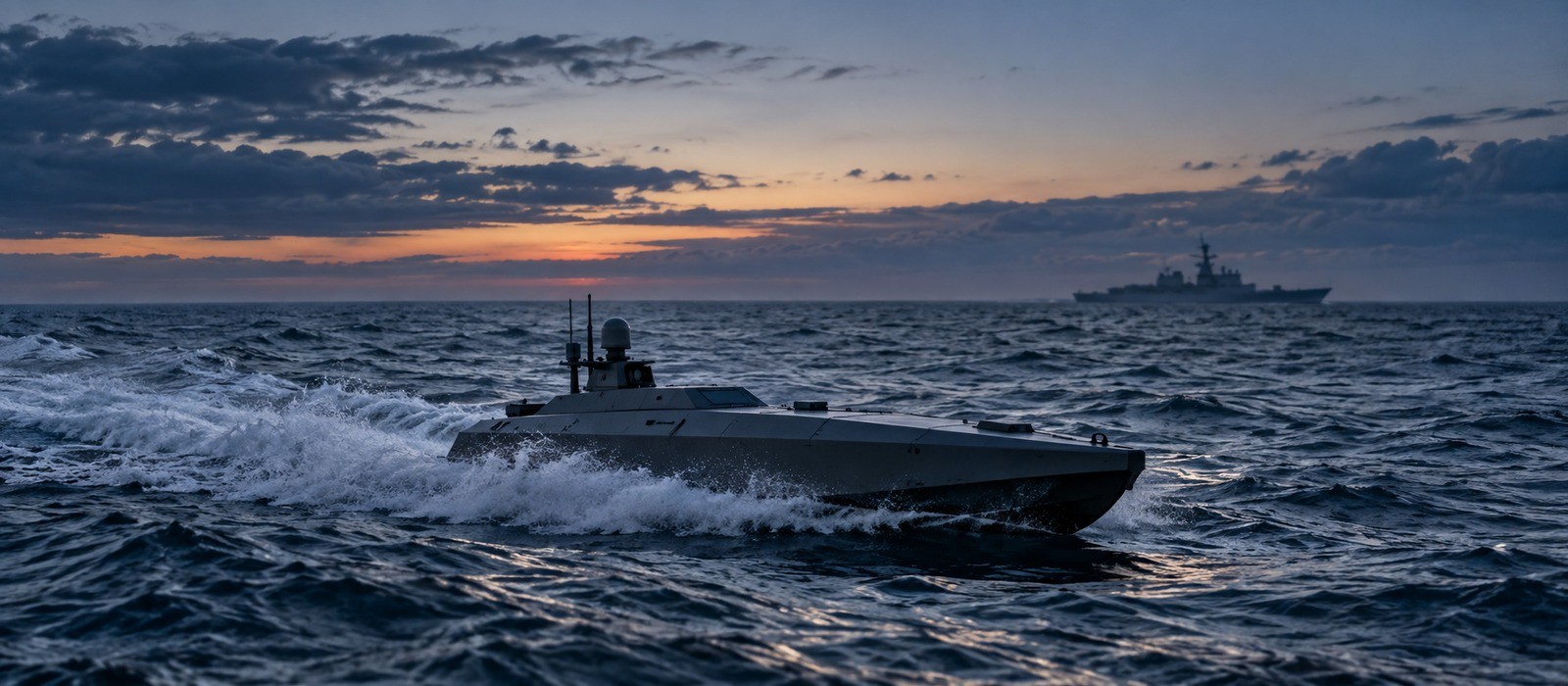


Abstract: Explosive-laden Unmanned Surface Vehicles (E-USVs) rapidly have emerged as a transformative element in modern naval warfare, offering a low-cost, high-impact solution for both state and non-state actors. While the concept of unmanned naval strike platforms dates to early use of fireships and WWI-era remotely guided boats, recent conflicts—most notably the Russia-Ukraine war and Houthi attacks in the Red Sea—have demonstrated the operational maturity and tactical effectiveness of EUSVs. Ukraine’s innovative use of these platforms has altered the balance in the Black Sea, enabling significant offensive actions despite limited naval assets. E-USVs are uniquely suited for anti-surface warfare, infrastructure attacks, and sea denial missions, particularly in geographically constrained waters. Their small size, low detectability, and increasing autonomy make them difficult to counter with traditional naval defences. As nations invest in development of USVs for broader mission sets, E-USVs represent a pivotal component in future naval strategies, particularly in contested environments dominated by Anti-Access/Area Denial (A2/AD) threats. However, the rise of E-USVs also demands robust defensive adaptations, including enhanced detection systems, revised fleet formations, and continuous crew training. This paper explores the historical evolution, tactical employment, and future implications of EUSVs, arguing for their growing significance in both offensive and defensive maritime operations.
Introduction
On 12 June 2024, Houthis struck Liberian flagged vessel MV Tutor in Red Sea with an Unmanned Surface Vessel (USV) resulting in sinking of the ship.1 Several other attacks were reported using USVs in the Red Sea in the sane year. This demonstrates a significant shift from Unmanned Aerial Vehicle (UAV) and Anti-ship missile attacks on shipping that ruled the headlines since last November.2
Use of explosive laden USVs, however, doesn’t represent a new tactic for Houthis as they have been using it since at least 2017,3 but it indicates a growing popularity of this kind of weapon system owing to its low cost, simplicity in design, deployment tactics and potential to cause damage on the target.
Whilst several technical advancements have been made in the field of Unmanned Aerial Vehicles (UAVs) and Unmanned Underwater Vehicles (UUVs); Unmanned Surface Vehicles (USVs) had not seen much application in Naval warfare. However, attack on Sevastopol by Ukrainian USVs in 20224 heralded a new chapter in the history of technological innovations in maritime operations, as was already the case with the modified ‘Taranto torpedoes’5 during the massive Pearl Harbour bombing, or the 1967 sinking of the Israeli destroyer ‘Eliat’ by P-15 ‘Termit’ surface- to-surface missiles.6 Navies are now investing in development of USVs and exploring missions where they can prove to be more effective than other traditional naval platforms and weapons.
Historical Uses of USVs
USVs have not developed as rapidly as UAV or garnered as much media attention, but they are not a new concept. Primitive unmanned vessels, such as fireships - loaded with combustibles, set on fire, and left to drift into enemy ships, have been in use for millennia.7
The very first unmanned vehicle, whether air, surface, or underwater, was a miniaturised boat named 'Teleautomata,' invented by Nikola Tesla.8 Subsequently, during WWI, the Germans deployed the 'FL-Boot,' a 17 meter vessel carrying 700 kgs of explosives, with the intent to use them against British Royal Naval vessels off the coast.9 The control mechanism was quite complex, with each boat equipped with a 20 km-long spool of wire to facilitate control signals. Observation was conducted by aircraft flying above, which sent radio messages to a control station regarding steering directions. Despite its powerful petrol engine and potential speed of 30 knots, the boats were not very successful due to the complexity of the control system.
During WWII, the Germans further developed a similar concept known as 'Linsen’.10 These high-speed boats were filled with explosives and featured a relatively simpler concept. Typically crewed by one person, theoperator would position the boat within the target's vicinity and then ‘bail out’ by jumping overboard. Subsequently, a control boat manned by an operator would steer the Linsen craft at high speed toward its target. Theoretically, this control boat would then pick up the original crew. Like other systems, there were several variants. The boats achieved a maximum speed of 31 knots from their 95 hp Ford V8 petrol engine and carried a charge of 300kg. The remote-control system utilized ultra-shortwave radio signals in the 7-meter band, employing various transmitted tones decoded into commands. This system allowed for functions such as steering, speed control, engine start/stop, and detonation. A contact fuse in the bow caused the bow to detach, while the main charge in the stern sank and detonated at a depth below the target, thereby increasing the explosive effect. During Operation Bruno in September 1944, Linsen boats were used to damage the lock gates of the port of Antwerp, disrupting Allied logistics.11
Several countries have been progressing efforts to develop USVs since. Fast forward to January 2017, a remote-controlled boat was used by Houthi rebels of Yemen to strike the Saudi frigate ‘Al Madinah’ 30 kilometres from Al Hudaydah.12 Al Hudaydah is a port city on the western shore of Yemen under the control of Houthi militias. This event was significant in the domain of maritime warfare as it was the first time an unmanned vehicle was operated from a distance in real warfare environment and its full operational capability was demonstrated.13 The event changed the configuration of the maritime battlefield, its strategies, tactics and contributed to accelerating the efforts of countries to develop their own USVs. Presently research and development are on to develop USVs to address almost all roles of ships at sea14 and they are being pitched for 3 D missions – called Dull, Dirty and Dangerous.15
Why USVs?
Certainly, there are some advantages and disadvantages of USVs compared to other unmanned system. Some advantages supporting USV development relate to their ability to maintain constant presence in Area of Operations. USVs that harness solar, and waves can maintain constant presence in an area for extended durations of time unlike UUVs and UAVs. USVs also provide cross domain capability, allowing a single platform to collect data or transmit data in all three mediums -surface, sub surface and
air. Another advantage is payload capacity. Due to their size, USVs can carry larger payload and be multi-mission capable. Modularity also provides the ability for a single hull form to be used for multiple missions with different payloads.
Despite their growing operational utility, Unmanned Surface Vehicles (USVs) face few operational limitations also that may affect their effectiveness in contested maritime environments. USVs are particularly vulnerable to electronic warfare, including jamming and spoofing of navigation and communication systems, which can lead to loss of control. Their stealth profile is inherently limited due to surface visibility and radar exposure, making them more detectable compared to underwater platforms. Their speed is generally lower than aerial platforms, and their performance can be significantly degraded in high sea states, where rough conditions may impair stability, sensor accuracy, and mission reliability. The table below draws comparison between UAVs, UUVs and USVs.

Table 1: Comparison between UAVs, UUVs and USVs
SWOT Analysis of USVs
The figure below shows SWOT analysis of the USVs. The analysis reveals a platform with significant strategic value in modern naval operations. Their strengths include cost-effectiveness, reduced risk to personnel, and adaptability across missions such as surveillance, mine warfare, and strike roles. Opportunities lie in the integration of artificial intelligence, autonomous swarming, and expanded use in asymmetric maritime environments. However, USVs also exhibit few weaknesses, including limited stealth, susceptibility to electronic warfare, and operational constraints in high sea states. Furthermore, threats such as electronic warfare, legal ambiguities, and counter-USV technologies pose challenges to their future deployment.

Fig 1: SWOT Analysis
Considering the advantages associated with USVs several countries including India are progressing efforts to develop these systems. On 31 January 2022, eighty unmanned surface vessels from 10 different countries participated in the International Maritime Exercise 2022, West Asia’s largest maritime exercise.16 The exercise was led by US Navy fifth command in the Red Sea, the Gulf of Oman, and the West Indian Ocean region. Apart from being the largest maritime exercise in West Asia, it was also the largest unmanned exercise in the world.17 Some of the front runners in research and development in USVs are Israel, USA, Turkiye and Italy and have operationally deployed some of these vessels. USVs are finding usage in variety of roles, including: -
- Ocean Data Collection and Survey/ Scientific research. One area where USVs are being used extensively is ocean data collection. USVs like Sail Drone and Wave glider can operate autonomously for months.18
- Maritime Security. Various USVs like Protector from Israel and Marlin from Turkiye have been developed especially for port security.19
- Mine Countermeasures. Considering the dangers associated with mine countermeasure operations, USVs are well suited for these roles.
- Surface Warfare. USVs are being developed capable of firing missiles and torpedoes. Explosive-laden USVs (E-USVs) have also emerged as a potent category, and this paper focuses specifically on their use.
- Special Operations Support. USVs also support special operations. These vessels can be used for insertion, extraction, and fire support for Special Operations.
Analysis of E-USVs in Russia-Ukraine War
When Russia invaded Ukraine in February 2022, the latter barely had a navy.20 The defenders even scuttled their one frigate to prevent Russia from seizing it.21 Two years later Ukraine is achieving significant maritime successes in the Black Sea.22 Its victories have been crafted through rapid technological innovation: Ukraine has built a fleet of E-USVs and the most glaring use of these in offensive role has been in the Black Sea against Russian targets.23 It is estimated that around 20 Russian ships have been sunk by such attacks.24 Ukraine, without a traditional navy to speak of, has staved off attacks from Black Sea fleet whilst slowly dismantling Russian dominance over the Sea by attacking ships in ports and at sea. This is the first instance in which E-USVs have been deployed in conventional war scenarios and are proving to be highly effective. We can anticipate that such weapons, or even more sophisticated ones, will soon become widely available and be deployed by both state and non-state actors considering Ukraine's repeated demonstration of this tactic. This paper therefore attempts an analysis of this new maritime weapon based on its operational use in the Russia–Ukraine war.

Fig 2: USV Attacks in the Black Sea in 2022-202325
The E-USV attacks in the Black Sea (as well as the Red Sea by Houthis) have demonstrated their precise targeting abilities, which can focus on specific areas of a ship. This capability, typically found only in the most advanced anti-ship missiles, allows critical areas of the ship such as the rudder, engine room, hatches and previously attacked locations to be targeted. USVs strike vessels at the waterline, and this, combined with their large warhead payload, has the potential for significant water ingress and damage control issues. Even if the ship does not sink, it may be rendered inoperable for an extended period after such an attack.
The E-USVs reduce the risk of collateral damage. In naval warfare positive identification is critical prior to engagement, particularly when enemy ships take refuge in busy International Shipping Lanes (ISLs). Engagement with torpedoes, anti-ship missiles create of catastrophic collateral damage. However, an E-USV with man-in-the-loop control can navigate around neutral vessels and reduce such risks.26
Compared to a UAV or UUV, the E-USVs have the additional benefit of enabling delivery of large explosive payloads over significantly longer ranges. They also pose a serious concern since they are difficult to detect from a distance due to their small size and low infrared signals. This makes early warning systems less effective. Latest developments also indicate efforts to develop submersible E-USVs or Low-Profile Vessels which can approach targets in semi-submerged state to reduce the detection ranges and then carry out attack.27
The events of Black Sea have also shown that E-USVs can be used effectively for sea denial missions if they integrated with aircraft reconnaissance missions. The mere presence of E-USVs is restricting the Russian Navy from operating freely in the Black Sea which has resulted in Ukraine successfully breaking blockade28 by establishing its own grain corridor and stretching Russian supply lines beyond the areas of operation of E-USVs. The war has already shown supply lines are critical and although, these E-USVs make headlines only when they sink a ship, but their mere presence is having a much larger impact on the war.
The warships have built in redundancies and damage control organisation which enable them to recover from an attack. They can also defend themselves from incoming attacks. E-USV attacks have therefore been conducted in swarms coordinating attacks from multiple directions on the target vessel. Usually, crafts have focussed on attacking the rear of the vessel to render them immobile and then attack the previously attacked locations on the vessel. However, not every E-USV attack has resulted in sinking of the vessel indicating limitations of attack near the waterline. In the case of attacks on merchant vessels, single E-USV has sufficed as these ships are neither defended nor have damage control organisations akin to warships.
Success of E-USVs is also changing the perception about USVs wherein they are being seen as complete solution in the ‘kill chain’ ranging from detecting a target to attacking it.29 Usually, naval warfare includes detection of probable target with one sensor and attack with another weapon. E-USVs on the other hand are useful as a self-sustaining unit from detection to attack themselves.
The E-USVs can be used for attacking not only ships but infrastructure also. The attack on Kerch Bridge in July 2023 which rendered it partially unusable was purportedly carried out by E-USVs.30 The final attribute is the cost effectiveness and simplicity of design and development which make them ideally suited for prolonged wars where supply lines of critical weaponry or spare parts may not be ensured. Even retro fitment of existing boats and jet skis can be carried out to turn them into E-USVs.
Offensive Employment Concept - E-USVs in Naval Warfare
E-USVs are particularly suited for anti-surface warfare missions. Innovatively integrated with naval operations they present a formidable threat to the enemy. However, owing to their characteristics E-USVs present greater threat in geographically constrained areas such as harbours, narrow straits and confined seas. These weapons can be deployed in the anchorages, outside enemy harbours and near areas where traffic converges such as straits. An attack on a ship in channel can be used for blocking of harbours by sinking ships in the narrow channels.
In the open sea the E-USVs will have to be kept in wait and watch mode to attack on opportune targets. Such systems coupled with renewable energy sources like solar can effectively be deployed in the areas for extended durations waiting for their targets to be detected. The low abovewater profile of the platforms makes them difficult to be detected by radar and visually. A batch of E-USVs integrated with the network centric operations can thus be re-positioned to carry out attacks on enemy combatants based on developing Maritime Domain Awareness (MDA) picture. They can be thus used in sea denial role and will prove to be cheaper than other means of sea denial missions like submarines. The E-USVs can also be deployed from ships such as amphibious platforms to extend their reach from operating bases.
In a maritime environment characterised by more and more potent A2/AD systems E-USVs stand to play a vital role by operating where other surface platforms cannot reach till a level of enemy degradation has been achieved.31 E-USVs can be used for targeting ships which form the sensor layers of A2/AD systems thus making way for the operations of the larger naval platforms within the A2/AD umbrella.
For offensive employment to be truly effective the E-USVs need to have satellite communications capability and long endurance which will ensure deployment of the vessels at longer distances in search of their target. The more widely available are the ones controlled by RF and are restricted by the distance at which these can be deployed. Innovative strides in communication are very essential to truly realise the potential of E-USVs as has been achieved by Ukraine.32 With the use of commercial Starlink satellite communication systems Ukraine has been able to operate its EUSVs like loiter surface munitions at great distances from operating bases.33 Therefore, satellite communication or MESH radios with relay through an airborne platform is required to ensure greater effectiveness of the weapon. Considering the offensive actions possible with E-USVs they represent a significant asymmetric weapon of the contemporary naval warfare capable of striking ships and infrastructure alike.
Defences against E-USVs in Naval Warfare
Considering the operational utility of E-USVs, proliferation of this tactic in naval warfare is inevitable. Accordingly, it is essential that own warships are adequately prepared to counter these threats. Maintaining a high level of readiness and constant surveillance for early warning will be the major actions that ships need to undertake in E-USV operational areas. Therefore, it will be essential to keep weaponry, watertight integrity, and machinery in high states of readiness. However, with current sensor systems, providing early warning may not be simple. Due to their small size and infrared signature, E-USVs are difficult to be detected from distance great enough to provide an early warning system. Continuous maintenance of optical, radar and EO-IR surveillance will be required. One of the best ways to improve early warning against E-USVs is through aerial surveillance. In this manner, it is possible to identify E-USV activities ahead of time and take the appropriate safety measures. Use of passive sonar systems to detect propulsion noise of approaching E-USVs may also be appropriate tactic in some cases to ensure early detection.34 Training will be the most important component of defence. Continued training of crews in identifying and engaging suspicious crafts as is undertaken in Force Protection Measures will be required.
To reduce the risk, it is also necessary to maintain close escorts for ships with insufficient defensive capabilities in areas where E-USV attacks are a real possibility. Re-evaluating surface warfare tactics in terms of ship formations is also essential in light of this new threat. The key to figuring out what capabilities need to be developed in order to destroy E- USVs is to find solutions that eliminate asymmetricity. These solutions will include sensors that can give early warning against small targets like USVs and weapons systems that can impact or prevent a fast-moving target from reaching the ship.35
Future Technological Advancements in E-USVs
The future of E-USVs will be significantly shaped by advances in AI, enabling greater autonomy, real-time target recognition, and coordinated swarm tactics. AI-driven swarming could allow multiple USVs to execute complex, synchronised attacks on high-value naval assets, overwhelming traditional defences. Technological advancements will enable USVs to morph into more roles in naval warfare. In a recent event Ukraine used USVs in air defence role wherein Magura USVs of Ukraine fitted with AIM-9 missiles have successfully shot down Russian Su-30s over the Black Sea.36 The versatility of USVs will therefore enable it to complement more traditional naval warfare tactics as technology continues to evolve.
However, these capabilities raise serious ethical and legal concerns also, particularly around autonomous lethal decision-making without human oversight, the risk of accidental escalation, and compliance with international humanitarian law. As these systems proliferate, nations will face urgent challenges in defining rules of engagement, accountability for AI-driven actions, and safeguards to prevent misuse or unintended conflict.
Conclusion
E-USVs offer promising capabilities and supplement the offensive potential of naval forces. Through attacks on ships in Red Sea and Black Sea, belligerents have demonstrated the innovative use of these new maritime weapons. Some may argue that offensive use of E-USVs is not revolutionary in naval warfare but a modern development of a tactics that date back centuries. But the ability to build a weapon that can attack moving targets accurately from hundreds of miles away without putting the operator in risk, swiftly, and cheaply, using mostly widely accessible parts from the market, is revolutionary. Considering the potential of USVs in maritime battle space Indian Navy has also taken steps in the right direction and launched its roadmap for unmanned systems. As has been brought out in the paper, E-USVs are the new maritime weapon, and navies need to invest in offensive employment of these weapons as also invest in developing counters for them.
Prolonged wars such as ongoing Russia-Ukraine war reinforce the criticality of war time logistics. E-USVs offer a cost-effective system that navy must focus on development as they are simple in design and can be assembled with readily available commercial systems obviating the need for ensuring supply of critical components of sophisticated weapon system. And finally, E-USVs are bringing paradigm shift in the maritime warfare. The greatest challenge to the navies operating in contested environment is from A2/AD capabilities of the adversary. As more technologically advanced weapons are developed which threaten the ships unmanned vessels will provide the answers.
The lessons from war in the Black Sea may not, however, be universal. Certain features of Ukraine's creative approaches may not work in more open waters. Open-ocean conditions may allow warships to operate at safer distances from USV operational ranges from shore. On the other hand, most naval engagements over the course of history have taken place in rather confined coastal waters. These weapons can therefore affect the direction of naval operations when combined with available intelligence and other capabilities.
Endnotes
- Nimah Kennedy and Michael Rios, “Ship Attacked by Houthi Rebels Believed to have Sunk at Sea,” CNN, 19 June 2024, https://edition.cnn.com/2024/06/19/middleeast/houthi-rebels-red-seaattacks-mv-tutor-intl/index.html.
- Hanna Duggal and Mohammad Hadad, “How Houthi Attacks on One of the World’s Main Maritime Trade Routes have impacted International Trade,” Aljazeera, February 22, 2024, https://interactive.aljazeera.com/aje/2024/mapping-red-sea-shipping-attacks/.
- Christopher P. Cavas, “New Houthi Weapon Emerges: A Drone Boat,” Defense News, 19 February, 2017, https://www.defensenews.com/digital-show-dailies/idex/2017/02/19/newhouthi-weapon-emerges-a-drone-boat/.
- HI Sutton, “Why Ukraine’s Remarkable Attack on Sevastopol Will Go Down in History,” Naval News, 17 November, 2022, https://www.navalnews.com/naval-news/2022/11/whyukraines-remarkable-attack-on-sevastopol-will-go-down-in-history/.
- “Taranto – The Impact and Long View of History,” Navy Wings, https://navywings.org.uk/portfolio/taranto-the-impact/.
- Gonzalo Vazquez Orbaiceta, “History Repeats itself: Lessons from the Attack on the Black Sea Fleet in Sevastopol,” Universidad de Navarra, 28 November, 2022, https://en.unav.edu/web/global-affairs/lecciones-del-ataque-a-la-flota-del-mar-negro-ensebastopol.
- “The Classical Association in Northern Ireland,” Wordpress, December 31, 2017, https://classical associationni.wordpress.com/2017/12/31/not-just-the-spanish-armada-someuses-of-fire-ships-in-the-ancient-world/.
- Kendal Miller Thompson, “I, Robot: Nikola Tesla’s Teleautomaton,” (2015), https://escholarsh ip.org/uc/item/4xr9r7rm.
- “German Explosive Remote-Control Speedboats of WW 1 and WW 2,” February 05, 2022, https://www.standingwellback.com/german-explosive-remote-control-speedboats-of-ww1-andww2/.
- Ibid.
- “Springboot Linse,” Wikipedia, https://de.wikipedia.org/wiki/Sprengboot_Linse.
- “Royal Saudi Navy Al-Madinah Class Frigate Damaged Following Attack by Houthi Militia off Yemen,” Army Recognition, January 31, 2017, https://armyrecognition.com/news/navynews/20 17/royal-saudi-navy-al-madinah-class-frigate-damaged-following-attack-by-houthimilitia-off-yemen.
- Dr Eyal Pinko, “Unmanned Vehicles in Maritime Domain Missions, Capabilities, Technologies and Challenges,” Maritime Strategic Evaluation for Israel, (February 2019): 82-94.
- Sanur Sharma, “Global Developments in Sea-Based Unmanned Crafts,” Journal of Defence Studies, vol 16 No 4, (October-December 2022): 21-50.
- Bernard Marr, “The 4 D’s of Robotisation: Dull, Dirty, Dangerous and Dear,” Forbes, October
- , 2017, https://www.forbes.com/sites/bernardmarr/2017/10/16/the-4-ds-of-robotization-dulldirty-dan gerous-and-dear/.
- Xavier Vavasseur, “IMX 2022: The Largest Unmanned Exercise in the World,” Naval News, February 08, 2022, https://www.navalnews.com/naval-news/2022/02/imx-2022-the-largestunmanned-maritime-exercise-in-the-world/.
- US Central Command, “Large Scale International Exercise in Middle East, Africa Concludes,” News, February 18, 2022, https://www.centcom.mil/MEDIA/NEWSARTICLES/News-Article-View/Article/2940622/large-scale-international-exercise-in-middleeast-africa-concludes/.
- “Energy Harvesting Ocean Robot,” https://www.liquid-robotics.com/wave-glider/how-itworks/.
- Tayfun Ozberg, “Marlin USV: Meet Turkiye’s Latest Drone Ship,” Naval News, September
- , 2022, https://www.navalnews.com/naval-news/2022/09/marlin-usv-meet-turkiyes-latestAn Operational View on The Unmanned Surface Vessels in Offensive Roles drone-ship /.
- “Ukraine has a Navy that Needs no Sailors,” The Economist, June 12, 2024, https://www.economist.com/the-economist-explains/2024/06/12/ukraine-has-a-navy-thatneeds-no-sailors#.Ibid.
- Paul Hockenos, “Ukraine is Winning the Wars Other Front,” Foreign Policy, April 02, 2024, https://foreignpolicy.com/2024/04/02/ukraine-war-black-sea-russia-front/.
- HI Sutton, “Evolution of Ukraine’s Maritime Drone,” Covert Shores, July 28, 2024, http://www.h is utton.com/Ukraine-Maritime-Drones-Evolution.html.
- Chloe Hoorman and Elise Vincent, “Ukrainian Naval Drone Attacks force Russian Fleet out of Crimea,” Le Monde, July 22, 2024, https://www.lemonde.fr/en/international/article/2024/07/22/u krainian-naval-drone-attacks-force-russian-fleet-out-of-crimea_6694576_4.html#.
- European Security and Defence, “Sea Drones at War: Tactical, Operational and Strategic Analysis of Maritime Uncrewed Systems,” September 05, 2024, https://eurosd.com/2024/09/articles/401 91/sea-drones-at-war-tactical-operational-and-strategic-analysisof-maritime-uncrewed-systems/.
- Michael McHugh, “Explosive USVs for Littoral Warfare,” Proceedings, vol. 149/12/1,450 (December 2023).
- “Ukraine has a Navy that needs no Sailors,” The Economist, June 12, 2024, https://www.ec onomist.com/the-economist-explains/2024/06/12/ukraine-has-a-navy-that-needs-no-sailors.
- Noah Berman and Merriel Ferragamo, “How Ukraine Overcame Russia’s Grain Blockade,” Council Foreign Relations, February 27, 2024, https://www.cfr.org/article/how-ukraineovercame-russias-grain-blockade.
- Bryan Clark, “Sea Drones in the Russia Ukraine War Inspire New Tactics,” IEEE Spectrum, July 10, 2024, https://spectrum.ieee.org/sea-dronU+0065.
- “Kerch Bridge: What is the Significance of Crimea Bridge and What Happened to it Amid Ukraine War?,” The Economic Times, July 17, 2023, https://economictimes.indiatimes.com/ news/international/us/kerch-bridge-what-is-the-significance-of-crimea-bridge-and-whathappened-to-it-amid-ukraine-war/articleshow/101836578.cms?from=mdr.
- Victor J Sussman, “USVs are Key in the Counter -A2/AD Fight,” Proceedings, vol./6/1408 (June 2020).
- HI Sutton, “Overview of the Maritime Drones of the Russia-Ukraine War 2022-24,” June 17,, http://www.hisutton.com/Russia-Ukraine-USVs-2024.html.
- Michael McHugh, “Explosive USVs for Littoral Warfare,” Proceedings, vol. 149/12/1,450, (December 2023).
- Hasan Ozyurt, “An Operational View on the USV Attacks in the Black Sea,” Naval News, February 18, 2024, https://www.navalnews.com/naval-news/2024/02/analysis-an-operationalview-on-the-usv-attacks-in-the-black-sea-from-an-admirals-eyes/.Ibid.
- Howard Altman, “Two Russia flankers Downed by AIM-9s fired from Drone Boats: Ukrainian Intel Boss,” 03 May 2025, https://www.twz.com/news-features/two-russian-su-30-flankersdowned-by-aim-9s-fired-from-drone-boats-ukrainian-intel-boss.
