


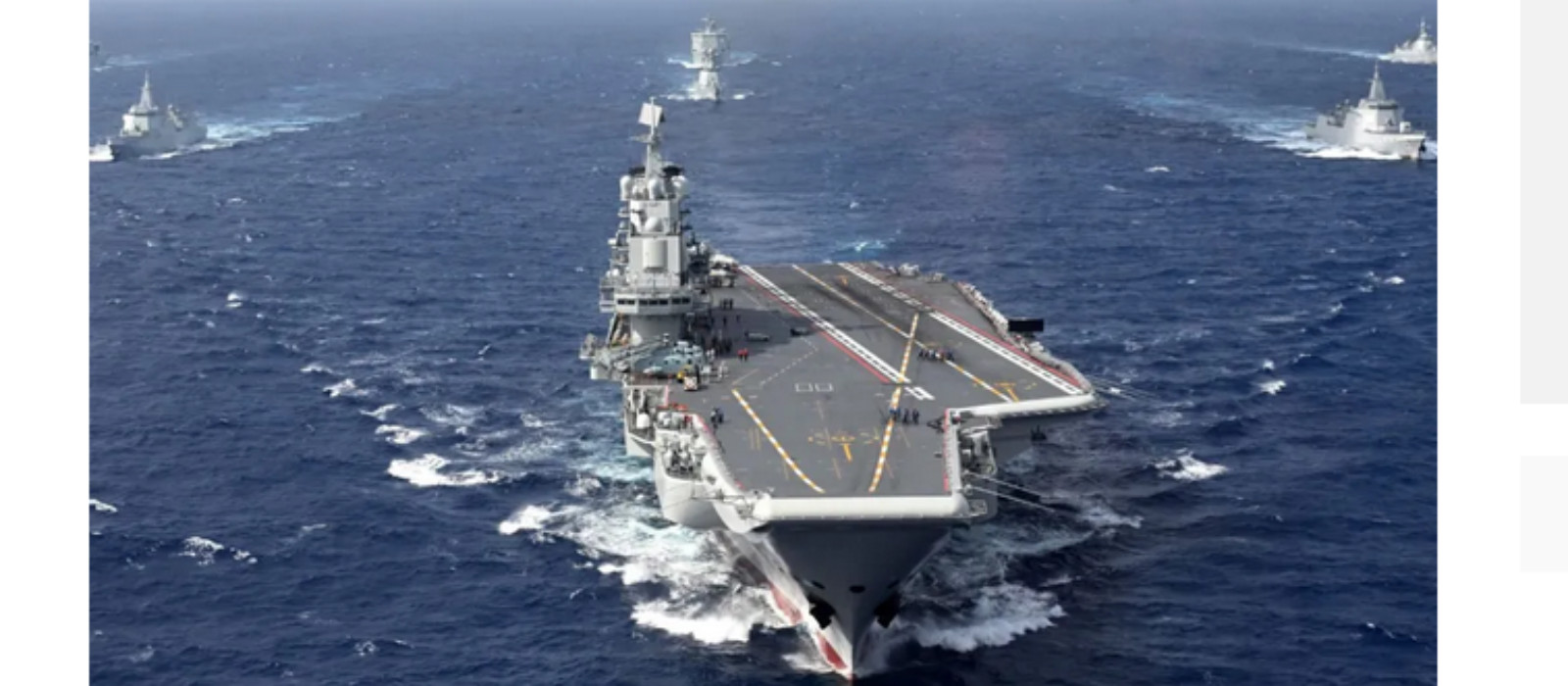


Abstract: China’s rapid expansion of aircraft carrier capabilities is reshaping the Indo-Pacific strategic environment, accelerating its transition from a near-seas defence force to a blue-water navy capable of sustained operations across multiple theatres. What began with the Liaoning as an experimental training platform has evolved into increasingly complex deployments involving the Shandong and the CATOBAR-equipped Fujian. Carrier groups now routinely transit the Miyako and Bashi Straits, operate east of Taiwan, and conduct multi-carrier operations, signalling improved aviation integration, long-range coordination, and command-and-control proficiency. These patterns reflect Beijing’s attempt to use its growing naval power and leverage its instruments for modern requirements of precision strike, multi-domain ISR, and extended-range manoeuvre.
Introduction
In the Western Pacific, China’s carriers could function primarily as instruments of presence, grey-zone coercion, and crisis signalling, though their survivability in high-end conflict remains constrained by dense U.S.–Japan ISR, submarines, and long-range missile threats. In the Indian Ocean Region, carriers could enhance China’s diplomatic reach and symbolic influence but face logistical limitations and strong regional presence of India and the US, reducing their wartime utility. Looking ahead to 2040, advances such as the Fujian’s EMALS, future nuclear-powered carriers, and emerging drone-carrier concepts will extend Beijing’s operational reach.1
China’s emergence as a formidable maritime power is reshaping the security architecture of the Indo-Pacific in profound ways. At the centre of this transformation stands the PLA(N) aircraft carrier programme, which has evolved from a modest experimental initiative into one of Beijing’s most potent instruments of maritime influence. While early discourse centred on the origins of PLA(N) carriers especially the refurbished Soviet-era Liaoning, the central issue today concerns how these platforms are being operationally employed across the Western Pacific and the Indian Ocean Region (IOR) to project power, shape behaviour, and recalibrate the balance of influence in littoral and open-ocean spaces.
Historical Analysis of Carriers’ Employability
Understanding how aircraft carriers may be employed in future crises requires a close examination of their historical use in major conflicts. The decisive role of carriers in the Second World War is especially significant. In the Pacific theatre, battles such as the Pearl Harbour attack, Midway and Coral Sea demonstrated that carrier aviation fundamentally altered the character of maritime warfare, shifting dominance from battleships to carriers. These engagements showed that effective carrier operations depend not only on technologically advanced platforms but also on deep pilot pools, high sortie-generation rates, well-rehearsed deck-handling cycles, and integrated support systems linking reconnaissance, logistics, and command networks. For modern navies, the Second World War provides both an aspirational model and a reminder that sophisticated hardware alone is insufficient without mature doctrine, rigorous training, and a resilient operational ecosystem.2
Short of wartime roles, aircraft carriers have long functioned as tools of crisis signalling. During the Cold War and the post–Cold War period, U.S. carriers were frequently deployed to communicate political resolve, deter adversaries, and assure partners from the Taiwan Strait to the Gulf.3 These deployments demonstrated the utility of carriers as flexible instruments capable of exerting psychological pressure, shaping regional perceptions, and influencing escalation dynamics without crossing the threshold into larger conflicts. In this respect, carriers emerged as potent diplomatic assets, projecting national power through visible presence.
Historical experience, however, also reveals the vulnerabilities of carriers in high-end combat. The Falklands War made clear that even highly capable surface groups face significant risk from anti-ship missiles, submarines, and disruptions to command-and-control networks. The conflict underscored the importance of layered air defence, strong anti-submarine warfare capabilities, and robust escort forces to protect carrier strike groups. It also highlighted the need for resilient communications, airborne early-warning platforms, and the ability to absorb attrition while maintaining operational tempo.4 These lessons continue to shape modern thinking about how carriers should be protected and how they ought to operate in contested environments.
Taken together, these historical cases point toward a hybrid role for aircraft carriers in contemporary strategy. They remain valuable for presence missions, crisis management, and political signalling, particularly in peacetime or low-intensity scenarios where visibility and symbolic power matter.. In high-end conflict, however, survivability considerations may require more cautious employment, greater reliance on escorts, distributed operations, and integration with land-based air and missile forces. The result is a balanced understanding of carriers, not as invulnerable capital ships, but as powerful and flexible assets whose effectiveness depends on doctrine, training, protection, and the broader operational system in which they are embedded.
Analysis of PLA(N) Carrier Programme
Beijing views aircraft carriers as essential components of a broader maritime strategy aimed at securing overseas economic interests, protecting vital Sea Lines of Communication (SLOCs), and challenging entrenched U.S. naval primacy. China’s evolving carrier posture reflects fusion of classical attributes of sea-power with twenty-first century operational concepts. China already dominates the South China Sea up to the First Island chain. They are making forays in and beyond the East China Sea and the Second Island chain and want to ultimately dominate the Western Pacific Ocean and northern Indian Ocean. China is trying to acquire more naval staging bases in the two regions. As part of its future strategy, Beijing will employ PLA(N) to control the near seas and project power in the far seas.5
Aircraft carrier construction is a unique programme which requires shipbuilding industry to uniquely programme itself (It is often said that work force/ resources required to construct an aircraft carrier is akin to constructing 10 destroyers). It fails imagination that when Dalian shipyard had already geared up for aircraft carrier why did Jiangnan shipyard was tasked to build the third flat deck?6 A number of factors help explain China’s decision to diversify construction of the third Type 003 aircraft carrier to a new shipyard. Competitive bidding is an unlikely driver, as all major shipbuilding facilities fall under the centralised control of the China State Shipbuilding Corporation (CSSC). Far more plausible is the need to diversify and optimise industrial resources by distributing major naval programmes across multiple yards, thereby reducing bottlenecks and better utilising China’s extensive shipbuilding capacity. This approach also enables the development of carrier-building expertise in more than one shipyard, strengthening industrial resilience and ensuring a broader skilled workforce for future projects. The most compelling justification, however, lies in Beijing’s ability to accelerate construction through modularisation and multi-yard contracting, particularly once the design of future nuclear-powered “super-carriers” is likely standardised. Parallel module production in multiple shipyards would significantly compress build timelines. Given these trends, it is highly plausible that China may eventually roll out two carriers simultaneously, potentially of the Type 004/05 or Type 005/06 classes.
Future Pathway. PLA(N) carrier development trajectory reflects a steady progression from refurbished platforms to increasingly sophisticated indigenous designs. The Type 001 Liaoning, commissioned in September 2012, marked the starting point with a 60,000–65,000-ton STOBAR configuration primarily suited for training and early operational deployment. Its successor, the Type 002 Shandong, entered service in December 2019 with modest design improvements and a slightly larger 65,000–70,000-ton displacement, retaining the STOBAR system but offering better aviation facilities and reliability. China’s first true leap came with the Type 003 Fujian, an 80,000-ton CATOBAR carrier equipped with EMALS, commissioned in November 2025 and intended to deliver higher sortie rates and more capable air operations. The projected Type 004, expected around 2030, is envisioned at 100,000–110,000 tons with nuclear propulsion and integrated electric drive, enabling expanded ISR reach and long-range operations, thereby intensifying pressure on Taiwan and Japan.7 By 2035, the Type 005 is anticipated as an even larger 110,000–130,000-ton platform featuring nuclear propulsion, directed-energy weapons, and the capacity to operate modified J-20 fifth-generation fighters, UCAVs, integral tankers, and advanced surveillance aircraft, supporting continuous dual- theatre presence and more frequent Indian Ocean deployments. Looking further ahead, the Type 006 projected for 2035-40 remains conceptual, potentially representing either a refined follow-on to the Type 005 or a next-generation design based on lessons learned, intended for persistent multi-axis operations within an increasingly multipolar maritime environment.8 By this stage, the Liaoning may be decommissioned or relegated to a dedicated training role.
Operational Pause in Carrier Programme. The reason for the delay in implementing the fourth aircraft program is still unclear, despite high economical bandwidth, over capacities with two shipyards.9 Several possible factors may explain the apparent operational pause in China’s aircraft-carrier program. A delay in ship design remains a probable cause, as lessons learned from the Fujian may still be under consolidation, with Type 004 construction expected to begin only after Fujian’s commissioning. The nuclear reactor intended for a future nuclear-powered carrier also remains unproven, particularly since the power requirements for a carrier differ significantly from those of SSNs and SSBNs. Other broader strategic factors may be influencing timelines. These include a potential reprioritisation of China’s naval capability development toward asymmetric and disruptive technologies such as space systems, autonomous vehicles, and AI enabled systems, illustrated by the construction of a drone carrier. Budget diversification based on threat assessments from the United States, aimed at enhancing Anti-Access/Area-Denial (A2AD) capabilities, is considered an unlikely driver since China already possesses substantial A2AD capacity within the First Island Chain. Similarly, consolidation of carrier operations is unlikely to be a primary factor because such activities can proceed alongside new construction. It is also important to note that two Chinese shipyards have already developed significant capacity for aircraft-carrier construction, enabling simultaneous modular production if required. Ultimately, only time will reveal which of these factors most accurately explains the current pause in the program.10
Evolving Deployment Patterns
The operational patterns of PLA(N) carrier deployments offer some insights into Beijing’s emerging maritime strategy. Since the mid-2010s, PLA(N) carriers have gradually expanded the scale, tempo and strategic ambition of their activities. What began as near-shore training evolutions has matured into recurring long-range deployments, increasingly sophisticated aviation operations, and coordinated multi-carrier activity.
Breakout through the Miyako/Bashi Strait. A central feature of PLA(N) deployments has been the frequent transit of carrier groups through the Miyako/ Bashi Strait, one of the few deep-water passages connecting the East China Sea to the Philippine Sea. These transits serve multiple operational purposes; they enable Chinese crews to practise movement through a constrained, heavily monitored chokepoint; they allow carrier groups to reach operationally relevant waters east of Taiwan; and they signal to regional states, especially Japan, that China is no longer confined within the first island chain. Once in the Philippine Sea, PLA(N) carriers regularly conduct launch-and-recovery cycles, long-range J-15 flights, deck-handling drills and escort manoeuvres, demonstrating steadily improving carrier-air integration.
Operations East of Taiwan. Carrier operations east of Taiwan have become a hallmark of the PLA(N)’s post-2020 pattern. These deployments allow China to rehearse encirclement and pressure tactics against Taiwan while simultaneously monitoring US and Japanese movements. They also provide China with the opportunity to train carrier operations in contested waters. Increasingly, these operations are integrated with land-based aircraft and PLA Rocket Force assets, suggesting an effort to develop multi-domain tactics suitable for grey-zone and crisis scenarios as well as for larger conflicts including the possibility of a peer-level war with the US involved.
Dual-Carrier Operations. Since 2022, China has carried out periodic dual-carrier operations, with Liaoning and Shandong operating in different sectors of the Philippines Sea. Although these manoeuvres remain limited compared with U.S. dual-carrier operations, they reflect steady progress in command-and-control and task group coordination. The PLA(N) is also experimenting with longer-duration, longer-distance operations that take carriers near the Western Pacific rim, allowing China to test communications, replenishment, and operational endurance in relatively less frequented waters. Collectively, these deployment patterns show that China is normalising the presence of large combatants beyond its coastal waters, in preparation for more assertive use of carrier groups in times of heightened tension.11
In 2024 Chinese state media released a series of videos that described China’s aircraft carriers and the carrier battle groups, including their history, composition, and operational theory.12 The video indicated operational philosophy in three zones of operations mainly, outer, middle and inner defence zones. The outer zone comprises of 01/02X submarines (SSN) and integral airwing operations, followed by middle zones with capable surface combatants like 01XRenhai, 01/02XType 052D, 01/02XType 054 and inner zone of integral self-defence weapons along with Close in Weapon System (CIWS) of surface combatants. Also, in late May 2025, Chinese aircraft carriers were observed operating within the First Island Chain. By June 2025, however, both carriers had shifted to exercises in the waters between the First and Second Island Chains, stretching toward Guam. Although this was not the first occasion where the two carriers carried out coordinated activities in distant waters, the pattern of deployment particularly in relation to the US Navy’s dual-carrier presence in the same area highlights Beijing’s intent to position its navy as a peer competitor to American naval power. The table below summarises carrier zones. 13

Operational Roles Across Strategic Contexts
PLA(N) aircraft carriers serve distinct and differentiated roles across the two primary theatres in which Beijing expects to operate i.e. the Western Pacific theatre and the Indian Ocean theatre. It will strongly influence oceanic countries in the Indo-Pacific and Indian Ocean, as well as smaller Southeast Asian states involved in the South China Sea disputes. Island and coastal nations such as Maldives, Sri Lanka, Seychelles, Solomon Islands and Fiji will come under increasing political pressure as China becomes more confident in sending carriers into their nearby waters. The visible presence of a Chinese carrier will make these states more cautious about criticising Beijing or supporting rival powers like India, Australia, the U.S. or Japan. Carrier visits, joint exercises and even humanitarian missions will help China build closer ties with political leaders and shape local opinion. At the same time, these states may feel further encouraged to accept Chinese-funded port and airport upgrades, maritime surveillance systems and security assistance, which will create long-term dependence on Beijing.
Western Pacific - Operating Environment.
The Western Pacific is a highly constrained and heavily monitored operating environment shaped by the First and Second Island Chains, with narrow maritime passages such as the Miyako Strait, Bashi Channel, and Luzon Strait, all under persistent surveillance by the United States, Japan, and Taiwan through satellites, patrol aircraft, submarines, and surveillance radars. This region presents significant risks due to dense ISR coverage, a high concentration of long-range missiles, strong U.S.–Japan undersea capabilities, and advanced opposing airpower, which together make close-in operations particularly hazardous. China’s aircraft carriers typically transit from coastal waters through the Miyako Strait into the Philippine Sea and areas east of Taiwan, conducting launch and recovery drills, long-range J-15 sorties, and dual or multi-carrier manoeuvres as part of their routine activities. Operating near home provides advantages such as proximity to China’s air and missile bases, enabling high-tempo air operations and rapid support. However, these benefits are offset by severe limitations, including vulnerability in chokepoints, exposure to enemy missile and air power, and a minimal ability to manoeuvre covertly or achieve surprise.14
Scenario Building vs Risk Assessment
In the Western Pacific, their use aligns closely with the political and military imperatives of the Taiwan, East China Sea, and broader Western Pacific theatres.15 In peacetime, carriers act as tools of presence, demonstrating PLA(N) competence and signalling China's determination to shape regional dynamics. During grey-zone coercive operations, such as ADIZ intrusions or Taiwan-encirclement missions, carriers provide additional aviation capacity and ISR support to raise psychological and operational pressure on adversaries. In the event of a Taiwan crisis, carriers would likely support diversionary operations, airborne early warning (AEW) and extended ISR, complicating US intervention plans by creating multiple axis. However, in a high-end conflict, especially one involving the United States and Japan, carriers would face substantial survivability challenges due to long-range missile threats, submarine activity, and superior opposing air power, forcing the PLA(N) to employ them at standoff distances.16
In the South China Sea, China’s aircraft carriers and supporting forces could allow it to sustain a more consistent presence around disputed reefs, islands, and resource areas. Such a posture may make it harder for smaller claimants including the Philippines, Vietnam, Malaysia, and Brunei to assert their rights or contest Chinese activities. The capacity to quickly deploy aircraft and conduct regular patrols could reduce the willingness of others to resist and potentially encourage some regional governments to adopt more accommodating or neutral positions. Other major navies, especially of U.S. and Japan, may find it harder to operate freely as China asserts that it can “manage regional security” through its own forces. These measures could enhance China’s political influence, control of maritime spaces, and ability to shape the choices of smaller states without direct coercion.
Hence, in peacetime their presence is highly likely, with carriers primarily used for training activities and strategic signalling toward Japan, Taiwan, the Philippines, and indirectly the United States, with minimal operational risk. In grey-zone coercion scenarios, the likelihood is moderate, with carriers supporting encirclement manoeuvres, ADIZ pressure, and intimidation around areas such as Taiwan, the Senkaku region, and the Philippines, entailing a medium level of risk. During a Taiwan crisis, carrier involvement becomes medium to high, focused on providing airborne early warning, ISR coverage, and diversionary air operations, but accompanied by significant risk given the likely involvement of Taiwan, the United States, and Japan. In a high-end conflict, however, the probability of meaningful carrier employment is low; they would be restricted to distant standoff roles due to extremely high vulnerability, especially against U.S. and Japanese forces.17
Indian Ocean Region (IOR) - Operating Environment
The Indian Ocean Region presents a vast and dispersed maritime environment characterized by long sea routes, few islands, and several critical chokepoints such as the Straits of Malacca, Lombok, Hormuz, and Bab-al-Mandeb all vital for global trade and energy flows. Surveillance remains moderate, led mainly by India and the United States through aircraft, ships, and radar networks and is far less dense than in the Western Pacific. The threat landscape is shaped by strong Indian and U.S. naval presence. Although missile threats are fewer, Chinese carriers would still face risks due to long transit distances and limited regional support infrastructure. Carrier deployments would require transiting from the South China Sea through either Malacca or Lombok before entering the Bay of Bengal and further into the Arabian Sea or toward East Africa. Typical operations in this region include port visits, partner-building activities, limited patrols, and sea-lane protection missions. The wide-open waters provide room for manoeuvre and opportunities for diplomatic signalling, but these advantages are offset by significant limitations, including constrained logistics, long distances from mainland China, and reliance on a small number of overseas support points such as Djibouti, Gwadar, and Hambantota. 18
Scenario Building vs Risk Assessment
In the Indian Ocean Region, Chinese carriers will operate under a somewhat different set of circumstances and practical limitations. The IOR is vital to China’s economic security, hosting the key sea lanes that carry its energy imports and export-driven trade. However, China currently lacks the logistical depth required to sustain long-duration or high-tempo carrier operations in this theatre. Although facilities in Djibouti, Gwadar and Hambantota offer symbolic footholds, they do not yet provide the comprehensive support needed for large carrier groups for high tempo sustained operations.19
Hence, the roles and risks associated with PLA(N) aircraft carrier deployment vary across scenarios in IOR. In peacetime diplomacy and port-visit missions, the likelihood of deployment is high, with carriers serving primarily as symbols of presence and influence in countries such as the Maldives, Sri Lanka, Seychelles, Pakistan, and various East African states, with minimal operational risk. For Sea Lines of Communication (SLOC) protection, deployments are moderately likely, with carriers providing escort functions and reassurance to partners including Pakistan, Gulf nations, East African states, and China’s own commercial interests under medium levels of risk. During regional crises, carrier use is also moderately likely, focused on evacuation support, deterrence, and stabilisation roles, though the operational risk becomes high due to limited logistics and the presence of other major powers; possible situations may involve the Maldives, Sri Lanka, Myanmar, Pakistan, or Gulf states. In a high-end conflict, however, the utility of Chinese carriers in the IOR would be low, as they would play only minimal roles due to the prohibitive risks posed by Indian and possibly U.S. forces and the challenges of sustaining operations far from China’s main bases.20
Conclusion
PLA(N) carrier expansion marks a major shift in Indo-Pacific maritime dynamics, signalling Beijing’s ambition to transition from a primarily regional navy to a force capable of sustained operations across multiple oceanic theatres. In the Western Pacific, aircraft carriers may become central instruments of presence, grey-zone coercion, and crisis signalling. Their routine movement through chokepoints such as the Miyako Strait/ Bashi Channel and operations east of Taiwan allow China to demonstrate operational confidence, rehearse encirclement tactics, and complicate U.S., Japan intervention planning. These deployments also help China contest the information domain by projecting an image of growing maritime proficiency. Yet, despite these gains, the PLA(N)’s carriers remain vulnerable in a high-end conflict. The dense ISR environment, superior allied submarine forces, and long-range precision fires ensure that carriers would operate under constant threat, forcing them to function at standoff distances and limiting their warfighting effectiveness.
In the Indian Ocean Region (IOR), carriers offer China diplomatic reach, signalling capability, and symbolic reassurance to partners and host nations along key Sea Lines of Communication. Their presence supports China’s broader economic and political interests, particularly in regions such as the Arabian Sea, East Africa, and the Bay of Bengal. However, the lack of robust logistical infrastructure combined with long transit routes and potent Indian and U.S. capabilities severely reduces their wartime utility. As a result, carriers in the IOR are likely to remain instruments of influence rather than decisive operational tools during conflict.21
As China continues refining its carrier operations, expanding its overseas support network, and integrating advanced aviation systems, including the J-35, KJ-600, and future UAV wing, its carriers could increasingly shape regional security outcomes in situations short of war.22 In these contexts, visibility, signalling, and the ability to generate sustained presence matter more than raw combat power, giving Beijing valuable leverage in coercion, deterrence, and regional diplomacy.
Ultimately, PLA(N) carrier programme could shape Indo-Pacific security for decades to come.23 Its greatest impact will likely remain in peacetime and grey-zone competition, where presence and perception matter most, while in high-end conflict carriers will continue to face significant operational and survivability challenges.
Endnotes
-
China’s Fujian Aircraft Carrier Makes History with First Catapult Launches of J-35 Stealth F i g h t e r a n d K J - 6 0 0 A E W & C , ” D e f e n c e S e c u r i t y A s i a , S e p t e m b e r 2 3 , 2025, https://defencesecurityasia.com/en/china-fujian-carrier-j35-kj600-emals-catapult-launch/.
-
Rotem Kowner, “Passing the Baton: World War II’s Asian Theater and the Coming of Age of the Aircraft Carrier,” Education About Asia 19, no. 2 (Fall 2014): 68-73.
-
Lutz, R. C, “Third Taiwan Strait Crisis,” EBSCO Knowledge Advantage: Research Starters, 2023, https://www.eb sco.com/research-starters/history/third-taiwan-strait-crisis.
-
John Woodward, Patrick Robinson, and Graham Rhys-Jones, "One Hundred Days: The Memoirs of the Falklands Battle Group Commander," Naval War College Review: vol. 46: No. 2 (1993): Article 11, https://digital-commons.usnwc.edu/nwc-review/vol46/iss2/11
-
Kamlesh Kumar Agnihotri and Chemi Rigzin, “The PLA Navy’s Aircraft Carrier, The Fujian: A Symbol of China’s ‘Far-Sea Dominance, Aspirations,” National Maritime Foundation, July 31, 2025.
-
Bradley Perrett, “Chinese Carrier Aircraft Fleet Is Poised For Rapid Growth,” Aviation Week, June 20, 2023, https://aviationweek.com/defense/aircraft-propulsion/chinese-carrier -aircraft-fleet-poised-rapid-growth.
-
Morung Express, “China to Build Four Nuclear-Powered Aircraft Carriers,” February 06, 2019, https://morungexpress.com/china-build-four-nuclear-powered-aircraft-carriers
-
Congressional Research Service, China Naval Modernisation: Implications for U.S. Navy Capabilities—Background and Issues for Congress, April 24, 2025, RL33153, https://crsreports.congress.gov.
-
Wong Hayley, “China’s Aircraft Carrier No. 4 on Track with ‘No Technical Bottleneck’ Admiral Reveals in First Official Confirmation,” South China Morning Post, March 06, 2024.
-
Author Analysis.
-
Rush Doshi, The Long Game: China’s Grand Strategy to Displace American Order, New York: Oxford University Press, 2021.
-
Daniel Clayton Rice, "CMSI Note #6: Sharpening the Sword: Chinese Navy Aircraft Carrier Battle Group Defense Zones,” (2024). CMSI Notes 6, https://digital-commons.usnwc.edu/cmsi-notes/6.
-
Daniel Clayton Rice, "CMSI Note #6.”
-
Author’s understanding.
-
Sam Roggeveen, “Chinese Aircraft Carrier’s Voyage Hints at PLA(N) for ‘Post-U.S.’ Navy,” Nikkei Asia, May 17, 2024, https://asia.nikkei.com/opinion/chinese-aircraft-carrier -s-voyage-hints-at-plan-for-post-u.s.-navy.
-
Sudarshan Shrikhande, “Indian Naval Strategy and China,” Cross Currents: The New Geopolitics of the Indian Ocean, (Canberra: ANU National Security College Press, 2024): 31–xx.
-
Author Analysis.
-
Author’s understanding.
-
Sandeep Unnithan, “The Future Indian Navy: The Sandeep Unnithan Show, featuring Rear Admiral Sudarshan Shrikhande (Retd.),” YouTube video, November 14, 2025, https://www.youtube.com/watch?v=I9zMm78RT9c
-
Author Analysis.
-
Darshana M. Baruah, “China in the Indian Ocean: A Stronger Indo-Pacific Presence,” International Institute for Strategic Studies, May 22, 2025, https://www.iiss.org/ online-analysis/charting-china/2025/05/china-in-the-indian-ocean-a-stronger-indo-pacific-presence/
-
Gabriel Honrada, “China Swaps Jets for Drones in a New-Age Carrier Race,” Asia Times, November 10, 2025, https://asiatimes.com/2025/11/china-swaps-jets-for-drones-in-a-new-age-carrier-race/.
-
Suyesha Dutta and Suvolaxmi Dutta Choudhury, “Balancing Tides: India’s Competition with China for Dominance of the Indian Ocean Region,” Asia Pacific Foundation of Canada, April 24, 2024, https://www.asiapacific.ca/publication/balancing-tides-indias-competition-china-dominance-indian.
