




Background
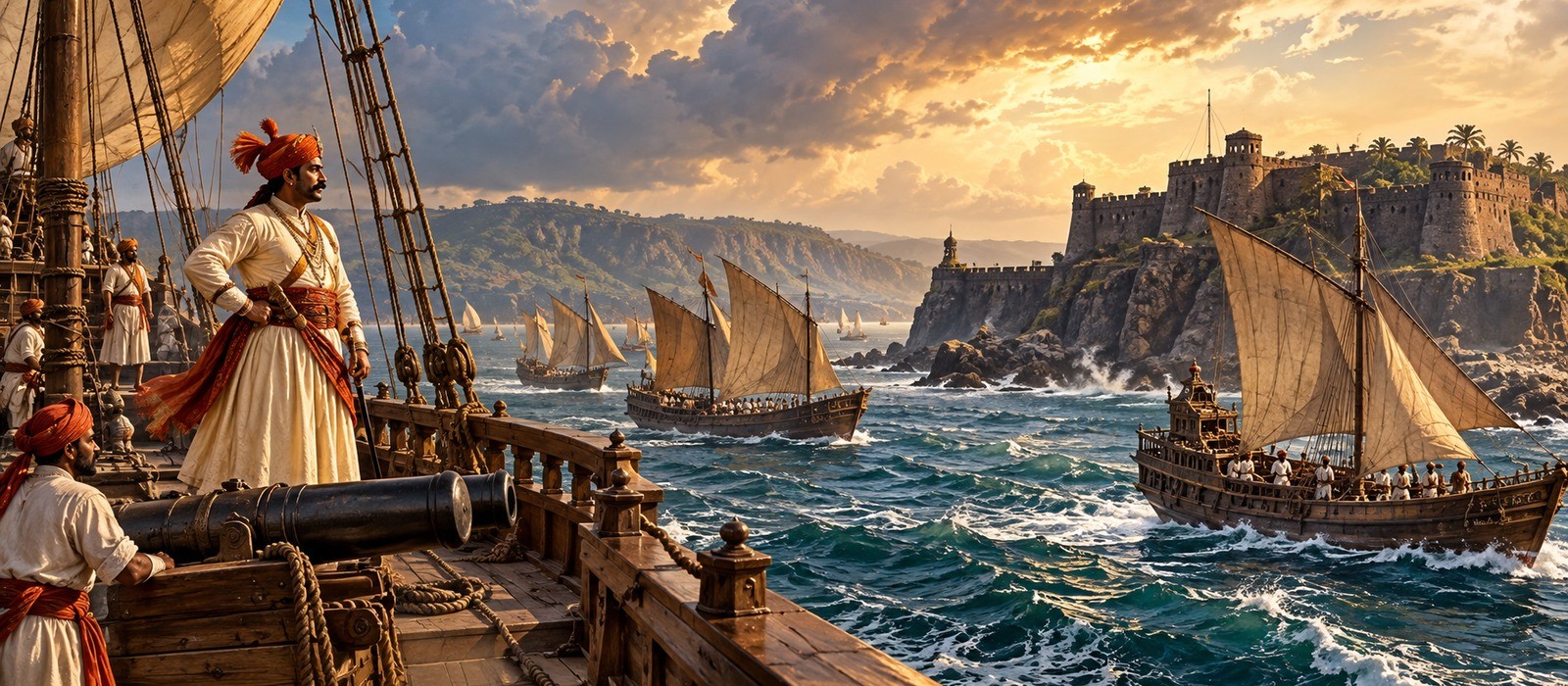
Even though the Western Coast of ancient and medieval India had a rich tradition of intrepid seafarers who engaged in maritime trade and commerce with the Gulf and East African countries, none attempted to establish a naval power to dominate the seas till Shivaji’s time. During his consolidation on land, he realised early that for the overall well-being and prosperity of his people, it was essential to have a fighting fleet of his own for defensive and offensive operations along the Konkan coast. The year 1659 holds special significance in Maratha military history because in this year Afzal Khan’s expedition was foiled and the hull of the first Maratha naval vessel was laid in a creek near Kalyan.1
Shivaji expanded his navy rapidly, which included the construction of multiple naval bases and fortifications along the coast of present-day Maharashtra. In February 1665, he led an expedition to Barcelore (modern-day Basrur), in a fleet comprising 85 frigates and three bigger ships.2 The Portuguese, who were the sovereign power at sea with their capital city at Goa, had acknowledged the strength of the Maratha Navy by sending an emissary during Shivaji’s coronation as Chattrapati in 1674. The coronation described Shivaji’s empire extending up to the limits of the oceans.3 However, it takes several decades to build a strong navy. Shivaji, in twenty years, could hardly be expected to create a powerful navy, but to his credit, Shivaji left a legacy of naval power behind. He had driven out the Siddis from the mainland; established control over Khanderi Island; and in 1670 had concluded a treaty with the Portuguese, for free coastal sea trade; and in 1680 with the English, for retention of control over Khanderi. His legacy was carried forward ably by Kanhoji Angre in the subsequent years.
Kanhoji’s Childhood and Early Naval Career
Kanhoji was born in 1669 in the small village of Angarwadi, six miles from Pune, from which he picked up the surname Angre. The original name of his ancestors was Sankhpal. Kanhoji’s father Tukoji had served at Suvarnadurg, under Shivaji, with a charge of 250 men.4 As a child, Kanhoji grew up among Koli sailors and was educated by a Brahmin at Harnai village near Suvarnadurg. Immediately upon completing his education, at a very young age, he joined the Maratha Navy to follow in the footsteps of his father to serve the motherland. Kanhoji was a bright lad with a sharp mind. Being a keen learner, he became adept at seamanship amongst the Kolis. Realising his motivation and dedication, Maratha Commander Bhim Rao, better known as Sidhoji Gujar, took Kanhoji under his tutelage. He quickly refined his skills in swordsmanship, riding, archery, map reading/ navigation and the use and deployment of cannons/guns. Kanhoji was part of the Maratha Fleet attack on the Siddis in October 1682 at the mouth of Thane River, in which the Maratha force was routed.5 Very early in his career, he learnt the bitter lesson that it was foolhardy to plunge into a naval battle without a detailed appreciation of the situation.
He made up his mind to fully acquaint himself with the strengths and weaknesses of the Maratha Fleet as well as of those of the adversaries. He sailed in different types of men-of-war; namely Gurab, Gullivat, Shibars and Pal and keenly observed and examined training levels and motivation of Maratha sailors, their expertise and professional competence in handling, manoeuvring and navigation of ships. He learned the nuances of the formation of ships, their deployment and tactics during encounters at sea. On his own initiative, on the quiet, he visited various types of warships of the Portuguese, Dutch, English and even the main adversary of the Marathas at the time-the Siddis. He gained detailed knowledge of their capabilities, training and tactics. He soon realised that compared to the Europeans and Siddis, the numbers and capabilities of the Maratha Navy were far less and inferior. Many of the ships were old and in a dilapidated state, lacking in sea and combat worthiness. The bulk of the crew consisted of Kolis and Bhandaris, a hardy race of coastal fishermen, known for their courage and endurance at sea. However, most captains of the ships were Muslims and the gunners and engineers were European mercenaries. The loyalties and leadership that a native has towards nation-building could not be expected of them. After Shivaji’s death, the Maratha naval officers were recruited on a recommendatory basis, and actual merit was given a go-by. Training and organisation left much to be desired. Professor SN Sen says in his book, “In its organisation, in the type of men of war, in its policy of selling permits and making prizes of merchantmen that didn’t possess it and in the art of science of Maritime warfare, the Maratha Navy remained where Shivaji had left it, until at the beginning of the next century when its control passed from a Chattrapati to a family of hereditary naval chiefs.”6
In 1688, the Siddis attacked Suvarnadurg in which Kanhoji was one of the Officers-in-Charge of 25 men. The fort commander, Achloji Mohite, wanted to surrender, but Kanhoji and his associates refused to do so, and in a coup placed him under arrest, ultimately managing to save the fort. Sambhaji, Shivaji’s son, who was Chattrapati at that time, thereafter appointed Kanhoji as Commander of Suvarnadurg.
Kanhoji’s Rise in the Navy and Consolidation of the Maratha Fleet
In 1689, on Sambhaji’s capture and death by Aurangzeb’s forces, his stepbrother Rajaram took over as the king. As he was also being hunted by the Mughal army, he escaped to the Jinji fort on the East coast of India. He was accompanied by his shadow cabinet including Sidhoji Gurjar, who was appointed as the Naval Forces Commander; Surkhel ( Admiral) by Rajaram. 7 Kanhoji was appointed as Deputy Commander and given charge of the northern coast of Konkan which included Suvarnadurg, Gheria (Vijaydurg) and Kulaba as major sea forts. In absence of Sidhoji, the overall responsibility of the Maratha Fleet fell on Kanhoji. At the time, he had 8-10 dilapidated ships under him. The overall situation was grim and the future looked bleak, as apart from the battered ships, the coastal forts and garrisons were battened down. There was hardly any income as the land of these forts was under Mughal army domination and the ships incapable of extracting any levy from merchantmen.
From 1689 to 1698, the Maratha Empire was in its worst phase as its ruler was in exile at Jinji and most territories were dominated by Mughal forces. Only isolated forts were being held by local Maratha Chieftains. Kanhoji utilised this period to consolidate his position and build up his Flotilla. After intensive training and workup, he started deploying his ships to police the coastal waters to extract tax (Dastak) from all merchantmen that didn’t carry Maratha papers. Apart from generating revenue, he aimed to drive home the message that the Western coast was the domain of Marathas. Vessels of all nations were attacked between Bombay and Travancore.8 In 1695, Kanhoji shifted his headquarters from Suvarnadurg to Kulaba sea fort, as it was strategically located between Siddis at Janjira and the English at Bombay. The Portuguese local base was also located in the near vicinity of Chaul. Both Khanderi and Kulaba provided him excellent monitoring posts over shipping in the area. In 1698, the Siddis blockaded Kulaba for six months and raided Angre’s territory, but he refused to be drawn out into a pitched battle with a superior force on the chosen grounds of Kassam Yakoot Khan. However, as the Siddis withdrew, Angre launched a counter-offensive and plundered the Siddis controlled territory around Thal. By now Kanhoji had transformed his Fleet into a cohesive fighting force. He had also reconquered large parts of the Konkan hinterland without much help from Rajaram.9 The locals and foreign powers had already started calling his fleet, ‘Angria’s Navy.’ Rajaram on his return in the summer of 1698 designated Kanhoji as Surkhel or Grand Admiral of North Konkan. Despite operating independently for nine years, Kanhoji had remained loyal to the house of Shivaji.
By 1700, Aurangzeb annexed Satara and Rajaram died during his escape at Sinhgad fort. Tarabai, Rajaram’s widow laid claim to the throne as a Regent of her son. Angre abstained from attending the transfer of power proceedings at Sinhgad, but declared himself as a servant of the throne, working for salt and bread. He had the least interest in courts and courtiers.10 By now Angre fully administered the coastline from Murud to Goa which was subject to Chouth levied by him. He had also started issuing tax permits (Dastak) to all ships plying off Konkan. This was despised and considered a hostile act by the Portuguese and English. The Portuguese had declared themselves as the sovereign power at sea and had imposed their own Cartaz from the early 16th CE. Even the Mughal and Siddi ships trading with Arab countries had to have Portuguese permits. East India Company (EIC) ships had also enjoyed free use of seas for almost a hundred years and considered it their right to do so. The Siddis had shifted their loyalties to Aurangzeb in 1677 and received annual maintenance of Rs 4.0 lakhs for their fleet. The English helped them with good quality gunpowder and cannons so that they could keep Angre engaged. The power of Siddis had gone up greatly on the Konkan coast and was practically unchallenged till 1683.11
All these powers were working towards cutting Angre to size. Between 1700 and 1707, the English targeted and seized all ships carrying Angre’s Dastak and the Siddis regularly raided forts and territories on land. Angre’s forces both on land and sea retaliated in equal measure. In 1704, Angre sailed with 7 Gallivats and anchored off Bombay. His mere presence blockaded Mumbai harbour, paralysing English shipping and trade. After a week he sailed back triumphant without firing a shot or exchanging a word with the English.12 There was a state of neither war nor peace, but both sides kept taking a heavy toll on each other. By 1706, the English had started calling Angre a Pirate as it suited them to show losses and gobble up Company’s profits. The EIC records state that Angre had taken various types of English-flagged vessels to the tune of lakhs of rupees.13
Kanhoji’s Commitment to the Navy during Maratha Power Politics
In 1707, the deaths of Aurangzeb and Siddi Kassam Yakoot set in motion a series of power realignment events. Sahuji, the grandson of Shivaji, held captive by Mughals since 1689 escaped and staked his claim to the Maratha throne as the rightful heir. Tarabai called him an imposter and refused to relent power. In October 1707, when their respective forces faced each other at Khed, Sahu’s minister Balaji, persuaded Tarabai’s powerful military commander to switch loyalties. Tarabai was forced to escape to Kolhapur and Sahu established himself at Satara. At the Panhala Conference, most Maratha Chieftains swore an oath to serve Tarabai. Kanhoji had not gone there but swore his loyalty to Tarabai. She announced him as ‘the Overall Commander of the Maratha Fleet.’ His new seal of office proclaimed Angre to be ‘Surkhel Forever and Viceroy of Konkan.’14 Siddi’s son, Rasool Khan realising the growing power of Angre, made peace with him, but a new landward threat emerged from Sahu’s forces. Kanhoji was however, not inclined to pick up a fight with Sahu’s Maratha forces.
He instead, utilised this period of uncertainty to focus on the consolidation of his fleet, fortification of coastal stations and strengthening of posts. The whole coast from Bombay to Goa was in his hands and there wasn’t a creek, harbour or river mouth where he had no fortifications and boat stations.15 He upgraded his Fleet on European lines, established shipyards and engaged hundreds of artisans to build ships. Sailors were trained, uniformed, disciplined and well-paid. His terms of service were the best, which attracted talent from the Dutch, Portuguese, Arabs, Muslims and Siddi Africans. This enabled him to build better and stronger ships and increase the efficiency of his equipment and men.16 By now, he had 10 Ghurabs (16-30 Guns) of 400 tons each, 50 Gallivats (4-10 Guns) and many other supporting vessels. He took special care and interest to work up his fleet into a combat-ready force.17
Kanhoji always strove not to have more than one enemy at a time.18 As his fleet was strong and the main threat remained from Sahu’s forces, he proposed and concluded a peace treaty with the Bombay Council in April 1713. In the following month, Sahu dispatched his Peshwa, Bahroji Pant Pingle to attack Kanhoji. Having foreseen such a contingency, Angre was well prepared for it. He allowed Pingle’s forces to come through the Bhor Ghat, and instead of a head-on battle, he went from behind and occupied Rajmachi and Lohgad forts dominating the pass between Deccan and Western Ghats thus, sealing off the escape route of the enemy. He completely routed the Peshwa and imprisoned him.19 He sent a message to Sahuji that he would soon be marching to Satara. In his continuing land campaign, Kanhoji took over seven more forts. Meanwhile on the seafront, in mid-1713, the Portuguese in conjunction with Siddis attacked Kulaba. He chose not to respond as his ships were already hauled up ashore out of the gun ranges of the Portuguese. After three months of siege, they withdrew. Sahuji in a desperate situation sent Balaji to negotiate with Angre. A treaty was ratified in Kulaba on 08 February 1714, according to which Kanhoji accepted Sahuji’s suzerainty as a Chattrapati as Tarabai’s claim was already usurped by Rajasbai, the second wife of Rajaram and her son Sambhaji. In return, Angre obtained control of 10 Sea Forts and 16 Land Forts, with rights of revenue of Rs 36 lakhs annually. Sahu also offered military assistance, whenever asked for by Angre. He was confirmed as Surkhel and Vazarat-Ma-Aab in hereditary perpetuity. Angre started signing his letters as ‘Kanhoji, son of Tukoji, Surkhel by the grace of King Sahu.’ His seal read ‘Sahu Karya Dhurandhar Tukoji Tamjanmanch Kanhoji Surkhaillasya Murdikeyan Vijarate.’20 Seeing this realignment, the Siddis also concluded a treaty with Angre in the presence of Balaji on 30 January 1715, resulting in a decade-long peace between them.
On securing his land fronts and having the benefit of assistance from Sahu’s forces, Angre focused his attention on the rising power of the English at sea, who weren’t following the 1713 treaty. Mr Charles Boone, the new Governor of Bombay, who had taken over in 1715, had embarked on the rapid addition of new ships and fortification on land. By 1718, he had added 19 ships carrying 220 guns, besides Bomb Vessels and Fire Ships. Secret orders were issued to seize or sink all ships encountered carrying Angre’s Dastak. On the other hand, Angre had been sparing ships genuinely belonging to the Company. This ended in April 1718, when Angre issued a warning stating that “our friendship is over and from this day forward, what God gives, I shall take.”21
With open hostilities, the EIC launched a secret attack on Gheria on 10 June 1718. However, Angre’s ships, because of the impending monsoons were already hauled up well inside the cove and a strong boom was erected across the channel. The intense shelling fell well short without any damage to the fort or ships. After this futile attempt, they returned to Bombay on 18 June 1718. Another attack was mounted on Khanderi from 05-14 November 1718, which was again repulsed by Angre’s men with heavy losses on the Company forces. After the attack, Angre’s ships from Gheria blockaded Bombay harbour for two of the best sailing months. In January 1719 when the English ships came out to seek battle, they found that Angre’s ships had already retreated.22
The EIC Fleet under command of Mr Brown again attacked Gheria Fort on 18 September 1720. During the initial bombardment, shots fell short. Another attempt was made to send in a landing party after further closing in by ships under cover of shelling on 29 September 1720. This assault also proved unsuccessful and the ships languished off Gheria till 18 October 1720. They finally sailed out for an attack on Angre’s Devgarh fort to help out the local Sawant of Wadi. The bombardment of Devgarh also had no effect. Mr Brown’s flotilla on their return passage to Bombay, on 22 October 1720, ran into pirates and in an ignominious fashion, the greater part of the fleet was harassed for two days by the pirates.23
After these repeated unsuccessful attempts against Angre, Mr Boone persuaded the Portuguese Governor into an alliance for a joint assault on Angre as the Royal Navy Squadron under command of Commodore Thomas Mathew had also arrived at Bombay on 27 August 1721. It had four warships with 110 guns. On 10 December 1721, the combined Anglo-Portuguese land force comprising of 6000 infantry, 200 cavalry troops, 8x24 Pounder guns, 8x18 Pounder guns and several small guns supported by 10 warships with 300 heavy guns launched an attack on Angre’s Kulaba fort.
Kanhoji, seasoned by numerous attacks on his forts, was well prepared as he had kept all developments under surveillance. His efficient spy network provided him with latest inputs. Angre could read the enemy’s plans like a book.24 In anticipation of events, he had already requested Sahuji to send land forces to help. An advance party under Pillaji Jadhav comprising of 1500 cavalry and 1000 infantry was already on standby near Alibaug. Kulaba Fort was adequately stocked up with provisions and ammunition and had 1000 infantry and 700 cavalry troops stationed within. Angre adopted an offensive defence strategy and asked Pillaji to launch a pre-emptive attack on the enemy’s base camp on 20 December 1721 with limited success. The final assault on the fort by English forces on 24 December 1721 was beaten back successfully by Angre’s defence. He asked Pillaji to attack the Portuguese forces waiting on the beach. The cavalry charge of 1500 Maratha men smashed through the enemy, scattering them in all directions. Pouncing on the opportunity, Kanhoji sent his cavalry from the fort on the retreating English. The ships under Commodore Matthew were of no help as the scene of action was beyond their gun range. The enemy force was completely defeated, on the morning of Christmas day, 25 December 1721.25
Kanhoji could have easily decimated the remaining Portuguese forces but chose to offer them a peace treaty from a position of strength. By now the remaining Maratha land forces of 25000 men under Bajirao had also arrived. The treaty was concluded on 9 January 1722, in which both parties agreed to mutual support and open their ports to each other. The Portuguese also agreed to supply to the Peshwa with much-needed guns and ammunition at reasonable prices.26 This revived the old rivalry between the English and the Portuguese as they blamed each other for the loss in battle. The Sawant of Wadi had collaborated with the Dutch to attack Gheria in January 1724 with seven ships having about 300 guns and 3000 men. This was also repulsed successfully by Angres’ men with heavy losses on the Dutch. By February 1724, Bajirao facilitated a peace treaty between the Sawant and Angre. In 1725, Siddi Rasool Yakoot Khan, well-supplied by the English with guns and ammunition, was persuaded to blockade Kulaba with a force of about 6000 men and more than 100 ships. Angre instead of taking him head-on, smartly bribed him into a settlement.27
From then onwards, Angre became bolder than ever and began to seek out the Company’s fighting as well as merchant ships and shifted to efficient administration and governance of Konkan for its overall prosperity. He built a fortified port at Purangarh in the Ratnagiri district. He established a township called Alibaug, the main village being today’s Ramnath. He introduced his coin called Alibaugi Rupaiya. He improved education, productivity of rice and established an efficient postal service. He was the first ruler of Konkan who thought about the conservation of forests.28 There was no naval power to challenge the supremacy of Angre’s fleet off the Konkan coast, right up to his death in 1729. Victorious alike over the English, Dutch and Portuguese, “The Maratha Admiral…” as an English historian declared, “…sailed the Arabian Sea in triumph.”29
Angre’s Strategy and Tactics
Shivaji, followed by his son Sambhaji, despite driving the Siddis out of land territories were unable to uproot them because of their fleet and the Janjira sea fort. This was evident to Kanhoji as a young lad during the futile assault on the Siddis in 1682. His long-term strategy therefore, was to build a strong Navy and strengthen fortifications along the coast. Only by doing so, the Maratha Navy would be able to exert its influence in the Konkan Coastal region. His aims and objectives were already set - to protect the Maratha merchantmen from pirates and foreign powers at sea, Maratha subjects were to be protected against depredations of the Siddis and the sovereignty of the sea was to be secured for the Maratha state. He worked relentlessly to fulfil his strategic vision. The forts were armed and provisioned against attack from the sea as well as a blockade. Dockyards were constructed behind the citadels. Expert craftsmen, artisans, shipbuilders and gun casters, which included foreigners, were employed and settled in localities developed behind the fortress. This was followed by the creation of operating bases, observation posts and anchorages all along the coast to supplement the fleet strength and gather intelligence. In his early days, he never attacked anyone or made any new enemies. He started deploying his ships innocuously in a policing role to extract taxes.
Angre shifted his Headquarters to Kulaba in 1695 as it was strategically located between the English and Siddi powers. He never lost control of Khanderi Island, which enabled him to monitor the shipping traffic in and out of Bombay harbour, being the hub of sea trade, as were the inland forts of Rajmachi and Lohgad used to keep watch on the movement between Konkan and Deccan.
He scrupulously avoided a major showdown with superior enemy forces. When the Siddis blockaded Kulaba in 1698, he refused to be drawn into battle on the chosen ground of Kassam Yakoot Khan. He advised his fort commanders also not to recklessly plunge into battle with superior forces and avoid unnecessary risks. The failed attacks of the English on Gheria and Khanderi were a result of such a strategy. On the other hand, he utilised his fleet to blockade enemy harbours effectively. Bombay Council got the message and felt it imperative to resuscitate the treaty of 1698. In 1713, when the Portuguese launched an attack on Kulaba, he again chose not to respond and after three months of siege, they had to withdraw in frustration without any damage to Kulaba fort or his ships as they were hauled up well out of range of Siddi ships.
He was fully aware that his ships were no match to the European ships, which had superior weapons, were better designed, more strongly built, capable of absorbing more punishment and had better sea-going qualities. As a corollary, he emphasized better tactics and leadership to utilise his own fleets’ strengths against the enemy’s weaknesses. He saw that the only way Marathas could overpower these superior ships was in hand-to-hand combat after boarding them. To achieve this, he resorted to the following tactics: -
-
Not to engage European ships at high seas, but instead chose his waters close to the coast and isolated them so that they were unable to provide mutual support.
-
He chose his Captains who were locals, daring, professionally efficient and familiar with coastal waters.
-
His ships invariably operated within the sight of their coast and kept themselves between the enemy ships and the coast. They attacked from the leeward side so that when the enemy ships turned to attack, their ships could drop away further to leeward and sneak into shallow waters or in the range of coastal guns. The enemy ships were often lured within their range. He had attained such a competent, professional reputation that a Portuguese writer had compared him to the famous Ottoman Admiral, Barbarossa.30
-
As the foreign ships closed the coast, they had to reduce sail and slow down. Angre’s ships lying in ambush in coves would then dash and chase them in their row boats. They would approach them from the rear to avoid a broadside, presenting as small a target as possible. When in range of their guns, they would straddle their rigging and quickly board them. He ensured that at least twice the number of swordsmen, as the crew on board the enemy ship, were sent in to engage in hand-to-hand combat.
-
Wolf pack tactics were followed to cater to the disparity of his forces concerning speed, seaworthiness and firepower. Kanhoji operated with large numbers of light craft, specially built for their speed and manoeuvrability, akin to the Maratha ponies used by Chattrapati Shivaji to create panic amongst the traditional Mughal armies in the Deccan.31
As brought out earlier, he generally strove to avoid having more than one enemy at a time. Realizing a greater threat from Sahuji, Angre concluded a treaty with the British in 1713, which essentially entailed the stoppage of hostilities between the two. The same year, keeping the larger interests of Maratha power in mind, he showed wisdom and moderation by making peace with Sahuji from a position of strength. He had already imprisoned Sahuji’s Peshwa, Bahroji Pant Pingle, sent to mount an attack on him. In acknowledging Sahuji’s supremacy, he recognized the right of the stronger of the two claimants (Sahuji vs Tarabai) to the title of Chattrapati. After the humiliating defeat of Anglo-Portuguese combined forces at Kulaba in December 1721, he again chose to conclude a peace treaty with the Portuguese from a position of strength. During the Maratha power struggle, as a military leader, he steered clear from state power politics and remained ever-loyal to the Chattrapati.
Conclusion
Shivaji Maharaj had striven to establish a Hindavi Swarajya, for which he laid a strong foundation with a national banner and common objective. Kanhoji Angre was inspired by Shivaji’s example of nationalism and therefore had joined the Maratha Navy at an early age. He grew up to be an intelligent, strong and professionally competent leader, who was dedicated to the cause of making the Maratha Navy strong in furtherance of the goal of nation-building. He rose rapidly in the Navy because of his administrative ability, initiative and ingenious thinking towards naval warfare and tactics. He mastered the art of guerrilla warfare at sea along the lines of Shivaji on land, avoided outright battles on the high seas with stronger adversaries and lured them to places of his choosing. Both during land and sea battles, he demonstrated evidence of not only good seamanship but also of wily diplomacy. On assuming the command of the Maratha fleet as Surkhel at a young age of 30, he displayed clarity of thought and strategic vision. Accordingly, he prioritized in-house creation of resources and facilities to build modern ships, fortify coastal defences, as well as neutralizing/weakening the threats posed by the Siddis, Portuguese, English, Dutch and Sawants of the Maratha state. He was prudent enough to enter into peace treaties with countrymen and foreigners alike, as the situation warranted at that time, and avoided opening many fronts at the same time. In his dealing with foreign powers, he could hardly be accused of treachery or faithlessness.
He remained loyal to the state, even when it was at its weakest after Rajaram’s death. He had a single-minded focus on strengthening the Navy, the Maratha state and always honoured treaties entered into by the State. He left behind an extensive province and respectable fleet to his heirs, which added immensely to the prestige and power of the Marathas. It can be said that if Shivaji was the founder, Kanhoji resurrected the Maratha Navy. His strategic vision breathed new life into the Maratha fleet and left behind a strong legacy for his successors to follow.
Endnotes
-
Surendra Nath Sen, The Military System of Marathas, (Calcutta: KP Bagchi and Co, 1958), 156.
-
Surendra Nath Sen, The Military System of Marathas, (Calcutta: KP Bagchi and Co, 1958), 156.
-
Ibid.,157.
-
Manohar Mulgonkar, The Sea Hawk Life and Battles of Kanhoji Angrey (Pune: Harper Collins, 2022), 15.
-
Sen, Op Cit., n.1, 171.
-
Malgonkar, Op Cit., n.3, 47.
-
Sen, Op Cit., n.1, 169.
-
Sen, Op Cit., n.1, 171.
-
Malgonkar, Op Cit., n.3, 84.
-
Malgonkar, Op Cit., n.3, 96.
-
KM Panikkar, India and Indian Ocean (London: George Allen and Unwin, 1945), 58.
-
Malgonkar, Op Cit., n.3, 115.
-
Malgonkar, Op Cit., n.3, 143.
-
Malgonkar, Op Cit., n.3, 129.
-
Malgonkar, Op Cit., n.3, 159.
-
Panikkar, Op Cit., n.10, 60.
-
Malgonkar, Op Cit., n.3, 160.
-
Malgonkar, Op Cit., n.3, 179.
-
Malgonkar, Op Cit., n.3, 183.
-
Malgonkar, Op Cit., n.3, 193.
-
Malgonkar, Op Cit., n.3, 214.
-
Malgonkar, Op Cit., n.3, 245.
-
Malgonkar, Op Cit., n.3, 266.
-
Malgonkar, Op Cit., n.3, 281.
-
Malgonkar, Op Cit., n.3, 286.
-
Malgonkar, Op Cit., n.3, 289.
-
Malgonkar, Op Cit., n.3, 308.
-
Malgonkar, Op Cit., n.3, 309.
-
Panikkar, Op Cit., n.10, 60.
-
Sen, Op Cit., n.1,172.
-
Panikkar, Op Cit., n.10, 62
