


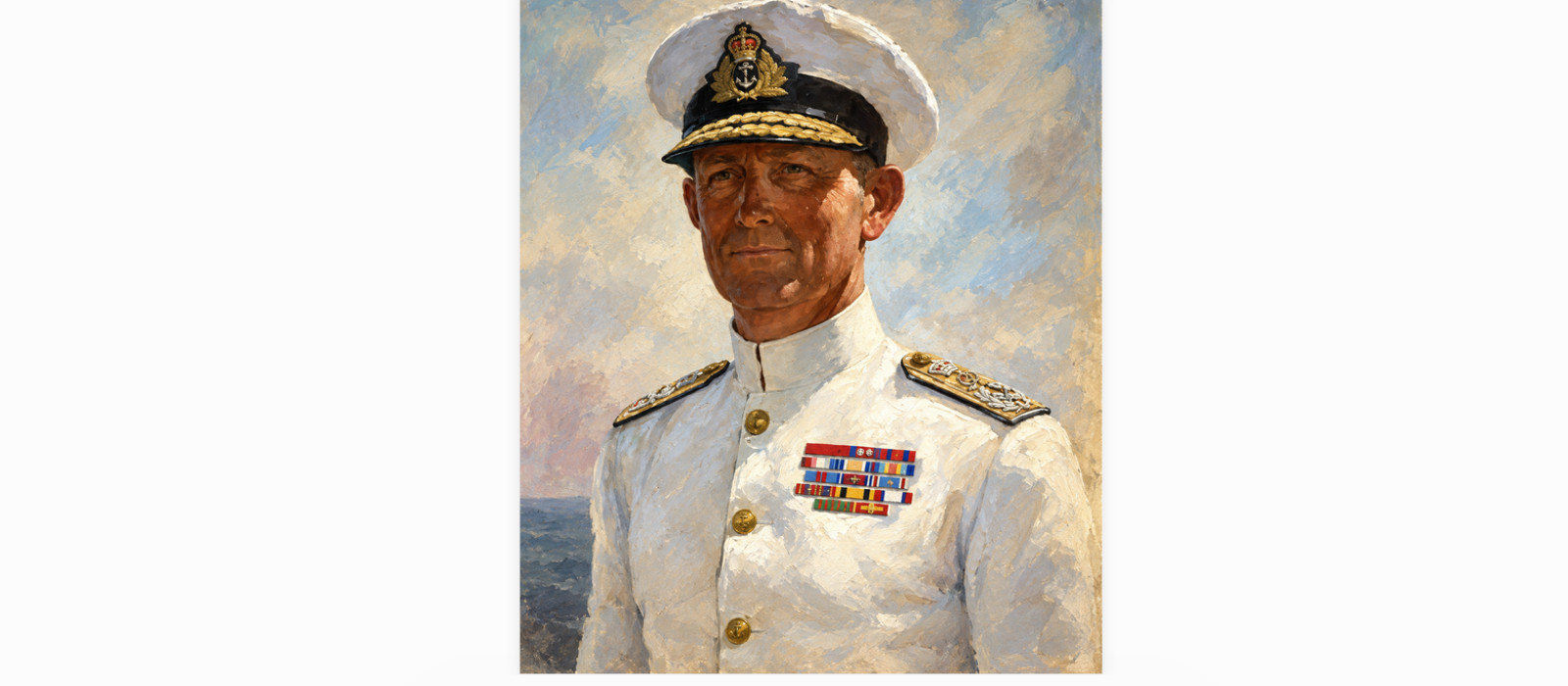


Countries have to often wage war in circumstances beyond their control. At that time, they are forced to fight with what they have at hand. Invaluable in such times, are senior leaders who are capable of pressing home the offensive in the face of heavy odds. Britain was lucky to have someone like that in World War II (WW II). Here is a brief account of that person, Admiral Andrew Browne Cunningham, known as ABC. This diminutive man was a giant, as a fighter. Naturally, he is second only to Nelson as a war hero for Britain. And mind you, he was no perfect man.
Extreme Higher Leadership
The Mediterranean was an important theatre for the Allies in WW II. They had to keep their Sea Lines of Communications (SLOCs) open, maintain their forces and disrupt enemy forces in North Africa, and defeat the Italian Navy. However, ABC, the Commander-in-Chief (C-in-C) of Britain’s Mediterranean Fleet, had very few resources and little hope of reinforcements. Most scarce was shore based air support and capital ships.1 But, the British were lucky. In ABC, they had a commander who was worth an entire army.2
From 05 June 1939, when he arrived in Alexandria as C-in-C, ABC kept up a relentless offensive. With victories at the battles of Taranto (November 1940) and Cape Matapan (March 1941), he defeated the Italian Navy.3,4 However, the Battle of Crete, which started on 20 May 1941, went terribly wrong and 32,000 British troops had to be evacuated to safety.5 ABC threw every ship he had at his disposal for the rescue. Time was very short, and the danger very high. In the absence of any useful air power of their own, the fleeing Allied forces were being hunted down by the German Air Force at will. Massive hits were being taken.
It was in these circumstances that ABC visited HMS Calcutta on 30 May 1941, as she limped into Alexandria harbour from Crete. In the previous days, the Calcutta had been in the thick of action, absorbing death and destruction, and watching ships going down around them. But, as the relentless operation continued, the Calcutta continued to brave the enemy, and provide anti-air protection to evacuation forces plying between Alexandria and Crete. For ABC, HMS Calcutta was not just another ship. He had been her Commanding Officer (CO) from 1926 to 1928. Only those who have commanded warships would know the paternal love for their ships that Captains carry to their grave.
Capt Dennis M Lees, the CO, spoke his heart and ABC listened carefully. Knowing ABC well, Capt Lees made a fervent plea against any further trip to Crete for more evacuation. But ABC had a duty to perform. He had great respect for the Army, and wouldn’t spare any effort to help them. He also didn’t see the Army, Navy and the Air Force as different entities. He saw them as one combined power that could win the war for his country and her allies. As Capt Lees feared, ABC ordered the Calcutta back to Crete. The ship sank the next day, about 100 nm north of Alexandria, resulting in the loss of about 150 crew.6 ABC was in tears, as he met the 250 survivors brought back the next day.
This disaster only further hardened ABC. He persisted with his offensive despite serious losses of ships and men. When General Wavell, C-in-C Middle East told him that he had done enough and that he didn’t have to risk ships and men the way he was doing, he told him that, “the Navy had never yet failed the Army in such a situation, and was not going to do so now, (and that) he was going in again that night with everything he had, which would float.” He also warned his staff against any thought of giving up, saying, “you can build a new ship in three years but you can’t rebuild a reputation in less than three hundred years.”7 Such is extreme higher leadership in war.
ABC - The Genesis
How did someone like ABC happen to the British Navy? Was it a fluke? By the time he joined HMS Britannia as a Cadet in 1897, at the age of 14, the Royal Navy (RN) was in the thick of the deterioration they had suffered in their warfighting skills in the nine decades since the Battle of Trafalgar, during which time they had no major battle experience. As a Midshipman, he gained operational experience as a part of the Naval Brigade fighting on land, alongside the Army in the Boer War.8 There he met young Lt Walter Cowan, ADC to Lord Kitchener, the Commander of the British Forces in South Africa.9 Cowan, 12 years older than ABC, took an immediate liking for the Midshipman. They shared a great passion for offensive action and were, both, destined to be legendary warriors. While ABC would rise to the rank of Admiral of the Fleet and become Britain’s star in WW II, Cowan would retire as an Admiral in 1931 and then, incredibly, accept the rank of Cdr at the age of 70 to fight in WW II as a commando for two years.10
From the time he was a SLt, ABC disliked big ships.11 On these ships, junior officers never got individual responsibility and were just minions. So he sought appointment on smaller ships and luckily got them. His appointment as Executive Officer (XO) HMS Locust, a 20 m long, 300 ton Torpedo Boat Destroyer in September 1903, turned out to be the beginning of a long association with Destroyers. On this ship, he had scope for initiative, opportunity to refine his seamanship, and a chance to shape a weapon system that was rapidly evolving. He has written about the excitement he got from bold and dangerous operations off the Greek coast, which had plenty of team work, action and opportunity to take instant decisions. He also loved his Captain, a virtual slave driver.
Promoted to Lt in 1904, he took a huge gamble. He opted not to undergo a specialization course. This was unthinkable in those days for an Executive branch officer. People were vying to get selected for Long Gunnery, Navigation and Direction or Communication courses. As a ‘salt horse’ in the Navy of 1904, he was aware, that he would have to display outstanding qualities as a Commanding Officer to merit promotions. But, this was exactly what he knew he could do. However, luck was not on his side for some time, and he spent the next four years on several big ships.
In 1908, at the age of 25, he got his first Command, a 270 ton Torpedo Boat.12 This was followed by the command of HMS Vulture, HMS Roebuck and finally HMS Scorpion, a 945 ton ship, which he was to command for seven years. This long shot at command was rare luck. ABC was also lucky to serve under superiors who were of the same offensive bent of mind like him. He also ended up serving in only one theatre, i.e. the Mediterranean, of which he developed deep knowledge. This was to stand him in good stead in the future as C-in-C Mediterranean. It also had its pitfalls.
WW I
World War I (WW I) gave ABC adequate offensive action. Owing to limited forces available in the Mediterranean, the flotilla of small ships had to do more than their fair share, including Mine Counter Measures (MCM), Naval Gunfire Support (NGFS) and escort of High Value Units (HVUs) in support of the Gallipoli campaign, for which he earned a Distinguished Service Order (DSO). Subsequently, he was also awarded a bar to his DSO. In 1912, he became a Lt Cdr and, on 30 June 1915, got accelerated promotion to the rank of Cdr.
The Gallipoli debacle suffered by the allies, of which he had personal experience, gave him lasting lessons for life. He learnt how to perform tasks unanticipated in peacetime, how to remain resolute under fire, how to improvise in action, and the need for inter-service cooperation. He also gained a deep love for the Army, whose raw fighting he would have loved to emulate. His competence in offensive action also impressed Adm Roger Keyes, C-in-C Mediterranean, a future Admiral of the Fleet. The admiration was mutual, as Keyes too was known for utter fearlessness. He also gained a reputation for stern discipline, high efficiency, adaptability, and a way with keeping warfare simple and straight. But, he was not a peoples’ man and was almost feared.
Between the World Wars
ABC’s fortunes steadily rose between WW I and WW II. One key reason was his lucky opportunity to command HMS Seafire, a Destroyer, in a flotilla under his old friend, Walter Cowan, who was now an Admiral.13 Cowan had become famous for his remark that, “he was disappointed that WW I had ended.”14 Such words were music to ABC’s ears. Cowan expected high standards of alertness and responsibility from his subordinates. He also told his Captains to constantly watch for officers who shine in emergencies and do well in difficult situations. He also wished that such officers be brought to the notice of the Admiralty, and that every effort be made to ensure their advancement in service. ABC easily fitted this description and Cowan’s reports are perceived to have been influential in his becoming a Flag Officer. He was promoted much ahead of his peers to Capt in 1920, at the age of 37.15
Post WW I, as the Navy was downsizing and officers were being laid off, ABC was retained, having been identified as a future leader by the Admiralty. He had displayed sustained war fighting skills and courage under real fire to merit deep selection. There could be another reason. Jolted by the setbacks of WW I in general, and the Jutland debacle in particular, RN was seeing a wave of operational reform. Aiding this, was the fact that two-thirds of the 20 years between the two World Wars saw Admirals Beatty and Chatfield, both lovers of offensive action and reform, becoming the First Sea Lord.16 They would have loved a record like ABC’s.
So, ABC got more command appointments. Command of a Destroyer Flotilla and later, HMS Lochinvar, a Destroyer Base. From 1926 to 1928, he became the Flag Captain and Chief Staff Officer to Admiral Cowan in the North America and West Indies Squadron. In 1928, ABC attended the Army Senior Officers' School at Sheerness, where he learnt important aspects of land campaigns, which made him appreciate the Army even more.17 After this, he also attended the Imperial Defence College (IDC). ABC became a RAdm in September 1932, at the age of 49. After attending the Senior Officers’ Technical and Tactical courses, he was appointed as RAdm Destroyers, Mediterranean Fleet. From his flag ship, he directed three, nine-ship flotillas. He used this time to practice fleet handling, for which he was to receive much praise in WW II. There were also fleet exercises in the Atlantic Ocean, in which he learnt the skills and value of night action that he would use to great effect in the future.18
WW II
ABC took over as C-in-C Mediterranean just before the start of WW II.19 He was energetic and aggressive as ever. His superiors assessed him as being capable of sizing up situations immediately, and taking lightning fast decisions without doubt or second thoughts. It was no wonder that, in later years, General Dwight D Eisenhower wrote in his diary, “Admiral Sir Andrew Browne Cunningham remains in my opinion at the top of my subordinates in absolute selflessness, energy, devotion to duty, knowledge of his task, and in understanding of the requirements of allied operations. My opinions as to his superior qualifications have never wavered for a second.”20 His orders were simple, direct and coherent. However, several serious tactical blunders that were committed in the Mediterranean, which led to great losses of men and units, can also be attributed to ABC’s lightning fast decisions and his refusal to change his opinion.
Mediterranean was not the primary theatre for the Admiralty. For them, it was the Atlantic. Italy’s loyalties being unknown, the situation was not clear. But, with Churchill taking over as the First Lord in September 1939, the focus shifted to the Mediterranean. However, within weeks of taking over command, ABC found that his big ships were taken away and he was left with just one Destroyer Flotilla. Further, the main British base at Malta had no useful Air Defence. ABC kept up relentless pressure on the Admiralty for resources, without avail.21 Shortly before Italy declared war, on 10 June 1940, ABC’s Fleet moved into a commercial harbour at Alexandria without any preparation for this deployment. As the Theatre Commander, he didn’t even have a proper base. In May 1940, Churchill became the Prime Minister and started interfering in operations, by demanding all kinds of support to furthering his land war plans in Europe and North Africa. But ABC, who understood his real tasks and limitations, ignored Churchill’s orders and conducted operations the way he thought were right. He, of course, enjoyed the confidence and support of his own Chief, Adm Dudley Pound, under whom he had served earlier.
In three years, ABC defeated the Italian Navy and kept the Mediterranean under Allied control. So much was the effect of ABC’s feared fighting paradigm, of striking at everything, anywhere, all the time, that his departure after handing over command of the Mediterranean Fleet was not announced, to avoid raising enemy morale. ABC went on to perform many more important military tasks for Britain and her allies till his retirement as the Naval Chief in 1946, as an Admiral of the Fleet. What is there to learn from ABC today?
Offensive
At the level of tactics, there is his sustained display of relentless offense, regardless of the balance of forces. His willingness to try something new, like the first ever night engagement (Cape Matapan), and the first ever all aircraft attack (Taranto), displayed a character trait of trying anything to succeed. By relentlessly attacking even the smallest enemy craft, he constantly conveyed his total commitment to complete annihilation, which won him admiration even from the enemy. In his memoirs he also mentions watching German Stukas with admiration as they made daring dive bombing runs on his own Carrier, putting her out of action.22 The fighter in him enjoyed a good performance, wherever it came from.
Ability to Maximise Advantages
ABC was also fortunate in several ways. He stayed mostly in one theatre, which went against the conventional wisdom of affording futuren Senior Officers an all-round exposure. How would he have fared had he operated in the Atlantic or in the Pacific later? It appears that he just happened to be in the right place at the right time, by sheer providence, and initially a bit of manoeuvring of career by him. But, this turned out to be beneficial for Britain. He was also fighting Italy, the weakest of the Axis powers in WW II. The Italians had an inefficient command system, poor communications, inadequate air power, no experience in night fighting, no radar, a dogmatic belief in the concept of Fleet-in-Being, which kept the Fleet in harbour for long, and a cipher that had been broken by the British. However, down history, many leaders have squandered such advantages too.
Building Personal Invincibility
At a higher level, it is interesting to see as to how, when on two occasions, he caused exit of his most critically required Aircraft Carriers from the theatre of operations, both times due to his personal folly; for which he was spared. Numerous people had paid for lesser failures with their jobs. How did ABC escape? Was his persona too intimidating for strong men like Churchill to rather let him make serious mistakes than face the public’s ire for running down a man who had been made a hero through publicity? Britain needed heroes badly, and ABC was one sure candidate to be projected. Perhaps Britain wanted this man, who could deliver a good punch with inadequate resources.
Jointness
His belief in jointness stemmed from the respect he developed for the Army, after watching them in South Africa and during WW I. Later, the Battle of Toronto taught him to love aviation. A useful lesson here is the importance of bleeding together to develop bonds.
Negotiation Skills
Senior military leaders often need to negotiate with top echelons from other services, industry, government, foreign allies, and even adversaries. The skills required are both, inborn as well as developed. Many successes of ABC are excellent material for study. At the core of his negotiation skills lay his simplicity, which made man-to-man communication simple. Added to this was his war record, which gave him professional respectability. However, it is most likely that his emotions, when he saw that adversaries did not see things the way he saw them, would easily show. This added a bit of intimidation too, into his tools for negotiation. Running confrontations with several high profile people, including Churchill, reveal ABC’s obstinacy, which could not have been useful in negotiations. His negotiation skills were tempered only by the natural mellowing that came with age, and his personal experience of seeing much death and destruction. Luckily, it all turned out the way Britain wanted. ABC was just what the doctor ordered in the circumstances, and his evolution was natural.
Epilogue
War needs fighters at every level. No amount of technology or (unproven) notions about the nature of future wars can take away the need for fighters, at all levels. Ecosystems that spot those with the right skills, and nurture them, will do themselves great service. For, war can come without warning. Why doesn’t ABC find a mention in our curricula or in discussions on naval strategy? With his known hate for theory, and relative disdain for high academic skills or technical knowledge, he wouldn’t have endeared himself to the thinkers or technology buffs from his time. He abhorred silly details or useless information. His strength, raw, unrestricted fighting, belonged to a genre that could not easily be theorized. Is it right to assume that there is not much to learn from ABC, ‘now that warfare and strategic thought has moved on’? Only another good fight will tell.
Endnotes
-
AB Cunningham, A Sailor’s Odyssey (London: Hutchinson, 1956), 389.
-
Jacques Mordal, 25 Centuries of Sea Warfare (London: Souvenir Press, 1965), 322.
-
Ibid., 326.
-
Ibid., 335.
-
Battle of Crete. https://military.wikia.org/wiki/Battle_of_Crete, accessed 01 October 2020.
-
Cunningham, Op Cit., n.1, 388.
-
Antony Beevor, Crete: The Battle and the Resistance (London: Penguin, 1992).
-
Cunningham, Op Cit., n.1, 23.
-
Ibid., 29.
-
Elaine Smith, “The Oldest Commando of WWII - 73 Year Old Walter Cowan of Course, Oh, He was also in WWI,” War History Online, 17 October 2017. https://www.warhistoryonline.com/world-war-i/the-oldest-commando-wwi.html, accessed 29 September 2020.
-
Cunningham, Op Cit., n.1, 47.
-
Ibid., 44.
-
Ibid., 99.
-
Andrew Gordon, Rules of the Game: Jutland and British Naval Command (Maryland: Naval Institute Press, 2005), 28.
-
Cunningham, Op Cit., n.1, 107.
-
Gordon, Op Cit., n.14, 572.
-
Paul Bevand, “Biography of Admiral of the Fleet AB Cunningham,” HMS Hood Crew Information. http://www.hmshood.com/crew/biography/abc_bio.htm, accessed 28 September 2020.
-
Ibid.
-
Cunningham, Op Cit., n.1, 206.
-
Admiral Sir Andrew Browne Cunningham: 1883–1963. http://www.historyofwar.org/articles /people_ cunningham.html, accessed 20 September 2020.
-
Cunningham, Op Cit., n.1, 232 - 233.
-
Mordal, Op Cit., n.2, 326.
