




Disclaimer: This is an expanded version of an article written for ‘The Daily Guardian’ newspaper for the Independence Day issue on 15 August 2020.
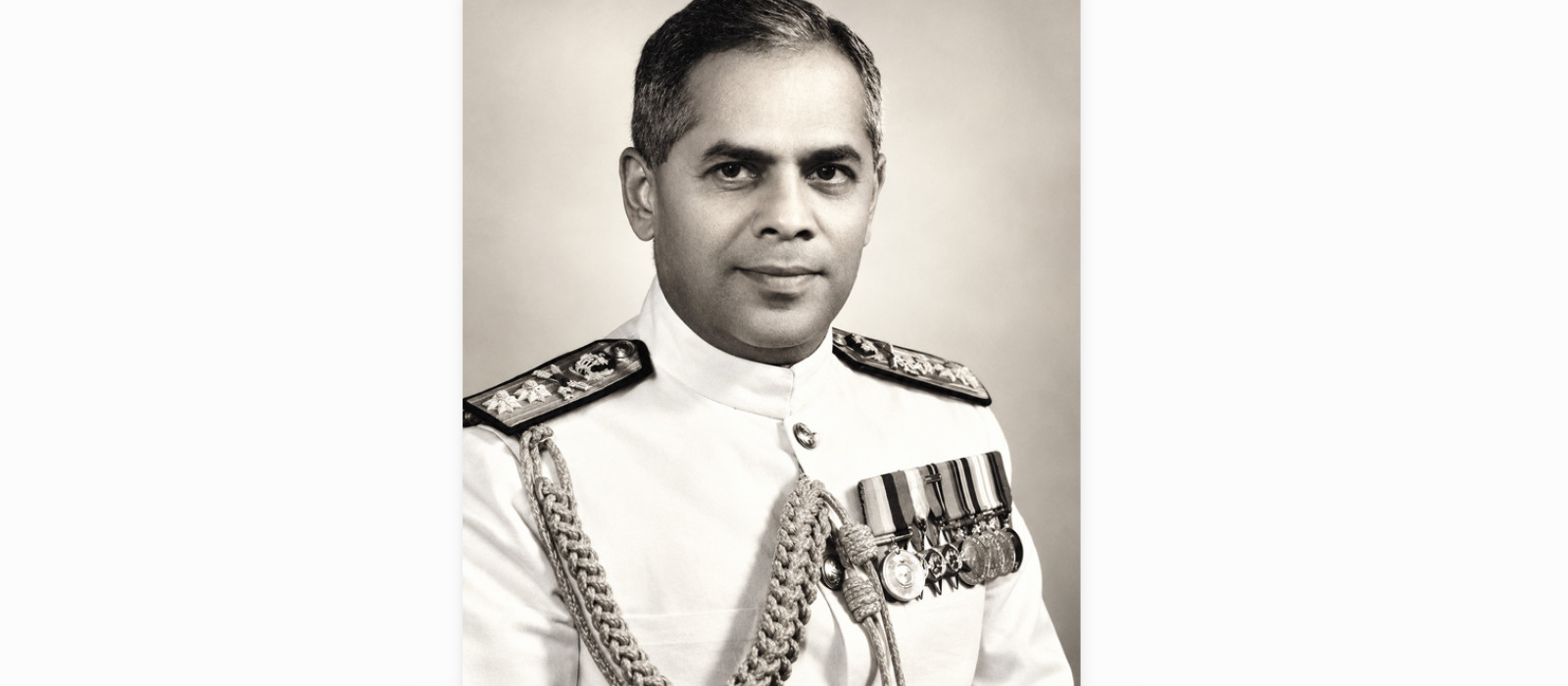
The sixth of August that just passed by marked the death anniversary of Admiral Adhar Kumar Chatterji, one of India’s greatest sons and Indian Navy’s revered icons. In true traditions of the silent service that is the Navy, Chatterji has remained largely unknown outside the domain of the white uniformed fraternity. The launch of the inaugural edition of the flagship journal, Indian Naval Despatch is an apt occasion to remember people like him who made trail blazing contributions to the navy and the nation.
AK Chatterji (or AKC, as he was often referred to) was the third Indian Chief of Naval Staff (CNS), assuming office in the rank of Vice Admiral on 04 March 1966. Halfway through his tenure, the Government took the decision to make the appointment of CNS tenable by a full four star Admiral, and bring him on par with the other two services. Consequently, on 01 March 1968, AKC became the first CNS in the rank of Admiral. Many newspapers then reported the event with the humorous headline “The Admiral Sheds his Vice,” which, many years later, also became the title of an anecdotal biography of AKC.
What the papers did not report then, and what needs to be underscored, is that the Admiral who shed his Vice also built the Indian Navy, and can be considered to be the architect of its growth and development. While making due allowance for the fact that all such growth stories are about continuity, team work and multifaceted contributions of many, some people stand out for their vision, pioneering initiatives and ability to think far ahead of their times. AKC was one such. Thus, his promotion to Admiral was not a matter of pomp or protocol, and rather 01 March 1968 was the day of restructuring of the Indian Navy. It was the day when the Western Naval Command, the Eastern Naval Command, Southern Naval Area and the Western Fleet were all formed, and plans made for the formation of the Eastern Fleet, which took shape a couple of years later. These developments underlined that the fledgling Indian Navy, the smallest among the three services, had grown its wings and was now ready to take off. The year 1968 marks that point when the Navy turned a decisive corner and propelled itself into a higher orbit. And, in many ways, AKC was the man responsible for this transformation.
Today, the Indian Navy is an internationally, highly regarded professional force with three dimensional capabilities. The 140 ship Navy of 2020 with an aircraft carrier and nuclear submarines in its arsenal, is a far cry from the Navy of 1947 that consisted of less than half a dozen sloops. The narrative of its growth has also seen other success stories, such as its achievements in indigenisation, wherein it pioneered making in India or its impressive world class niche capabilities in fields such as hydrography, underwater medicine, diving and ocean sailing, to name a few. More importantly, as ‘matters maritime’ become increasingly important in international affairs and India becomes an important player in the Indo-Pacific as well as a ‘preferred security partner’ in the Indian Ocean Region (IOR), the Navy is set to become a significant asset in our foreign policy and international cooperation matrix.
In some ways, much of this spectacular success owes to the seeds that were sown in 1968. At the dawn of independence in 1947-48, the Indian Navy had authored a ‘Plans Paper’ that was audacious in scope and envisaged a two fleet navy, with two aircraft carriers, two light cruisers, eight submarines and several blue water surface ships. The Government approved the planned force levels, albeit without any financial commitments. Given the situation over the next two decades on our land frontiers and other development imperatives of a newly independent nation, the Navy faced huge budgetary and other constraints. The sea remained a distant horizon for our political apex and the Navy grew at a snail’s pace, despite the best efforts of its top leadership.
In March 1966, when VAdm AK Chatterji took over the reins of the Navy, the strategic situation was fraught with uncertainty. Britain had indicated its desire to withdraw west of Suez, the Cold War was in full swing, and USA and USSR were competing to extend their influence in the IOR. Indian politics was entering an era of uncertainty after the long tenure of Jawaharlal Nehru and the sudden demise of his successor Lal Bahadur Shastri. Within the Indian Navy, there was considerable disquiet about not being given an opportunity for action in the 1965 War with Pakistan. During the war, the lack of a submarine in the Indian Navy’s inventory was acutely felt and this became a top national priority immediately after.
A year later, in October 1967, an Israeli Navy destroyer Eilat was sunk off Port Said, by missile attacks from small Egyptian missile boats. This was to change surface warfare forever, with surface to surface missiles launched from ships as a new potent weapon. Indian Navy and AKC were closely following all these developments as they chalked out the Navy’s plans.
It is one of those great coincidences of history that Chatterji as a Commander had been the lead author of the aforementioned Plans Paper of 1948, as the first Director of Naval Plans and Intelligence, at the relatively young age of 32. Now he was in a position to be the principal architect and bring the grand design to fruition. He did so in splendid fashion. In November 1967, the Navy’s fleet tanker, INS Deepak, was commissioned giving the Fleet much needed reach and mobility. Adm SM Nanda, who was the Flag Officer Commanding Indian Fleet (FOCIF) at that time and who succeeded AKC as Navy Chief, says in his book, The Man Who Bombed Karachi, that “with this development, ships got proficient in the process of underway replenishment at sea and were enabled to stay out for prolonged periods. The helicopter on board came in handy to deliver mail and essential stores at sea and often pitched in to evacuate patients whenever the aircraft carrier was not in company.” Thus, fleet operations started taking a new hue.
In December 1967, India entered the submarine age with the commissioning of INS Kalvari in the erstwhile Soviet Union. The Kalvari reached Visakhapatnam in July 1968, and the submarine arm was formed. The Navy had now become truly three dimensional. October 1968 witnessed another momentous event - the launch of INS Nilgiri, the nation’s first indigenous major warship. The keel of the second ship in this class, INS Himgiri, was laid a month later in November 1968. In quick succession, in December 1968, the Navy commissioned the submarine depot ship INS Amba, two anti-submarine frigates - the Petyas, and the second submarine INS Khanderi. The Petyas (three more joined before 1971) were to form the fulcrum of the Eastern Fleet in later years. The submarine and surface ship acquisition also saw the Navy turn away from its traditional supplier United Kingdom to the Soviet Union. It was a course alternation that would result in other acquisitions, new doctrines, Standard Operating Procedures (SOPs) and, verily, a new culture.
The decision to buy OSA class missile boats around the same time from the Soviet Union was amongst the most significant. Fondly named AK boats (after the initials of the CNS, AK Chatterji) by the service, they were to prove decisive in the 1971 War in setting ‘Karachi ablaze’ and forcing a quick resolution of the conflict. The Navy Day is celebrated every year on 04 December to commemorate that attack and, in the process, raise a silent toast to AKC for the foresight shown in acquiring these small but formidable ships.
In 1967, after a lot of discussion and tarrying, the Government approved the ‘Ten year Defence Plan 1966-77,’ which gave the Navy its impetus for expansion and modernisation. In the words of Adm Nanda, “the emphasis was on self-reliance, self-sufficiency and indigenisation.” It needsemphasis that since its earliest days, the Indian Navy was a pioneer of ‘Make in India’ and Atmanirbhar Bharat (a self-reliant India), contributing not merely to its own growth, but also to the national technology ecosystem.
The decision to acquire a submarine rescue vessel and Sea King anti-submarine helicopters was also made in 1968, the latter fetching up just before the 1971 war. That year also saw two new maritime reconnaissance Alize aircraft, with modern sonobuoys, added to the Navy’s inventory. A little later, in March 1969, the Navy’s Alouette helicopter squadron was commissioned. The maritime soul of the nation, long dormant, was slowly being stirred into consciousness. The other momentous events and initiatives, in 1968 or thereabouts, included the launch of the Naval Dockyard in Visakhapatnam, which in turn made it possible for the Navy to establish the Eastern Fleet there, just before the onset of the 1971 War, and thereby realise our long held dream of a two fleet navy; the setting up of Naval Academy, then in temporary barracks in Kochi and which today is the pride of our nation at Ezhimala in Kerala; setting up of Boys Training Establishment for streamlining training of Sailors; expansion of Naval design organisation, which today boasts of outstanding indigenous ship designs; streamlining the officer cadre with rational promotion policies and unique personal numbers to all; creation of the rank of Master Chief Petty Officer to retain sailors with expertise, and introduction of trousers in white uniform, which is the standard outfit today.
It may, thus, be seen that the restructuring of the Navy on 01 March 1968 formed the template that lasts till today and provided the Indian Navywith the framework to transform itself into a world class force. The visionary changes, made more than 50 years ago, bear the imprint of Admiral Chatterji and continue to serve the Navy well even today.
But what about the man himself? Surely, we ought to know more about someone who transformed the Service. AKC was born on 22 November 1914 in Dhaka (now in Bangladesh). He had his early education at the Ravenshaw Collegiate School, Cuttack, and after his matriculation in 1930, he passed the Intermediate Science Examination of Calcutta University from Brojo Mohan College, Barisal (now in Bangladesh). He was awarded a Government Scholarship for standing first in the Dhaka division. He, thereafter, joined the Physics (Honours) course at the Presidency College, Calcutta. Known to be very bright in studies, he topped the Federal Public Service (FPSC, predecessor of UPSC) examination in 1933 for selection to the Royal Indian Marine (later Royal Indian Navy and, on 26 January 1950, the Indian Navy).
He was commissioned on 01 September 1935 and, after four years of afloat training, selected to specialise in Anti-Submarine Warfare (ASW). As the preface to his autobiography brings out, “British officers greatly appreciated the sharp intellect, grasp of naval warfare and leadership qualities in this young officer. On completion of the course in August 1940, his outstanding performance was recognised when he was immediately appointed as instructor in HMS Osprey, the ASW School of the United Kingdom (UK). It was indeed a rare honour for an Indian officer in pre-independence era.” An interesting piece of trivia is that one of his ‘students’ for a week long ASW orientation course was then Capt Lord Louis Mountbatten. Mr Probir Roy, a corporate leader and son of the late Vice Adm MK Roy recollects that, “My father used to call him ‘cent percent Chatterjee,’ as he maxed all his courses in the UK.”
His ASW expertise was brought to bear upon in his subsequent appointments on the sloop HMIS Sutlej, which undertook Atlantic and other convoys in a dense submarine environment, giving him experience of the War; as the first Officer-in-Charge of India’s ASW School established at Castle Barracks (today’s INS Angre) in Mumbai; and as the Staff Officer responsible for fitting ASW equipment on ships. In 1944-45, he assumed Command of fleet minesweeper HMIS Kathiawar and participated in the Burma campaign. His technical bent of mind made him a good choice tohead another institution, the Navy’s Radar School HMIS Chamak in Karachi, before he was deputed to UK for his Staff Course in January 1947.
On his return to India, he was appointed as the Director of Naval Plans. Here, his colleagues were Lt YN Singh (regarded as the pioneer aviator of the Indian Navy) and Lt Cdr N Krishnan, who rose to the rank of VAdm and distinguished himself as a great combat leader. In his autobiography, A Sailor’s Story, Krishnan regarded as one of the Navy’s bright sparks, talks of the esteem and affection for AKC and says, “Adhar was an extrovert, supremely confident of himself. He had good reason to be so, because he had a brilliant brain backed by phenomenal memory. He could read pages from the seamanship manual and repeat them from memory that was word perfect.”
AKC’s brilliance is, in fact, a constant theme among officers of that generation. Adm JG Nadkarni, considered one of the Navy’s most erudite officers said of him, “he was undoubtedly one of the finest officers of the Indian Navy. He was certainly the most intelligent.” Talking of his Plans Paper, Nadkarni said, “The plan not only became a foundation on which all other plans were based, but became a model of how these papers should be prepared. The plan has never been bettered.”
After this stint, AKC was appointed to the cruiser INS Delhi as her Executive Officer (Commander), and soon thereafter as the Commanding Officer (CO) and the first Indian to command a Capital Ship. From there, he did a two year stint as our Naval Adviser in London (a first again), before returning to command the INS Delhi for a second time. Interestingly, AKC’s first tenure as CO Delhi was brief, from 01 June 1950 - 03 October 1950 - and he assumed command at Indonesia, where Pandit Nehru had proceeded, embarked onboard the Delhi. The second command tenure was from 01 April 1953 - 13 October 1954. At UK, he oversaw the training of several hundred cadets and junior officers on deputation to that country.
His subsequent tours of duty in the intervening years between 1953 and 1966 as Commodore-in-Charge, Bombay (COMBAY), participant at the Imperial College of Defence Studies (now RCDS), Deputy Chief of Naval Staff (DCNS), FOCIF and Commandant, National Defence College (NDC), further burnished his image of a tech savvy, highly professional, far sighted person who was also an extremely warm and affectionate human being. As Krishnan recollects, “working with him was always an exhilarating experience.”
During his tenure as FOCIF, he laid high emphasis on the integration of the Indian Navy’s first aircraft carrier INS Vikrant with the Fleet, which had catapulted the Indian Navy to a select league of nations that possessed such capability. Former Flag Officer Commanding-in-Chief (FOC-in-C), Eastern Naval Command and scholar, VAdm PS Das, who was the Flag Lt to AKC as FOCIF recollects, “His memory was razor sharp and his knowledge of tactical publications unmatched. He was a Staff Officer’s nightmare one moment, but a caring person the next. It was my privilege to serve as his first Flag Lieutenant. He was a short, but very tall man.” Cmde KK Sanjana, CO Mysore when AKC was Fleet Cdr, adds, “AKC was undoubtedly one of our most distinguished officers of the time and had a reputation of being a highly professional Admiral.”
In 1962, soon after the India-China conflict, he was entrusted with the task of recommending long term measures for the defence of Andaman and Nicobar (A&N) islands, the nation’s strategic outpost in the Far East. He embarked INS Trishul and undertook survey of the islands for 10 days. His report on the infrastructure and facilities to be created for the A&N islands was accepted in totality by the Government and became yet another blueprint of perspective nature, which was steadily progressed and materialised. He was also an active advocate of indigenous shipbuilding, and was associated with both, Garden Reach Shipbuilders & Engineers Limited, Kolkata, and Hindustan Shipyard Limited, Visakhapatnam, as a Director between 1958 and 1964.
Thus, when he became the Chief, there were huge expectations from him. It was not easy translating his ideas for the Navy in a system plagued by several constraints – continental mind-set, distractions on land borders, ill-informed criticism of the Navy’s defensive role in the 1965 War, reduced budget and competing demands on the polity. Rahul Roy-Chaudhury, brings out the problems in his introduction to AKC’s biography, “On the role of naval forces in the changing strategic environment, the Indian Navy and Government held opposing views.” Chatterji, thus had the onerous burden of advocating the Navy’s view, persuade them to implement the Navy’s expansion plan, and restore the fighting spirit of the force.
On some occasions AKC did court controversy, but with the good of service and nation at heart. In the very first year of his tenure as CNS, he wrote a forceful article, “India and Seapower,” in The Hindu newspaper, on 11 December 1966, arguing that, “the vacuum of maritime power by withdrawal of Britain west of Suez had implications for India’s maritime security and advocated expansion of the Indian Navy to act as a moderating force in the vast (Indian Ocean) region.” A little over a year later, on 04 March 1968, he claimed that, “Indian Navy would assume complete charge of Indian Ocean in the wake of Britain’s military withdrawal from the area.”
The government of the day disagreed with AKC and his assessment, rejected the notion of a power vacuum, dismissed the need for a two fleet navy and remained unsympathetic to his point of view. But, as has been pointed out by many, his advocacy needed to be seen in context of his being a strategist of repute and proponent of naval expansion, as rhetoric “to goad the government into some sort of action rather than as intent of policy.” Furthermore, as Adm Vishnu Bhagwat brings out, the straightforward AKC implied that, “the vacuum would have to be filled albeit steadily.” Another eminent academic, Prof GVC Naidu too terms the statement as “considerable exaggeration,” but one that gave an indication of the Navy’s vision.
But, if history is any judge, it would seem that AKC stands vindicated. The militarisation of IOR that he had alluded to came true, with several extra regional navies now operating here. Meanwhile, for us, the two fleet navy is now a reality and, as India moves to become the preferred security partner in IOR, with the Indian Navy as its most predominant vector in the maritime domain, one would have to admire the perspicacity of AKC. Most importantly though, the pieces slowly fell into place and as the plans got approved, despite the headwinds, the higher political and military apex started to see a role for the Navy ‘beyond the defence of shores.’As brought out by Prof Naidu in his book, Indian Navy and South East Asia, a huge expansion took place in the Indian Navy between 1965 and 1971 in terms of both, manpower and hardware. This can be majorly attributed to AKCs indefatigable efforts at being both, planner and implementer. A small instance of this is how, after having inducted submarines in our inventory, he was able to negotiate special submarine pay for personnel of the submarine cadre in the teeth of some opposition from others in the Ministry.
Thus, it may be seen that AKC was blessed with several attributes. Apart from what has been brought out hitherto, his colleagues and juniors describe him variously as - “most mathematically minded,” “analytical bent of mind,” “progressive approach,” “ardent advocate of indigenisation,” “excellent manager of time,” “gifted with remarkable memory,” “supremely confident of his facts and figures and able to quote facts to second or third places after decimal,” “of mercurial temperament but he cooled down quickly,” “a very well-read person who could speak at ease on any subject,” “kind and considerate,” “easily approachable,” “universally popular,” “equipped with pithy sense of humour,” “great extrovert,” “full of hearty laughter,” “lover of technology,” “great eye for detail,” “devoted family man,” “loving husband and father” and similar such encomiums. This is rich praise indeed.
Socially, Adm and Mrs Chatterji endeared themselves to the naval fraternity through their kindness, simplicity and jovial nature. “Cholo Madhobi,” as the Admiral would urge Mrs Chatterji to take leave from a function, had become one of the pet phrases in the naval fraternity, reflective of the convivial atmosphere the couple created during their social interactions. One interesting episode that illustrates his friendly yet simultaneously combative nature, which resulted in another pioneering venture, is that Adm Chatterji as CNS, on learning about Army besting the Navy at a sailing competition, was upset and decided to form a Polo team to settle scores! Thus, was formed the Navy Polo team and, in due course, it did defeat the Army at the game. While he may have been conscious of his own brilliance, AKC was also encouraging of others views and perspectives. As Krishnan brings out, “Chatterji was a man of considerable strategic acumen and receptive to ideas both conventional and unconventional.” Adm Vishnu Bhagwat, a Chief known for his intellectual bent of mind, who was the Flag Lt to AKC when the latter was the Chief, brings out, “Despite their imposing personalities, officers like AKC and many Admirals of that generation were liberals and open minded professionals, and appreciated young officers and their strategic and tactical thinking.”
VAdm JS Bedi, former FOC-in-C, Western Naval Command, who spent many years associated with naval plans, gives a broad spectrum view of his legacy recollecting that, “we were Midshipmen on Mysore in July 1968, when he spent a few days at sea. Vishnu Bhagwat was his Flag Lt. AKC spent an evening in the Gun Room with us and that is when we heard about the likely induction of OSA boats and Kalveri. Much later, while in Plans, I had the good fortune to see some of his file notings. They were brilliant. The First Plans Paper has his hallmark on it. One of the greatest reasons for the planned and balanced growth of our Navy can be attributed to the steady and professional approach of the Plans Directorate. Each incumbent there has refused to see the Navy through any coloured glasses and has assiduously pursued the balanced growth of our Navy and its facilities within the meagre resources.”
AKC retired on 01 March 1970, at the relatively young age of 55. However, he led an active post retirement life. He wrote and commented on matters of national security in many articles for various journals and newspapers. He also joined the Birla Institute of Scientific Research and Birla Economic Research Foundation as Adviser. He authored four books on maritime issues - Indian Navy’s Submarine Arm (1982), Naval Aviation - a World History (1985), Monsoons, Cyclones and Floods (1992) and The Oceans (1992). Nadkarni described the naval aviation book as “a textbook on the subject,” while Asha Rani Mathur, the well-known TV anchor, who is also a writer and editor said of his books that, “she was impressed by the logical presentation and flow of matter and the text’s concise explanations.” Always ahead of his times, he was also a big votary for India to acquire nuclear submarines and actively lobbied for them.
Illustrating his versatility, post retirement, he also became a gourmet cook bringing his perfectionist attitude to make a range of marmalades, jams, jellies, pickles, sauces, kebabs, biryani, Sandesh, other Bengali sweets and numerous other dishes. He also was a keen photographer, inveterate traveller and lover of nature and he indulged in these passions with gusto. VAdm MP Awati, a navy legend himself, described AKC as “a giant of a man, most bright and with an endearing Bengali accent.”
AKC will be remembered above all and most fondly for his Plans Paper at the dawn of independence, and for his stewardship of the Navy at a crucial juncture in the 1960s. As VAdm Krishnan sagely reminds us, “although such exercises as planning come naturally to us in the present day, at that period of time we were venturing forth into uncharted waters. And yet, they were able to bring out an ambitious document, led by AKC, because we were clear in our minds that the Indian Ocean was no longer a British lake… India occupied a position of strategic pre-eminence in the vast ocean of her name. The use of this ocean without let or hindrance was vital not only to our economy but our every existence as a free country.”
As Cmde AP Golaya brings out, on a range of issues as diverse as importance of maritime trade, exploitation of oceans for economic reasons (today often used in context of Blue Economy), maritime diplomacy, use of satellites for oceanic surveillance and meteorological and hydrological ocean phenomenon, AKC could gaze far into the future and predict their possible impact.
AKC passed away on 06 August 2001. His foresight, vision, intellectual depth, range of interests, planning ability and steadfastness in the face of challenges, mark him out as truly one of the great Indians and maritime heroes. However, he was more than that. Beyond a mere listing of his many attributes and achievements, is the acknowledgement that he was the architect of the modern Indian Navy. A true ‘renaissance man’ with eclectic interests and passions, he would in the opinion of this author, occupy the same place as Homi Bhabha, Vikram Sarabhai, Satish Dhawan, MS Swaminathan as a leader par excellence, pioneer and builder of modern India. Let us doff our caps in tribute to AKC.
Endnotes
-
Hugh and Colleen Gantzer, INS Delhi: The Golden Book, Decommissioning Publication (Mumbai: The TATA Press Limited, 1978).
-
Cmde G. Kailath, ed. Mysore Memorabilia Decommissioning Publication (Mumbai: The TATA Press Limited, 1985).
-
RAdm RD Katari, A Sailor Remembers (Delhi: Prabhat Prakashan, 2012).
-
Cmde Srikant B Kesnur, ed. INS Delhi Self Reliance through Indigenisation (Commissioning Publication) (Mumbai: Printography Press, 1997).
-
Adm SN Kohli, Sea Power and the Indian Ocean, with Special Reference to India (Delhi: Ritana Books, 1996).
-
VAdm N. Krishnan, A Sailor’s Story: An Autobiography, ed. Krishan Arjun (Bangalore: Punya Publishing Pvt Ltd, 2011).
-
Purobi Mukharji, Probhati Mukherjee and AP Golaya, The Admiral Who Shed His Vice: An Anecdotal Biography of Admiral AK Chatterji (Delhi: Pentagon Press, 2014).
-
GVC Naidu, Indian Navy and Southeast Asia (Delhi: Knowledge World, 2000).
-
Adm SM Nanda, The Man Who Bombed Karachi: A Memoir (Delhi: Harper Collins Publishers, 2015).
-
Harsh V. Pant, The Rise of the Indian Navy: Internal Vulnerabilities, External Challenges (UK: Ashgate Publishing Limited, 2012).
-
VAdm Mihir K. Roy, War in the Indian Ocean (Delhi: Lancer Publishers & Distributors, 1995).
-
RAdm Satyindra Singh, Under Two Ensigns: The Indian Navy 1945-1950 (Delhi: Oxford & IBH, 1985).
-
Daya Shankar, Memoirs and Memories (Pune: Impact Printers, 2004).
-
Cdr HS Rawat, ed. Vikrant Decommissioning Publication (Mumbai: Indian Navy Printers India, 1997).
-
Personal Discussions/Exchanges with - Late VAdm MP Awati (Retd), VAdm PS Das (Retd), VAdm JS Bedi (Retd), RAdm AR Radhakrishnan (Retd), Cmde AP Golaya, Cdr Yogesh Athavale, Shri Probir Roy and Smt Probhati Mukherjee.
