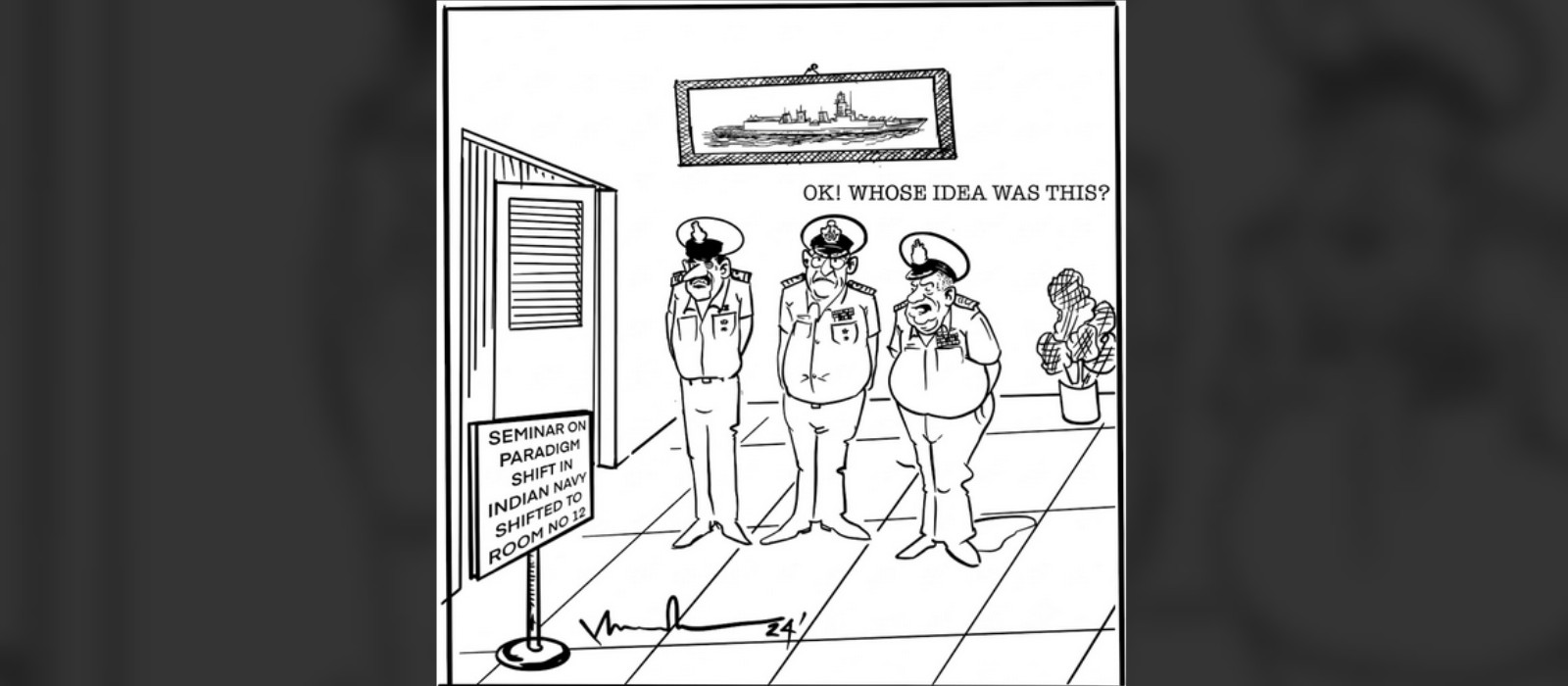


In the high-stakes game of ‘Gradus ad Navalis’, naval officers of all manner of rank and specialisation have developed a secret arsenal: buzzwords.1 These magical incantations are not just words; they are the keys to the kingdom, the secret handshake of the naval elite. They aren’t just empty jargon; they reflect deeper knowledge and strategic thinking. While some may use them seemingly effectively, others might sprinkle them haphazardly, leading to hilariously unrelated applications. Regardless, mastering this linguistic dance can certainly be a secret weapon in your arsenal.
-
Paradigm Shift: When Lt Hombal from the logistics department suggested replacing the water cooler in the ship’s junior sailors’ dining hall with a clean, green cooling technology using carbon dioxide as the refrigerant he called it a “paradigm shift.” Never mind that half the staff can’t even find the power button; it’s revolutionary! In the often-serious world of naval operations, the term “paradigm shift” occasionally surfaces in delightfully unexpected ways. When the GPS systems go dark, and the paper maps roll out, commanders speak of a “paradigm shift in maritime strategy,” navigating the seas with a hint of nostalgia. The operations room, once buzzing with caffeine-fuelled tactics, now vibrates with the energy of a new “stimulant logistics” plan, as red bull energy drinks take the helm. On deck, sailors witness a “paradigm shift in labour saving devices,” marvelling at the efficiency v/s the traditional mop, or ‘Botha’. Below decks, the galley becomes a hub of “naval gastronomy” as daringly new spices and condiments (brought from the by lanes of Colaba causeway by the mess man at the urging of the Asst LOGO) invade the taste buds of the crew and results in a paradigm shift in menus worthy of note by the visiting flag officer. And when the captain’s briefings shift to an ungodly hour, murmurs of a “paradigm shift in command communication schedules” echo through the passage-ways. These light-hearted “shifts” bring a splash of humour and incomprehension to the high seas, proving that even in disciplined naval life, there’s room for confounding one’s shipmates and drawing a chuckle or two.
-
Synergy: Lt Beliram the ACRO2 on the Aircraft Carrier, loves this one. He proposes using the new word he has heard the Commander Air using i.e. ‘synergy’ for everything, including merging the aircrew snack bar or ‘hover-inn’ and the ‘heads’ (seperated by a bulkhead and an exhaust fan) to save time. Efficiency at its finest! In the unique dialect of ‘Navalese,’ the word “synergy” often sails into conversation, sometimes in the most amusing of contexts. Picture this: a group of sailors, each from different departments, come together to tackle the Herculean task of untangling a massive knot of ropes. As they pull and twist in harmonious disarray, the First Lieutenant observing the operation declares, “Look at that synergy!” Meanwhile, in the mess hall, cooks from various culinary backgrounds collaborate on a dish that combines flavours from across the globe. The result? A meal that’s dubbed a “synergistic feast for the senses,” despite its questionable taste. And let’s not forget the “synergy” achieved when the Navy band sailing on a G Class enroute to Seychelles in monsoons attempts to synchronize their tunes with the rhythm of the rolling and pitching amidst the crashing waves, creating a sea shanty that’s more cacophony than melody. In these moments, “synergy” becomes the buzzword that brings a smile to even the most weathered sailor’s face, as it’s applied with a wink and a nod to the collaborative chaos that is life at sea. At a higher level, jointness off course brings synergy always and every time!
-
Leverage: “Leverage” refers to gaining a strategic advantage by exploiting various factors; it is so much more impressive than the synonym, “use/ usage. This includes securing favourable positions, using advanced technology (such as superior weaponry), employing deception and intelligence, and maintaining efficient logistics. Essentially, leverage is about maximizing every advantage to tip the scales in your favour on the high seas. During the war game briefing in the FOOs office, young FNO suggestion of ‘leveraging’ INS Jyoti’s (Tanker) resemblance to a merchant ship tanker (actually she was originally a civilian tanker) to enhance the fleet’s stealth capability to sneak closer to the enemy (say, RED) force for data gathering without being detected. Unfortunately, the EXO and the motely ship’s crew have to paint the steel mammoth in the darkness to orange and white leading still get caught by the RED MPA as the ISAR is politically correct in being colour-blind. And, of course, the time available before entering harbour would once again be ‘leveraged’ for repainting he into drab grey.
-
Disruptive Innovation: This phrase refers to innovations and technologies that make expensive technology and products accessible and more affordable to a broader market, in this case the Navy. In business theory, it’s when a ragtag team (usually with smaller budgets) sneaks into the technological market, grabs the least profitable slice of the pie, and then—bam! —gradually challenges the bigwig industry leaders providing the same at out of the world prices. Think of it as David with a slingshot taking on Goliath’s might. Just pondering can the coinage of the term by Indian Navy i.e. ‘Much more with much less’ be claimed as a “disruptive innovation.” Innovation is often confused with improvisation (which is what Jugaad is) or improvement. There was a nice naval term we all learned as cadets, ‘jury rigging’ which has long since been promoted to innovation.
-
Bandwidth: It’s not about internet speed; it’s about capacity. “I’d love to help with your project, but I’m low on bandwidth,” says Lt Cdr Busy Body, as he invests some more time in the hand-held device we call smart phones. There was a time when it referred to just radio waves and all had time for saying yes to helping solve a problem that was not strictly their own. Now, in the naval realm, bandwidth refers to your capacity—the mental and temporal room—to take on extra tasks. When your executive officer asks, “Got the bandwidth for that new project?” he is really saying, “Can you juggle more cannonballs without tripping over your peg leg?” So, check your sails, sailor? If your plate is already piled high, you might need to politely decline (if you have the bandwidth to decline of course).
-
Think Outside the Box: Ah, this is the second most used statement in Navy think tank briefings. Picture this: You’re in the briefing for UNREP prior to a replenishment serial with a foreign Navy ship, and everyone’s brainstorming. The boss leans back, strokes his chin, and says, “Team, we need fresh ideas. Innovate! Disrupt!” And there you are, ready to dazzle. You raise your hand (or metaphorically raise it, because who does that these days?), and you say, “What if we use drones instead of the Coston Gun Line. The room falls silent, eyes widen; minds race. The EXO blinks; the NO glares till the CO nods slowly. “That’s…unexpected,” he says. “I like it! Make sure we film it to share with the rest of the fleet” And just like that, you’ve thought outside the box. You’ve transcended the mundane, escaped the cardboard confines, and soared into the realm of elevated thinking. Remember, the box is overrated. It’s time to embrace the wild, the weird, and the wonderfully wacky. Thinking outside the box means breaking free from conventional, predictable approaches. It’s about ditching the well-worn path and exploring uncharted territory.
-
Value-Added: Everything must add value, or so they say. In the mystical land of military, the concept of value-added is akin to the golden fleece. Heroes (and officers) embark on quests to find it. You’re in a flight safety meeting in a carrier. Buzzwords fill the air. The Cdr Air leans forward, eyes gleaming. “Team,” he says, “everything must add value!” But what is value? Fear not! It’s a blend of ROI, KPIs, and a dash of unicorn tears. Enter Lt Hombal, the paradigm shifter. He unveils the value-added CO2 water cooler—like a regular water cooler, but with a PowerPoint presentation. It’s infused with synergy, paradigm shifts, and blockchain vibes. Colleagues nod, pretending to understand. But let’s be honest, -- it’s just water. Plain, unadulterated aqua. Just hydration. So, chase value—but don’t forget to laugh, hydrate, and occasionally do minor things even when no one is looking.
-
Ecosystem: The Ship is no longer just a ship; it’s an ecosystem. “I’m nurturing an ecosystem for keeping the sharp edge of the sword of the sword arm of the Navy sharpest,” Certainly! In the Navy an ecosystem extends beyond mere bulkheads—it’s a dynamic network of interconnected departments. Each department affects and is affected by the others, creating a constantly evolving relationship. Adaptability is key—just like organisms in a biological ecosystem. So, when the CO says, “I’m nurturing an ecosystem,” they’re not running a routine ship—they’re orchestrating this intricate dance, ensuring everyone thrives and the ship meets all its designated tasks. Remember, in this ecosystem, the Lt Hombal water cooler isn’t just a water cooler; it’s a hub of hydration, gossip, and strategic discussions. Keep nurturing, the ecosystem! And may your disruptive, value added, out of the box ideas with a larger bandwidth bloom like tropical flowers. Why simplify all this impressive stuff with older approaches like “all hands; whole ship; band of brothers”. No. talk in terms of an eco-system. In conclusion, while these buzzwords may sometimes be used in ways that leave everyone scratching their heads, they certainly add a layer of humour to the daily grind. So the next time you hear a young executive or a naval colleague talking about leveraging the synergy of their ecosystem for a paradigm-shifting project, just smile and nod. After all, they’re going places – even if it’s just to the next buzzword on the list. “Touch base” with these new realities and smell the coffee and not only during stand-easy.
Endnotes
-
The author may be pardoned for beginning with some confounding Latin to illustrate how to impress without conveying anything! The phrase roughly means ‘quest for navalese’ although he declines to vouch for it!
-
ACRO- An Aircraft Control Room Officer (ACRO) serves a crucial role on an aircraft carrier. The ACRO operates from the island, which is the command centre for flight-deck operations